The Correct Answer and Explanation is:
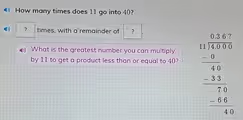
The correct answer is 3 times, with a remainder of 7.
To determine this, we need to perform the division of 40 by 11. This process involves finding out how many full groups of 11 can be made from the number 40, and then identifying what is left over.
First, let’s find the main number of times 11 fits into 40. We can do this by looking at the multiples of 11:
- 11 × 1 = 11
- 11 × 2 = 22
- 11 × 3 = 33
- 11 × 4 = 44
The largest multiple of 11 that is less than or equal to 40 is 33. The next multiple, 44, is too large. This means that 11 goes into 40 a total of 3 times. This number is called the quotient. The image provides a supporting question, “What is the greatest number you can multiply by 11 to get a product less than or equal to 40?”, which directly guides us to this answer of 3.
Next, we calculate the remainder. The remainder is what is left over after subtracting the product of the quotient (3) and the divisor (11) from the original number, or dividend (40). The calculation for the remainder is:
Remainder = Dividend – (Quotient × Divisor)
Remainder = 40 – (3 × 11)
Remainder = 40 – 33
Remainder = 7
Therefore, the remainder is 7. This step is also visible in the long division work shown in the image, where 33 is subtracted from 40, leaving a result of 7. In summary, 40 divided by 11 equals 3 with 7 left over.