The Correct Answer and Explanation is:
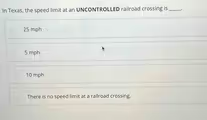
Based on the options provided, the most appropriate answer is 10 mph.
Explanation
While the specific options on a test can sometimes simplify official regulations, the correct answer is intended to reflect the need for extreme caution at an uncontrolled railroad crossing. The choice of 10 mph represents a significant reduction in speed, which is necessary for a driver to safely navigate this type of intersection.
An uncontrolled railroad crossing is one that lacks active warning devices like flashing lights, bells, or crossing gates that automatically lower when a train is near. Instead, it typically only has passive signs, such as the circular railroad advance warning sign and the crossbuck sign (a white X shape). At these locations, the full responsibility for detecting an approaching train and stopping safely rests with the driver. A speed of 10 mph is slow enough to allow a motorist to properly look both ways down the tracks, listen for the sound of a train or its horn, and still have enough time to bring the vehicle to a complete stop if a train is approaching.
It is critical to note that the official Texas Transportation Code (Sec. 545.201) establishes a prima facie speed limit of 15 miles per hour when approaching and crossing a railroad grade crossing. A prima facie limit means that this is the assumed legal speed unless you can prove that a different speed was safe and reasonable under the specific conditions. Since 15 mph is not an option on this test, 10 mph is the closest and most logical choice that aligns with the principle of slowing down to a very safe and controllable speed. Driving at a higher speed, like 25 mph, would not provide adequate reaction time, and the idea of having no speed limit at a crossing is incorrect and extremely dangerous.