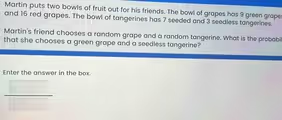
The Correct Answer and Explanation is:
9/80
This problem asks for the probability of two independent events happening together. The two events are:
- Choosing a green grape from the first bowl.
- Choosing a seedless tangerine from the second bowl.
Since the choice of a grape does not influence the choice of a tangerine, these events are independent. To find the probability of both events occurring, we must calculate the probability of each event separately and then multiply them together.
Step 1: Find the probability of choosing a green grape.
First, we determine the total number of grapes in the bowl.
Total grapes = 9 green grapes + 15 red grapes = 24 grapes.
The number of favorable outcomes (choosing a green grape) is 9.
The probability of choosing a green grape is the number of green grapes divided by the total number of grapes.
P(green grape) = 9/24
This fraction can be simplified by dividing both the numerator and the denominator by their greatest common divisor, which is 3.
P(green grape) = 9 ÷ 3 / 24 ÷ 3 = 3/8.
Step 2: Find the probability of choosing a seedless tangerine.
Next, we determine the total number of tangerines in the bowl.
Total tangerines = 7 seeded tangerines + 3 seedless tangerines = 10 tangerines.
The number of favorable outcomes (choosing a seedless tangerine) is 3.
The probability of choosing a seedless tangerine is the number of seedless tangerines divided by the total number of tangerines.
P(seedless tangerine) = 3/10.
Step 3: Multiply the probabilities.
To find the probability of choosing a green grape AND a seedless tangerine, we multiply the individual probabilities.
P(green grape and seedless tangerine) = P(green grape) × P(seedless tangerine)
P(green grape and seedless tangerine) = (3/8) × (3/10) = 9/80.
The final probability is 9/80, which cannot be simplified further.