The Correct Answer and Explanation is:
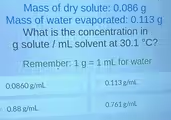
The correct answer is 0.761 g/mL.
To determine the concentration of the solution, we must follow the definition provided in the question, which is grams of solute per milliliter of solvent (g solute / mL solvent). This requires a straightforward calculation using the values given in the problem. The process involves identifying the solute and the solvent, ensuring their quantities are in the correct units, and then performing the division.
First, we identify the mass of the solute. The problem explicitly states that the “Mass of dry solute” is 0.086 grams. This value will serve as the numerator in our concentration formula, as it represents the amount of the substance that was dissolved.
Next, we need the volume of the solvent. The problem provides the “Mass of water evaporated” as 0.113 grams. In this experimental setup, the evaporated water was the original solvent for the solute. The question requires the volume of the solvent in milliliters (mL), not its mass in grams. Fortunately, a crucial piece of information is supplied: “Remember: 1 g = 1 mL for water.” This is a simplified expression of water’s density, allowing for a direct conversion. Using this relationship, the mass of 0.113 grams of water is equivalent to a volume of 0.113 milliliters. This value will be the denominator in our calculation. The stated temperature of 30.1 °C provides context for the experiment but is not needed for the calculation itself, since the simplified density was already given.
With both values in the correct units, we can calculate the concentration:
Concentration = (Mass of solute) / (Volume of solvent)
Concentration = 0.086 g / 0.113 mL
Concentration ≈ 0.76106 g/mL
When we round this result to three significant figures, consistent with the provided answer choices, we get 0.761 g/mL. This means that for every milliliter of water used as the solvent, 0.761 grams of the solute were dissolved.