The Correct Answer and Explanation is:
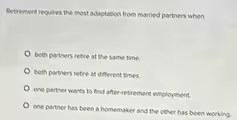
The correct answer is: one partner has been a homemaker and the other has been working.
This scenario requires the most significant adaptation because it fundamentally disrupts a long-standing division of roles, space, and daily life that has likely been in place for decades.
In a traditional household model where one partner works outside the home and the other manages the household, each person has a distinct domain and routine. The working partner has a structured day, a professional identity, and social connections tied to their job. The homemaker has established systems for running the house, personal autonomy within that space, and their own schedule.
When the working partner retires, this entire structure is upended for both individuals. The newly retired partner loses their primary source of identity, purpose, and daily structure. They are suddenly at home all day, often in a space that has been the exclusive domain of the homemaker. This can lead to feelings of uselessness or a desire to “help” by reorganizing or managing household tasks, which can feel like criticism or an intrusion to the homemaker.
Simultaneously, the homemaker’s role is also profoundly challenged. Their established routines are disrupted by the constant presence of their partner. Their autonomy and control over their “workplace” are diminished. The quiet and solitude they may have been accustomed to during the day is gone.
This situation forces a complete renegotiation of roles, responsibilities, personal space, and the couple’s day to day relationship. Unlike couples where both partners worked and are retiring from a shared experience, this model requires adapting from two completely different life structures into one shared, unstructured existence. This clash of established habits and expectations creates a high potential for conflict and demands a greater level of mutual adjustment than any of the other scenarios.