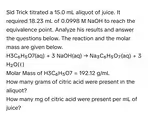
The Correct Answer and Explanation is:
Answer:
The amount of citric acid in the aliquot is 0.117 grams.
The concentration of citric acid is 7.80 mg per mL of juice.
Explanation:
This problem is solved using stoichiometry, which relates the quantities of reactants and products in a chemical reaction. The goal is to work from the known information about the titrant, sodium hydroxide (NaOH), to find the unknown quantity of the analyte, citric acid (H₃C₆H₅O₇).
First, we determine the moles of NaOH used to reach the equivalence point. The volume of NaOH must be converted from milliliters to liters (18.25 mL = 0.01825 L). We then use the molarity formula:
Moles = Molarity × Volume
Moles of NaOH = 0.0998 mol/L × 0.01825 L = 0.001821 moles of NaOH
Next, we use the balanced chemical equation to find the mole ratio between NaOH and citric acid. The equation shows that 3 moles of NaOH react with 1 mole of citric acid. This 3:1 ratio allows us to calculate the moles of citric acid present in the juice aliquot:
Moles of H₃C₆H₅O₇ = 0.001821 mol NaOH × (1 mol H₃C₆H₅O₇ / 3 mol NaOH) = 0.000607 moles of H₃C₆H₅O₇
To answer the first question, we convert these moles of citric acid into grams using its molar mass (192.12 g/mol ):
Grams = Moles × Molar Mass
Grams of H₃C₆H₅O₇ = 0.000607 mol × 192.12 g/mol = 0.1166 g
Rounding to three significant figures, based on the given values, the mass is 0.117 grams.
For the second question, we find the concentration in milligrams per milliliter. First, convert the mass from grams to milligrams (0.117 g × 1000 mg/g = 117 mg). Then, divide this mass by the original volume of the juice aliquot:
Concentration = 117 mg / 15.0 mL = 7.80 mg/mL
The result is reported to three significant figures.