The Correct Answer and Explanation is:
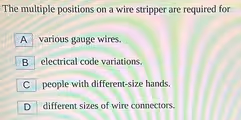
The correct answer is A. various gauge wires.
A wire stripper is a fundamental tool for anyone working with electrical wiring. Its primary purpose is to remove the outer plastic or rubber insulation from a wire to expose the metal conductor, allowing for a secure connection to a terminal, another wire, or a device.
Electrical wires are not one size fits all. They come in many different thicknesses, which are standardized and measured by a system known as wire gauge. In North America, the most common standard is the American Wire Gauge (AWG). In this system, a smaller gauge number signifies a thicker wire, while a larger number indicates a thinner wire. For instance, a 14 AWG wire is a common size for household lighting circuits, while a much thinner 22 AWG wire might be used for low voltage electronics.
To work correctly, a wire stripper must cut through the insulation without nicking, scratching, or cutting the metal conductor underneath. Damaging the conductor can reduce its current carrying capacity, create a point of failure where the wire can break, and pose a safety risk.
This is why wire strippers have multiple positions. Each hole or notch on the jaws of the tool is precisely machined to match a specific wire gauge. The positions are typically labeled with the corresponding gauge number (e.g., 10, 12, 14, 16). By selecting the correct position for the wire being used, a person can ensure a clean, safe, and precise cut through the insulation only, leaving the conductor completely intact and ready for connection. The other options are incorrect because the tool’s positions are related to the physical dimensions of the wire, not electrical regulations, user hand size, or the connectors used afterward.