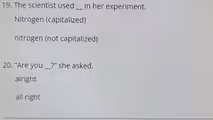
The Correct Answer and Explanation is:
The correct answer for sentence 20 is all right.
The completed sentence should be: “Are you all right?” she asked.
While “alright” is a very common spelling that you will frequently see in informal writing, such as text messages, social media posts, and even some modern fiction, it is not considered standard English. The universally accepted and formally correct spelling is the two word phrase, “all right”. For academic, professional, and any other formal type of writing, “all right” is always the proper choice.
A helpful way to remember this distinction is to consider similar word pairs. For example, “all ready” and “already” have different meanings. “We are all ready to go” means that everyone in the group is prepared. “The movie has already started” means the film began at a previous time. The same applies to “all together” and “altogether”. “Let’s sing all together” means to sing in unison, while “That is an altogether different problem” means it is a completely different issue.
The key difference is that “all right” and “alright” are intended to mean the exact same thing: satisfactory, safe, acceptable, or okay. Since “all right” is the original and established form, and “alright” does not offer a new or distinct meaning, grammarians and major style guides like the AP Stylebook and The Chicago Manual of Style reject “alright” as a nonstandard variant or a simple misspelling.
Therefore, to ensure your writing is always correct and perceived as professional and educated, it is best to stick with the two word phrase. In the context of a grammar question or test, “all right” is invariably the correct answer.