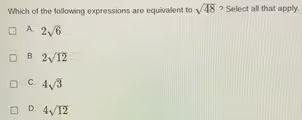
The Correct Answer and Explanation is:
The correct answers are B and C.
To determine which expressions are equivalent to the square root of 48 (√48), we should first simplify √48 and then evaluate each option to see if it matches.
The process of simplifying a square root involves finding the largest perfect square that is a factor of the number under the radical sign. A perfect square is the product of an integer with itself, like 4 (2×2), 9 (3×3), or 16 (4×4).
Let’s find the factors of 48 to identify the largest perfect square factor:
The factors of 48 are 1, 2, 3, 4, 6, 8, 12, 16, 24, and 48.
The perfect squares in this list are 4 and 16. The largest one is 16.
Now, we can rewrite √48 as the square root of the product of 16 and 3:
√48 = √(16 × 3)
Using the property of radicals which states that √(a × b) = √a × √b, we can separate the terms:
√(16 × 3) = √16 × √3
Since the square root of 16 is 4, the simplified expression is:
4√3
This shows that Option C, 4√3, is equivalent to √48.
The question asks us to select all expressions that apply, so we must check every option. We can verify each choice by converting it into a single radical of the form √x. This is done by squaring the coefficient (the number outside the radical) and multiplying it by the number inside the radical.
- Option A: 2√6
To check this, we calculate √(2² × 6) = √(4 × 6) = √24. Since √24 is not equal to √48, this option is incorrect. - Option B: 2√12
We calculate √(2² × 12) = √(4 × 12) = √48. This is equivalent to the original expression. Therefore, this option is correct. - Option D: 4√12
We calculate √(4² × 12) = √(16 × 12) = √192. Since √192 is not equal to √48, this option is incorrect.
Based on these calculations, the expressions equivalent to √48 are 2√12 and 4√3.