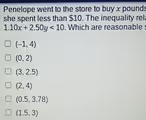
The Correct Answer and Explanation is:
The correct reasonable solutions are (0, 2), (3, 2.5), and (1.5, 3).
To determine which options are valid, we must check each ordered pair (x, y) against two important criteria. First, the solution must be “reasonable” in the context of the problem. Since x and y represent the pounds of items being purchased, these values cannot be negative. A person cannot buy a negative quantity of something. Second, the values must satisfy the given mathematical inequality, 1.10x + 2.50y < 10, which means the total cost must be strictly less than $10.
Let’s evaluate each option:
- (-1, 4): This option is not a reasonable solution. The value of x is -1, which represents -1 pound. It is impossible to purchase a negative weight, so this choice is invalid regardless of the inequality.
- (0, 2): This is a reasonable option since both values are non-negative. We test it in the inequality: 1.10(0) + 2.50(2) = 0 + 5.00 = $5.00. Since $5.00 is less than $10, this is a correct solution.
- (3, 2.5): This is a reasonable option. We test it in the inequality: 1.10(3) + 2.50(2.5) = 3.30 + 6.25 = $9.55. Since $9.55 is less than $10, this is a correct solution.
- (2, 4): This is a reasonable option. We test it in the inequality: 1.10(2) + 2.50(4) = 2.20 + 10.00 = $12.20. Since $12.20 is not less than $10, this solution is incorrect.
- (0.5, 3.78): This is a reasonable option. We test it in the inequality: 1.10(0.5) + 2.50(3.78) = 0.55 + 9.45 = $10.00. The cost is exactly $10, but the inequality requires the amount spent to be strictly less than $10. Since 10 is not less than 10, this solution is incorrect.
- (1.5, 3): This is a reasonable option. We test it in the inequality: 1.10(1.5) + 2.50(3) = 1.65 + 7.50 = $9.15. Since $9.15 is less than $10, this is a correct solution.