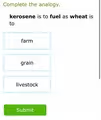
The Correct Answer and Explanation is:
The correct answer to the analogy is grain.
An analogy works by establishing a relationship between the first pair of words and then applying that same relationship to the second pair. To solve this, we must first identify the connection between “kerosene” and “fuel.”
The relationship here is one of a specific example to its general category. Kerosene is a specific type of fuel. The word “fuel” is a broad term that encompasses many different substances used to produce heat or power, such as gasoline, diesel, wood, and coal. Kerosene is just one member of this larger group. Therefore, the pattern is: a specific item is to its broader classification.
Now, we must apply this same “specific is to category” relationship to the second pair of words, “wheat is to…” We need to find a general category that includes wheat as one of its specific examples.
Let’s examine the options provided:
- Farm: A farm is the location where wheat is grown. This establishes a relationship of “product to its place of origin,” which does not match the relationship between kerosene and fuel.
- Livestock: Livestock refers to farm animals, such as cows, sheep, and pigs. Wheat is a plant, not an animal, so this option is incorrect.
- Grain: Grain is the correct answer because it is the general category for the seeds of cereal grasses. Wheat is a specific type of grain, just as oats, barley, rice, and corn are other types of grains. This perfectly mirrors the relationship between kerosene and fuel.
In summary, the analogy is completed by recognizing the consistent logical pattern. Kerosene is a specific type of fuel, and wheat is a specific type of grain.