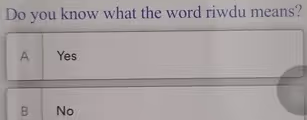
The Correct Answer and Explanation is:
The correct answer to the question is B, No.
This question is a classic example of a tool used in psychology and survey design to measure a respondent’s honesty or a specific cognitive bias. The word “riwdu” is a nonce word, which means it is a fabricated term with no established definition in the English language or any other. It was created specifically for the purpose of this question. Because the word has no meaning, it is impossible for anyone to genuinely know what it means.
The primary function of this question is not to test vocabulary but to assess a person’s tendency towards social desirability bias. This is the impulse to answer questions in a manner that will be viewed favorably by others. An individual might feel pressure to appear knowledgeable and intelligent, and therefore might be tempted to answer “Yes,” even though they have never encountered the word before. This response, however, would be an overstatement of their knowledge, indicating either dishonesty or a lack of careful consideration. Such questions are often embedded in longer surveys or personality tests as a “lie scale” item to help researchers gauge the validity of a person’s other answers.
Choosing option A, “Yes,” reveals that the respondent is either guessing, mistaken, or intentionally misrepresenting their knowledge. In any of these cases, the answer is factually incorrect.
The only truthful and logically sound response is B, “No.” Selecting “No” demonstrates intellectual honesty and self awareness. It shows that the person is willing to admit the limits of their knowledge rather than pretending to know something they do not. In the context of a test or survey, this response signals that the individual is a reliable and attentive participant. Therefore, answering “No” is the correct choice, as it reflects an accurate assessment of the situation presented by this cleverly designed question.