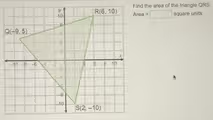
The Correct Answer and Explanation is:
The correct answer is 140 square units.
A straightforward way to determine the area of a triangle on a coordinate plane is to use the “box method.” This technique involves enclosing the triangle within a rectangle and then subtracting the areas of the smaller right triangles created in the corners.
First, we define the dimensions of the bounding rectangle. We find the minimum and maximum x and y coordinates from the vertices Q(-9, 5), R(6, 10), and S(2, -10). The x-coordinates range from -9 to 6, giving the rectangle a width of 15 units. The y-coordinates range from -10 to 10, giving the rectangle a height of 20 units. The area of this large rectangle is its width times its height, which is 15 multiplied by 20, for a total of 300 square units.
Next, we calculate the areas of the three right triangles that are inside the rectangle but outside of triangle QRS.
- The top triangle has vertices at (-9, 5), (6, 5), and (6, 10). Its base is 15 units and its height is 5 units. Its area is (1/2) * 15 * 5 = 37.5 square units.
- The bottom-right triangle has vertices at (6, 10), (2, -10), and (6, -10). Its base is 4 units and its height is 20 units. Its area is (1/2) * 4 * 20 = 40 square units.
- The bottom-left triangle has vertices at (-9, 5), (2, -10), and (-9, -10). Its base is 11 units and its height is 15 units. Its area is (1/2) * 11 * 15 = 82.5 square units.
Finally, we subtract the sum of these three areas from the total area of the rectangle. The combined area of the corner triangles is 37.5 + 40 + 82.5 = 160 square units. Subtracting this from the rectangle’s area gives the area of triangle QRS: 300 – 160 = 140 square units.