The Correct Answer and Explanation is:
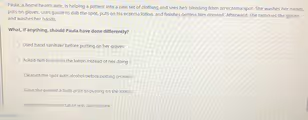
The Correct Answer: Paula should have covered the bleeding spot with a sterile bandage before applying any lotion.
Explanation:
Paula demonstrated good initial practices by performing hand hygiene and putting on gloves, which are crucial first steps for infection control. Her primary error occurred in the sequence of her wound care. A bleeding mole removal site constitutes an open wound, creating a direct pathway for pathogens to enter the body. The fundamental principle of wound care is to protect this compromised area from contamination.
By applying eczema lotion directly after dabbing the site, Paula introduced a significant risk of infection. Eczema lotion is a non sterile product, meaning it can harbor bacteria. Applying it to an open wound can trap these microorganisms against the skin, creating an ideal environment for them to multiply and cause a local infection or a more serious condition like cellulitis. This action violates standard protocols for both wound care and infection prevention.
The correct procedure would have been to manage the wound completely before continuing with the patient’s skincare routine. After stopping the bleeding with the gauze, Paula should have assessed the wound. The next critical step was to apply a sterile dressing or an adhesive bandage to completely cover and protect the site. Once the wound was securely covered, she could have then proceeded to apply the eczema lotion to the surrounding, intact skin, being careful to avoid the bandaged area. This simple but vital step ensures the wound remains clean and protected while still allowing the patient to receive their routine skin treatment. By failing to cover the wound first, Paula compromised patient safety and deviated from the standard of care expected of a health aide.