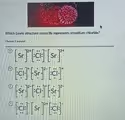
The Correct Answer and Explanation is:
The correct answer is the second option: [:Cl:]¹⁻ [Sr]²⁺ [:Cl:]¹⁻
This Lewis structure correctly represents strontium chloride because it illustrates the principles of ionic bonding. The formation of strontium chloride involves the transfer of electrons from a metal (strontium) to a nonmetal (chlorine), creating charged ions that are held together by electrostatic attraction.
First, we analyze the elements involved. Strontium (Sr) is an alkaline earth metal located in Group 2 of the periodic table. This position indicates that a strontium atom has two valence electrons in its outermost shell. To achieve a stable electron configuration like the nearest noble gas, it is most energetically favorable for strontium to lose these two electrons. When a neutral atom loses two negatively charged electrons, it becomes a cation with a positive two charge. This is correctly shown in the structure as [Sr]²⁺, with the two valence electrons removed.
Next, we consider chlorine (Cl), which is a halogen in Group 17. A chlorine atom has seven valence electrons. To achieve a stable octet, it needs to gain one electron. When a neutral chlorine atom gains an electron, it becomes an anion with a negative one charge, known as the chloride ion. This is correctly depicted as [:Cl:]¹⁻, with a full octet of eight dots and the negative charge indicated.
For the overall compound to be electrically neutral, the total positive charge must balance the total negative charge. Since one strontium ion has a +2 charge, two chloride ions, each with a -1 charge, are required to create a neutral compound. The total charge is (+2) + 2(-1) = 0. The correct Lewis structure must therefore show one Sr²⁺ cation and two Cl⁻ anions. The second option is the only one that accurately portrays this ionic arrangement, showing the proper charges and the complete octet for each chloride ion resulting from the electron transfer.