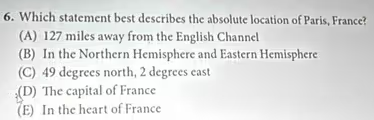
The Correct Answer and Explanation is:
The correct answer is (C) 49 degrees north, 2 degrees east.
In geography, it is crucial to distinguish between absolute and relative location. Absolute location refers to a precise, fixed point on the Earth’s surface. This exact position is universally identified using a specific coordinate system, most commonly latitude and longitude. Latitude lines measure distance north or south of the Equator, while longitude lines measure distance east or west of the Prime Meridian. Together, these coordinates provide a unique “address” for any place on the globe.
Option (C) provides the coordinates “49 degrees north, 2 degrees east.” This is a clear example of absolute location. It uses the grid system of latitude and longitude to pinpoint the specific location of Paris, France. While the exact coordinates for the center of Paris are closer to 48.8566° N, 2.3522° E, the given figures are a standard and accurate approximation used for this level of geography.
The other options describe relative location or provide information that is not a geographic location at all. Relative location describes a place’s position in relation to other landmarks or features. For instance, option (A), “127 miles away from the English Channel,” and option (E), “In the heart of France,” are both examples of relative location. They describe where Paris is, but only by comparing it to another feature or region. Option (B) is a very broad locator, placing Paris in a quadrant of the globe, but it is not specific enough to be considered an absolute location. Option (D), “The capital of France,” describes the city’s political function, not its geographic position. Therefore, the only statement that correctly describes the absolute location of Paris is the one that uses latitude and longitude coordinates.