Client teaching is an important part of the maternity nurse’s role. Which factor has the greatest influence on successful teaching of the gravid client?
a. the client’s readiness to learn
b. the client’s educational background
c. the order in which the information is presented
d. the extent to which the pregnancy is planned
A
A 38-week primigravida who works as a secretary and sits at a computer 8 hours each day tells the nurse that her feet have begun to swell. Which instruction would be most effective in preventing pooling of blood in the lower extremities?
a. wearing support stockings
b. reduce salt in her diet
c. move about every hour
d. avoid constrictive clothing
C
During a prenatal visit, the nurse discusses with a client the effects of smoking on the fetus. When compared with nonsmokers, mothers who smoke during pregnancy tend to produce infants who have
a. lower apgar scores
b. lower birth weights
c. respiratory distress
d. a higher rate of congenital anomalies
B
A 26-year-old, gravida 2, para 1 client is admitted to the hospital at 28-weeks gestation in preterm labor. She is given 3 doses of terbutaline sulfate (Brethine) 0.25 mg subcutaneously to stop her labor contractions. The nurse plans to monitor for which primary side effect of terbutaline sulfate?
a. drowsiness and bradycardia
b. depressed reflexes and increased respirations
c. tachycardia and a feeling of nervousness.
d. a flushed, warm feeling and a dry mouth
C
A mother who is breastfeeding her baby receives instructions from the nurse. Which instructions is most effective to prevent nipple soreness?
a. wear a cotton bra
b. increase nursing time gradually
c. correctly place the infant on the breast
d. manually express a small amount of milk before nursing
C
A full term infant is transferred to the nursery from labor and delivery. Which information is most important for the nurse to receive when planning immediate care for the newborn?
a. length of labor and method of delivery
b. infant’s condition at birth and treatment received
c. feeding methods chosen by the parents
d. history of drugs given to the mother during labor
B
In developing a teaching plan for expectant parents, the nurse plans to include information about when the parents can expect the infant’s fontanels to close. The nurse bases the explanation on knowledge that for the normal new born, the
a. anterior fontanel closes at 2 to 4 months and the posterior by the end of the first week
b. anterior fontanel closes at 5 to 7 months and the posterior by the end of the second week
c. anterior fontanel closes at 8 to 11 months and the posterior by the end of the first month
d. anterior fontanel closes at 12 to 18 months and the posterior by the end of the second month.
D
When assessing a client who is at 12-weeks gestation, the nurse recommends that she and her husband consider attending childbirth preparation classes. When is the best time for the couple to attend these classes?
a. at 16-week gestation
b. at 20-weeks gestation
c. at 24-weeks gestation
d. at 30-weeks gestation
D
The nurse should encourage the laboring client to begin pushing when
a. there is only an anterior or posterior lip of cervix left.
b. the client describes the need to have a bowel movement
c. the cervix is completely dilated
d. the cervix is completely effaced
C
The nurse is counseling a couple who has sought information about conceiving. For teaching purposes, the nurse should know that ovulation usually occurs
a. two weeks before menstruation
b. immediately after menstruation
c. immediately before mensturation
d. three weeks before menstruation
A
The nurse instructs a laboring client to use accelerated-blow breathing. The client begins to complain of tingling fingers and dizziness. What action should the nurse take?
a. administer oxygen by face mask.
b. notify the healthcare provider of the client’s symptoms.
c. have the client breathe into her cupped hands
d. check the client’s blood pressure and fetal heart rate
C
When preparing a class on newborn care for expectant parents, what content should the nurse teach concerning the newborn infant born at term gestation?
a. milia are red marks made by forceps and will disappear within 7 to 10 days
b. meconium is the first stool and is usually yellow gold in color
c. vernix is a white, cheesy substance, predominantly located in the skin folds.
d. pseudostrabismus found in newborns is treated by minor surgery
C
Twenty-four hours after admission to the newborn nursery, a full-term male infant develops localized edema on the right side of his head. The nurse knows that, in the newborn, an accumulation of blood between the periosteum and skull which does not cross the suture line is a newborn variation known as
a. a cephalhematoma, caused by forceps trauma and may last up to 8 weeks.
b. a subarachnoid hematoma, which requires immediate drainage to prevent further complications
c. modeling, caused by pressure during labor and will disappear within 2 to 3 days
d. a subdural hematoma which can result in lifelong damage
A
An expectant father tells the nurse he fears that his wife “is losing her mind”. He states she is constantly rubbing her abdomen and talking to the baby, and that she actually reprimands the baby when it moves too much. What recommendation should the nurse make to this expectant father?
a. reassure him that these are normal reactions to pregnancy and suggest that she discuss his concerns with the childbirth education nurse
b. help him to understand that his wife is experiencing normal symptoms of ambivalence about the pregnancy and no action is needed.
c. ask him to observe his wife’s behavior carefully for the next few weeks and report any similar behavior to the nurse at the next prenatal visit.
d. let him know that these behaviors are part of normal maternal/fetal bonding which occur once the mother feels fetal movement.
D
A new mother who has just had her first baby says to the nurse, “I saw the baby in the recovery room. She sure has a funny looking head.” Which response by the nurse is best?
a. “this is not an unusual shaped head, especially for a first baby.”
b. “it may look funny to you, but newborn babies are often born with heads like your baby’s”
c. “that is normal; the head will return to a round shape within 7 to 10 days.”
d. “your pelvis was too small, so the baby’s head had to adjust to the birth canal.”
C
A new mother asks the nurse, “how do I know that my daughter is getting enough breast milk?” Which explanation will the nurse provide?
a. “weight the baby daily, and if she is gaining weight, she is eating enough.”
b. “your milk is sufficient if the baby is voiding pale straw-colored urine 6 to 10 times a day.”
c. “Offer the baby extra bottle milk after her feeding, and see if she is still hungry.”
d. “If you’re concerned, you might consider bottle feeding so that you can monitor her intake.”
B
A client who gave birth to a healthy 8 pound infant 3 hours ago is admitted to the postpartum unit. Which nursing plan is best in assisting this mother to bond with her newborn infant?
a. encourage the mother to provide total care for her infant
b. provide privacy so the mother can develop a relationship with the infant.
c. encourage the father to provide most of the infant’s care during hospitalization.
d. meet the mother’s physical needs and demonstrate warmth toward the infant.
D
A couple, concerned because the woman has not been able to conceive, is referred to a healthcare provider for a fertility workup and a hysterosalpingogrphy is scheduled. Which complaint would indicate to the nurse that the woman’s fallopian tubes are patent?
a. back pain
b. abdominal pain
c. shoulder pain
d. leg cramps
C
Which nursing intervention would be most helpful in relieving postpartum uterine contractions or “afterpains”?
a. lying prone with a pillow on the abdomen
b. using a breast pump
c. massaging the abdomen
d. giving oxytocic medications
A
Which maternal behavior is the nurse most likely to see when a new mother receives her infant for the first time?
a. she eagerly reaches for the infant, undresses the infant, and examines the infant completely
b. her arms and hands receive the infant and she then traces the infant’s profile with her fingertips
c. her arms and hands receive the infant and she then cuddles the infant to her own body.
d. she eagerly reaches for the infant and then hold the infant close to her own body
B
On admission to the prenatal clinic, a 23-year-old woman tells the nurse that her last menstrual period began on February 15, and that previously her periods were regular. Her pregnancy test is positive. This client’s expected date of delivery would be
a. November 22
b. November 8
c. December 22
d. October 22
A
The nurse is counseling a woman who wants to become pregnant. The woman tells the nurse that she has a 36-day menstrual cycle and the first day of her last menstrual period was January 8. The nurse correctly calculates that the woman’s next fertile period will be
a. January 14-15
b. January 22-23
c. January 30-31
d. February 6-7
C
A client at 32-weeks gestation is hospitalized with severe pregnancy-induced hypertension (PIH), and magnesium sulfate is prescribed to control the symptoms. Which assessment findings would indicate that therapeutic drug level has been achieved?
a. 4+ reflexes
b. urinary output of 50 mL per hour
c. a decrease in respiratory rate from 24 to 16
d. a decreased body temperature
C
Twenty minutes after a continuous epidural anesthetic is administered, a laboring client’s blood pressure drops from 120/80 to 90/60. What action will the nurse take?
a. notify the healthcare provider or anesthesiologist immediately
b. continue to assess the blood pressure q 5 minutes
c. place the woman in a lateral position
d. turn off the continuous epidural
C
A client at 28-weeks gestation calls the antepartal clinic and states that she is experiencing a small amount of vaginal bleeding which she describes as bright red. She further states that she is not experiencing any uterine contractions or abdominal pain. What instruction should the nurse provide?
a. come to the clinic today for an ultrasound
b. go immediately to the emergency room
c. lie on your left side for about one hour and see if the bleeding stops.
d. bring a urine specimen to the lab tomorrow to determine if you have a urinary tract infection
A
An off-duty nurse finds a woman in a supermarket parking lot delivering an infant while her husband is screaming for someone to help her wife. Which intervention has the highest priority?
a. use a thread to tie off the umbilical cord
b. provide as much privacy as possible for the woman.
c. reassure the husband and try to keep him calm
d. put the newborn to breast
D
A pregnant client with mitral stenosis Class III is prescribed complete bedrest. The client asks the nurse, “why must I stay in bed all the time?” Which response is best for the nurse to provide this client?
a. “complete bedrest decreases oxygen needs and demands on the heart muscle tissue.”
b. “we want your body to be healthy, and this is the only way we can make sure that will happen.”
c. “I know you’re upset. Would you like to talk about some things you could do while in bed?”
d. “labor is difficult and you need to use this time to rest before you have to assume all child-caring duties.”
A
The nurse is teaching care of the newborn to a group of prospective parents and describes the need for administering antibiotic ointment into the eyes of the newborn. Which infectious organism will this treatment prevent from harming the infant?
a. herpes
b. staphylococcus
c. gonorrhea
d. syphilis
C
A newborn infant is brought to the nursery from the birthing suite. The nurse notices that the infant is breathing satisfactorily but appears dusky. What action should the nurse take first?
a. notify the pediatrician immediately
b. suction the infant’s nares, then the oral cavity
c. check the infant’s oxygen saturation rate
d. position the infant on the right side
C
Just after delivery, a new mother tells the nurse, “I was unsuccessful breastfeeding my first child, but I would like to try with this baby.” Which intervention is best for the nurse to implement first?
a. assess the husband’s feelings about his wife’s decision to breastfeed their baby
b. ask the client to describe why she was unsuccessful with breastfeeding her last child
c. encourage the clients to develop a positive attitude about breastfeeding to help ensure success
d. provide assistance to the mother to begin breastfeeding as soon as possible after delivery.
D
The nurse is teaching a woman how to use her basal body temperature pattern as a tool to assist her in conceiving a child. Which temperature pattern indicates the occurrence of ovulation, and therefore, the best time for intercourse to ensure conception?
a. between the time the temperature falls and rises
b. between 36 and 48 hours after the temperature rises
c. when the temperature fails and remains low for 36 hours.
d. within 72 hours before the temperature falls
A
A woman who had a miscarriage 6 months ago becomes pregnant. Which instruction is most important for the nurse to provide this client?
a. elevate lower legs while resting
b. increase caloric intake by 200 to 300 calories per day
c. increase water intake to 8 full glasses per day
d. take prescribed multivitamin and mineral supplements
D
A newborn, whose mother is HIV positive, is scheduled for follow-up assessments. The nurse knows that the most likely presenting symptoms for a pediatric client with AIDS is
a. shortness of breath
b. joint pain
c. a persistent cold
d. organomegaly
C
The nurse is caring for a woman with a previously diagnosed heart disease who is in the second stage of labor. Which assessment finding are of greatest concern?
a. edema, basilar rales, and an irregular pulse
b. increased urinary output and tachycardia
c. shortness of breath, bradycardia, and hypertension
d. regular heart rate and hypertension
A
A woman with Type 2 diabetes mellitus becomes pregnant, and her oral hypoglycemic agents are discontinued. Which intervention is most important for the nurse to implement?
a. describe diet changes that can improve the management of her diabetes.
b. inform the client that oral hypoglycemic agents are teratogenic during pregnancy
c. demonstrate self-administration of insulin
d. evaluate the client’s ability to do glucose monitoring
A
A client receiving epidural anesthesia begins to experience nausea and becomes pale and clammy. What intervention should the nurse implement first?
a. raise the foot of the bed
b. assess for vaginal bleeding
c. evaluate the fetal heart rate
d. take the client’s blood pressure
A
The total bilirubin level of a 36-hour, breastfeeding newborn is 14 mg/dL. Based on this finding, which intervention should the nurse implement?
a. provide phototherapy for 30 minutes q8hour
b. feed the newborn sterile water hourly
c. encourage the mother to breastfeed frequently
d. assess the newborn’s blood glucose level
C
A 35-year-old primigravida client with severe preeclampsia is receiving magnesium sulfate via continuous IV infusion. Which assessment data would indicate to the nurse that the client is experiencing magnesium sulfate toxicity?
a. deep tendon reflexes 2+
b. blood pressure 140/90
c. respiratory rate 18/minute
d. urine output 90 mL/4 hours
D
A 30-year-old gravida 2, para 1 client is admitted to the hospital at 26-weeks gestation in preterm labor. She is started on an IV solution of terbutaline (Brethine). Which assessment is the highest priority for the nurse to monitor during the administration of this drug?
a. maternal blood pressure and respirations
b. maternal and fetal heart rates
c. hourly urinary output
d. deep tendon reflexes
B
A full term infant is admitted to the newborn nursery. After careful assessment, the nurse suspects that the infant may have an esophageal atresia. Which symptoms are this newborn likely to exhibit?
a. choking, coughing, and cyanosis
b. projectile vomiting and cyanosis
c. apneic spells and grunting
d. scaphoid abdomen and anorexia
A
The nurse attempts to help an unmarried teenager deal with her feelings following a spontaneous abortion at 8-weeks gestation. What type of emotional response should the nurse anticipate?
a. grief related to her perceptions about the loss of this child.
b. relief of ambivalent feelings experienced with this pregnancy.
c. shock because she may not have realized that she was pregnant.
d. guilt because she had not followed her healthcare provider’s instructions
A
The nurse is teaching breastfeeding to prospective parents in a childbirth education class. Which instruction should the nurse include as content in the class?
a. begin as soon as your baby is born to establish a four-hour feeding schedule.
b. resting helps with milk production. Ask that your baby be fed at night in the nursery.
c. feed your baby every 2 to 3 hours or on demand, whichever comes first.
d. do not allow your baby to nurse any longer than the prescribed number of minutes
C
The nurse is assessing the umbilical cord of a newborn. Which finding constitutes a normal finding?
a. two vessels: one artery and one vein
b. two vessels: two arteries and no veins.
c. three vessels: two arteries and one vein
d. three vessels: two veins and one artery
C
A new mother is afraid to touch her baby’s head for fear of hurting the “large soft spot.” Which explanation should the nurse give to this anxious client?
a. “some care is required when touching the large soft area on top of your baby’s head until the bones fuse together.”
b. “that’s just an ‘old wives’ tale so don’t worry, you can’t harm your baby’s head by touching the soft spot.”
c. “the soft spot with disappear within 6 weeks and is very unlikely to cause any problems for your baby.”
d. “there’s a strong, tough membrane there to protect the baby so you need not be afraid to wash or comb his/her hair.”
D
The nurse caring for a laboring client encourages her to void at least q2h, and records each time the client empties her bladder. What is the primary reason for implementing this nursing intervention?
a. emptying the bladder during delivery is difficult because of the position of the presenting fetal part.
b. an over-distended bladder could be traumatized during labor, as well as prolong the progress of labor
c. urine specimens for glucose and protein must be obtained at certain intervals throughout labor.
d. frequent voiding minimizes the need for catheterization which increases the chance of bladder infection.
B
A client who is attending antepartum classes asks the nurse why her healthcare provider has prescribed iron tablets. The nurse’s response is based on what knowledge?
a. supplementary iron is more efficiently utilized during pregnancy.
b. it is difficult to consume 18 mg of additional iron by diet alone
c. iron absorption is decreased in the GI tract during pregnancy
d. iron is needed to prevent megaloblastic anemia in the last trimester
B
A woman who things she could be pregnant calls her neighbor, a nurse, to ask when she could use a home pregnancy test to diagnose pregnancy. Which response is appropriate?
a. “A home pregnancy test can be used right after your first missed period”
b. “These tests are most accurate after you have missed your second period”
c. “home pregnancy tests often give false positives and should not be trusted.”
d. “the test can provide accurate information when used right after ovulation.”
A
A full-term infant is transferred to the nursery from labor and delivery. Which information is most important for the nurse to receive when planning immediate care for the newborn?
a. the length of labor and method of delivery
b. the infant’s condition at birth and treatment received
c. the feeding method chosen by the parents
d. the history of drugs given to the mother during labor
B
A client in active labor complains of cramps in her leg. What intervention should the nurse implement?
a. ask if she takes a daily calcium tablet
b. extend the leg and dorsiflex the foot
c. lower the leg off the side of the bed.
d. elevated the leg above the heart
B
A client at 30-weeks gestation, complaining of pressure over the pubic area, is admitted for observation. She is contracting irregularly and demonstrates underlying uterine irritability. Vaginal examination reveals that her cervix is closed, thick, and high. Based on these data, which intervention should the nurse implement first?
a. provide oral hydration
b. have a complete blood count drawn
c. obtain a specimen for urine analysis
d. place the client on strict bedrest
C
A client in active labor is admitted with preeclampsia. Which assessment finding is most significant in planning this client’s care?
a. patellar reflex 4+
b. blood pressure 158/80
c. four-hour urine output 240 mL
d. respiration 12/minute
A
A 4-week-old premature infant has been receiving epoetin alfa (Epogen) fro the last three weeks. Which assessment finding indicates to the nurse that the drug is effective?
a. slowly increasing urinary output over the last week
b. respiratory rate changes from the 40s to the 60s
c. changes in apical heart rate from the 180s to the 140s
d. change in indirect bilirubin from 12 mg/dL to 8 mg/dL
C
The healthcare provider prescribes terbutaline (Brethine) for a client in preterm labor. Before initiating this prescription, it is most important for the nurse to assess the client for which condition?
a. gestational diabetes
b. elevated blood pressure
c. urinary tract infection
d. swelling in lower extremities
A
A client with no prenatal care arrives at the labor unit screaming, “The baby is coming!” The nurse performs a vaginal examination that reveals the cervix is 3 centimeters dilated and 75% effaced. What additional information is most important for the nurse to obtain?
a. gravidity and parity
b. time and amount of last oral intake
c. date of last normal menstrual period
d. frequency and intensity of contractions
C
The nurse assesses a client admitted to the labor and delivery unit and obtains the following data: dark red vaginal bleeding, uterus slightly tense between contractions, BP 110/68, FHR 110 beats/minute, cervix 1 cm dilated and uneffaced. Based on these assessment findings, what interventions should the nurse implement?
a. insert an internal fetal monitor
b. assess for cervical changes q 1 hr
c. monitor bleeding from IV sites.
d. Perform Leopold’s maneuvers
C
Immediately after birth a newborn infant is suctioned, dried, and placed under a radiant warmer. The infant has spontaneous respirations and the nurse assesses an apical heart rate of 80 beats/minute and respiration of 20 breaths/minute. What action should the nurse perform next?
a. initiate positive pressure ventilation
b. intervene after the one minute apgar is assessed
c. initiate CPR on the infant
d. assess the infant’s blood glucose level.
A
The nurse is preparing to give an enema to a laboring client. What client would require the most caution when carrying out this procedure?
a. a gravida 6, para 5 who is 38 years of age and in early labor
b. a 37-week primigravida who presents at 100% effacement, 3 cm cervical dilatation and a -1 station
c. a gravida 2, para 1 who is at 1 cm cervical dilatation and a 0 station admitted for induction of labor due to post dates.
d. a 40-week primigravida who is at 6 cm cervical dilatation and the presenting part is not engaged
D
The nurse is providing discharge teaching for a client who is 24 hours postpartum. The nurse explains to the client that her vaginal discharge will change from red to pink and then to white. The client asks, “What if I start having red bleeding after it changes?” What should the nurse instruct the client to do?
a. reduce activity level and notify the healthcare provider
b. go to bed and assume a knee-chest position
c. massage the uterus and go to the emergency room
d. do not worry as this is a normal occurrence
A
One hour after giving birth to an 8-pound infant, a client’s lochia rubra has increased from small to large and her fundus is boggy despite massage. The client’s pulse is 84 beats/minute and the blood pressure is 156/96. The healthcare provider prescribes methergine 0.2 mg IM X 1. What action should the nurse take immediately?
a. give the medication as prescribed and monitor for efficacy
b. encourage the client to breastfeed rather than bottle feed
c. have the client empty her bladder and massage the fundus
d. call the healthcare provider to question the prescription
D
A client at 32 weeks gestation is diagnosed with preeclampsia. Which assessment finding is most indicative of an impending convulsion?
a. 3+ deep tendon reflexes.
b. periorbital edema
c. epigastric pain
d. decreased urine output
C
A client at 32-weeks gestation comes to the prenatal clinic with complaints of pedal edema, dyspnea, fatigue, and a moist cough. Which question is most important for the nurse to ask this client?
a. “Which symptom did you experience first?”
b. “Are you eating large amounts of salty foods?”
c. “Have you visited a foreign country recently?”
d. “Do you have a history of rheumatic fever?”
D
A couple has been trying to conceive for nine months without success. Which information obtained from the clients is most likely to have an impact on the couple’s ability to conceive a child?
a. exercise regimen of both partners includes running four miles each morning.
b. history of having sexual intercourse 2 to 3 times per week
c. the woman’s menstrual period occurs every 35 days.
d. they use lubricant with each sexual encounter to decrease friction
D
After each feeding, a 3-day-old newborn is spitting up large amounts of Enfamil Newborn Formula, a nonfat cow’s milk formula. The pediatric healthcare provider changes the neonate’s formulat to Similac Soy Isomil Formula, a soy protein isolate based infant formula. What information should the nurse provide to the mother about the newly prescribed formula?
a. the new formula is a coconut milk formula used with babies with impaired fat absorption.
b. Enfamil Formula is a demineralized whey formula that is needed with diarrhea
c. The new formula is a casein protein source that is low in phenylalanine
d. Similac Soy Isomil Formula is a soy-based formula that contains sucrose
D
The nurse is performing a gestational age assessment on a full-term newborn during the first hours of transition using the Ballard (Dubowitz) scale. Based on this assessment, the nurse determines that the neonate has a maturity rating of 40-weeks. What finding should the nurse identify to determine if the neonate is small for gestational age? (select all that apply)
a. admission weight of 4 pounds, 15 ounces (2244 grams)
b. head to heal length of 17 inches (42.5 cm)
c. frontal occipital circumference of 12.5 inches (31.25 cm)
d. skin smooth with visible veins and abundant vernix
e. anterior plantar crease and smooth heel surfaces
f. full flexion of all extremities in resting supine position
A, B, C
The nurse is assessing a client who is having a non-stress test at 41-weeks gestation. The nurse determines that the client is not having contractions, the fetal heart rate baseline is 144 bpm, and no fetal heart rate accelerations are occurring. What action should the nurse take?
a. check the client for urinary bladder distention
b. notify the healthcare provider of the nonreactive results
c. have the mother stimulate the fetus to move
d. ask the client if she has felt any fetal movement
D
A vaginally delivered infant of an HIV positive mother is admitted to the newborn nursery. What intervention should the nurse perform first?
a. bathe the infant with an antimicrobial soap
b. measure the head and chest circumference
c. obtain the infant’s footprints
d. administer vitamin K
A
A pregnant client tells the nurse that the first day of her last menstrual period was August 2, 2006. Based on Nagele’s rule, what is the estimated date of delivery?
a. april 25, 2007
b. may 9, 2007
c. may 29, 2007
d. june 2, 2007
B
Which action should the nurse implement when preparing to measure the fundal height of a pregnant client?
a. have the client empty her bladder
b. request the client lie on her left side
c. perform Leopold’s maneuvers first.
d. give the client some cold juice to drink
A
A client who is in the second trimester of pregnancy tells the nurse that she wants to use herbal therapy. Which response is best for the nurse to provide?
a. “Herbs are a cornerstone of good health to include in your treatment”
b. “Touch is also therapeutic in relieving discomfort and anxiety.”
c. “Your healthcare provider should direct treatment options for herbal therapy.”
d. “It is important that you want to take part in your care.”
D
The nurse is planning preconception care for a new female client. Which information should the nurse provide the client?
a. discuss various contraceptive methods to use until pregnancy is desired.
b. provide written or verbal information about prenatal care
c. ask the client about risk factors associated with complications of pregnacy
d. encourage healthy lifestyles for families desiring pregnancy
D
A primigravida client wo is 5 cm dilated, 90% effaced, and at 0 station is requestion an epidural for pain relief. Which assessment finding is most important for the nurse to report to the healthcare provider?
a. cervical dilation of 5 cm with 90% effacement
b. white blood cell count of 12,000/mm3.
c. hemoglobin of 12 mg/dL and hematocrit of 38%
d. a platelet count of 67,000/mm3
D
A woman who gave birth 48 hours ago is bottle-feeding her infant. During assessment, the nurse determines that both breasts are swollen, warm, and tender upon palpation. What action should the nurse take?
a. apply cold compresses to both breasts for comfort
b. instruct the client run warm water on her breasts
c. wear a loose-fitting bra to prevent nipple irritation
d. express small amounts of milk to relieve pressure
A
A 30-year-old multiparous woman who has a 3-year-old boy and a newborn girl tells the nurse, “My son is so jealous of my daughter, I don’t know how I’ll ever manage both children when I get home.” How should the nurse respond?
a. “Tell the older child that he is a big boy now and should love his new sister.”
b. “Ask friends and relatives not to bring gifts to the older sibling because you do not want to spoil him.”
c. “Let the older child stay with his grandparents for the first six weeks to allow him to adjust to the newborn.”
d. “Regression in behaviors in the older child is a typical reaction so he needs attention at this time.”
D
A 24-hour-old newborn has a pink papular rash with vesicles superimposed on the thorax, back, and abdomen. What action should the nurse implement?
a. notify the healthcare provider
b. move the newborn to an isolation nursery
c. document the finding in the infant’s record.
d. obtain a culture of the vesicles
C
The nurse observes a new mother is rooming-in and caring for her newborn infant. Which observation indicates the need for further teaching?
a. cuddles the baby close to her.
b. rocks and soothes the infant in her arms.
c. places the infant prone in the bassinet.
d. wraps the baby in a warm blanket after bathing
C
When explaining “postpartum blues” to a client who is 1 day postpartum, which symptoms should the nurse include in the teaching plan? (Select all that apply)
a. mood swings
b. panic attacks
c. tearfulness
d. decreased need for sleep
e. disinterest in the infant
A, C
A client who has an autosomal dominant inherited disorder is exploring family planning options and the risk of trasmission of the disorder ot the infant. The nurse’s response should be based on what information?
a. males inherit the disorder with a greater frequency than females.
b. each pregnancy carries a 50% chance of inheriting the disorder.
c. the disorder occurs in 25% of pregnancies
d. all children will be carriers of the disorder
B
The nurse is explaining to a 30-year-old gravid client that alpha fetoprotein testing is recommended for which purpose?
a. detect cardiovascular disorders
b. screen for neural tube defects
c. monitor for placental functioning
d. assess for maternal pre-eclampsia
B
The nurse identifies crepitus when examining the chest of a newborn who was delivered vaginally. Which further assessment should the nurse perform?
a. elicit a positive scarf sign on the affected side.
b. observe for an asymmetrical Moro (startle) reflex.
c. watch for swelling of fingers on the affected side
d. note paralysis of affected extremity and muscles
B
A primigravida at 40-weeks gestation is receiving oxytocin (Pitocin) to augment labor. Which adverse effect should the nurse monitor for during the infusion of Pitocin?
a. dehydration
b. hyperstimulation
c. galactorrhea
d. fetal tachycardia
B
A 23-year-old client who is receiving Medicaid benefits is pregnant with her first child. Based on knowledge of the statistics related to infant mortality, which plan should the nurse implement with this client?
a. refer to client to a social worker to arrange for home care.
b. recommend perinatal care for an obstetrician, not a nurse-midwife
c. teach the client why keeping prenatal care appointments is important.
C
A female client with insulin-dependent diabetes arrives at the clinic seeking a plan to get pregnant in approximately 6 months. She tells the nurse that she wants to have an uncomplicated pregnancy and a healthy baby. What information should the nurse share with the client?
a. “Your current dose of insulin should be maintained throughout your pregnancy.”
b. “Maintain blood sugar levels in a constant range within normal limits during pregnancy.”
c. “The course and outcome of your pregnancy is not an achievable goal with diabetes.”
d. “Expect an increase in insulin dosages by 5 units/week during the first trimester.”
B
A multigravida client at 41-weeks gestation presents in the labor and delivery unit after a non-stress test indicated that the fetus is experiencing some difficulties in utero. Which diagnostic test should the nurse prepare the client for additional information about fetal status?
a. biophysical profile
b. ultrasound for fetal anomalies
c. maternal serum alpha-fetoprotein screening
d. percutaneous umbilical blood sampling
A
A multigravida client arrives at the labor and delivery unit and tell the nurse that her “bag of water” has broken. The nurse identifies the presence of meconium fluid on the perineum and determines the fetal heart rate is between 140 to 150 beats/minute. What action should the nurse implement next?
a. complete a sterile vaginal exam
b. take maternal temperature every 2 hours
c. prepare for an immediate cesarean birth
d. obtain sterile suction equipment
A
Which breastfeeding, a new mother strokes the top of her baby’s head and asks the nurse about the baby’s swollen scalp. The nurse responds that the swelling is caput succedaneum. Which additional information should the nurse provide this new mother?
a. the infant should be positioned to reduce the swelling
b. the swelling is a subperiosteal collection of blood
c. the pediatrician will aspirate the blood if it gets larger
d. the scalp edema will subside in a few days after birth
D
A 3-month-old with myelomeningocele and atonic bladder is catheterized every four hours to prevent urinary retention. The home health nurse notes that the child has developed episodes of sneezing, urticaria,, watery eyes, ad a rash in the diaper area. What action is most important for the nurse to take?
Change to latex – free gloves when handling infant
The 6-week-old infant diagnosed with pyloric stenosis has recently developed projectile vomiting. Which assessment finding indicates to the nurse that the infant is becoming dehydrated?
Crying without tears
A 6-year old with heart failure (HF) gained 2 pounds in the last 24 hours. Which intervention is most important for the nurse to implement?
Assess bilateral lung sounds
A 34-week primigravida with preeclampsia is receiving Lactated Ringer’s 500 ML with magnesium sulfate 20 grams at the rate of 3 grams/hour. How many mL/hour should be the nurse program into the infusion pump?
75mL/hour
A 36-week primigravida is admitted to labor and delivery with severe abdominal pain and bright red vaginal bleeding. Her abdomen is rigid and tender to touch. The fetal heart rate (FHR) is 90 beats/minute, and the maternal heart rate is 120 beats/minute. What action should the nurse implement first?
Notify healthcare provider at patients’ bedside
A 39 week gestation, a multigravida is having a non-stress test (NST). The fetal heart rate (FHR) has remained non- reactive during the 30 minutes of evaluation. Based on this finding, which action should the nurse implement?
Place an acoustic simulator on the abdomen.
Artificial rupture of the membranes of a laboring client reveals meconium- stained fluid. What intervention has the greatest priority?
Have a meconium aspirator available at delivery
At 20 weeks gestation, a client who has gained 20 pounds during pregnant states that she is felling fetal movement. Fundal height measurement is 20 cm, and the clients only complaint is that her breasts are leaking clear fluid. Which assessment finding warrants further evaluation?
Gestational weight gain.
A client at 35 weeks gestation complains of a “pain whenever the baby moves.” On assessment, the nurse notes the client’s temperature to be 101.2 F, with severe abdominal or uterine tenderness on palpation. The nurse knows that these findings are indicative of what condition?
Chorioamnionitis
A client at 40-weeks gestation presents to the obstetrical floor and indicates that the amniotic membranes ruptured spontaneously at home. She is in active labor, and feels the need to bear down and push. What information is most important foe the nurse to obtain first?
Color and consistency of fluid
A client delivers a viable infant, but begins to have excessive uncontrolled vaginal bleeding after the IV Pitocin is infused. When notifying the healthcare provider of the client’s condition, what information is most important for the nurse to provide?
Maternal blood pressure
A client whose labor is being augmented with an oxytocin (Pitocin) infusion requests an epidural for pain control. Findings of the last vaginal exam, performed 1 hour ago, were 3 cm cervical dilatation, 60% effacement, and a -2 station. What action should the nurse implement first?
Determine current cervical dilation
A community health nurse visits a family in which a 16-year old unmarried daughter is pregnant with her first child and is at 32 weeks gestation. The client tells the nurse that she has been intermittent back pain since the night before. What is the priority nursing intervention?
ask the client if she has experienced any recent changes in vaginal discharge
The current vital signs for a primipara who delivered vaginally during the previous shift are: temperature 100.4 F, heart rate 58 beats/minute, respiratory rate 16 breaths/minute, and blood pressure 130/74. What action should the nurse implement?
Document vital signs in record (normal)
A four-year-old boy was recently diagnosis with Duchenne muscular dystrophy (DMD). Which characteristic of the disease is most important for the nurse to focus on during initial teaching?
Lower legs become progressively weaker, causing a wedding, unsteady gait
A full-term 24 hour old infant in the nursery regurgitates and suddenly turns cyanotic. What should the nurse do first?
Stimulate the infant to cry
The healthcare provider prescribes amoxicillin 500 mg PO every eight hours for a child who weighs 77 pounds. The available suspension is labeled, amoxicillin suspension 250 mg/5 ml. The recommended maximum does is 50 mg/kg/24 hour. How many mL should the nurse administer in a single dose based on the child’s weight? (enter the numerical value only. If rounding is required, round to the whole number.)
10mL/dose
An infant is placed in a radiant warmer immediately after birth. At one hour of age, the nurse finds the infant to be jittery, tachypneic, and hypotonic. What is the first action that the nurse should take?
Determine infants blood sugar level
An infant with tetralogy of fallot becomes acutely cyanotic and hyperpneic. What action should the nurse implement first?
Place the infant in a knee -chest position
Insulin therapy is initiated for a 12 year-old child who is admitted with diabetic ketoacidosis (DKA). Which action is important for the nurse to include in the child plan of care?
Monitor serum glucose for adjustment in infusion rate of regular insulin (Novolin R).
A laboring client’s membranes rupture spontaneously. The nurse notices that the amniotic fluid is greenish-brown. What intervention should the nurse implement first?
Report to HCP
A male infant with a 2-day history of fever and diarrhea is brought to the clinic by his mother who tells the nurse that the child refuses to drink anything. The nurse determines that the child has a weak cry with no tears. What prescription is most important to implement?
Infuse normal saline intravenously
A mother of a 3-year-old boy has just given birth to a new baby girl. The little boy asks the nurse, “why is my baby sister eating my mommy’s breast?” How should the nurse responds? (Select all that apply.)
-Remind him that his mother breastfed him too
-Reassure the older brother that it does not hurt
-Explain that newborns get milk mothers this way
A new mother calls the nurse stating that she wants to start feeding her 6-month-old child something besides breast milk, but is concerned that the infant is too young to start eating solid foods. How should the nurse respond?
Advice the mother to wait at least another month before starting any solid foods.
The nurse is assessing a 2 hour-old infant born by cesarean delivery at 39-weeks gestation. Which finding should receive the highest priority when planning the infants care?
Respiratory rate of 76 breaths per min
The nurse is assessing a 38-week gestation newborn infant immediately following a vaginal birth. Which assessment finding best indicates that the infant is transitioning well to extrauterine life?
Cries vigorously when stimulated
The nurse is caring for a female client, a primigravida with preeclampsia. Findings include +2 proteinuria, BP 172/112 mmHg, facial and hand swelling, complains of blurry vision and a severe frontal headache. Which medication should the nurse anticipate for this client?
Magnesium Sulfate
The nurse is conducting postpartum teaching with a mother who is breastfeeding her infant. When discussing birth control, which method should the nurse recommend to this client as best for her to use in preventing an unwanted pregnancy?
Condoms and contraceptive foam or gel
The nurse is examining an infant for possible crytorchildism. Which exam technique should be used?
Place the infant in warm room and use a calm approach
The nurse is planing care for a client at 30-weeks gestation who is experiencing preterm labor. What maternal prescription is most important in preventing this fetus from developing respiratory distress syndrome?
Betamethasone (Celestone) 12 mg deep IM.
The nurse is planning discharge teaching for a client who had an evacuation of gestationaltrophoblastic disease (GTD) two days ago. Which information is most important for the nurse to
include in this client’s teaching plan?
OCP at least one year
The nurse is reviewing the serum laboratory finding for a 5 day old infant with congenital adrenal hyperplasia. Which laboratory results should be reported to the healthcare provider immediately?
Sodium 119
The nurse observes a mother giving her 11 month old ferrous sulfate, followed by 2 ounces of orange juice. What should the nurse do next?
Give positive feedback about way she administered the sulfate
The nurse places one hand above the symphysis while massaging the fundus of a multiparous client whose uterine tone is boggy 15 minutes after delivering a 7 pound 10 ounce infant. Which information should the nurse provide the client about this finding?
Both lower uterine segment and fundus need to be massaged
One day after vaginal delivery of a full- time baby, a postpartum client’s white blood cell count is 15,000/mm3. What action should the nurse take first?
Check the differential since the WBC is normal for this client.
A one-day-old neonate develops a cephalhematoma. The nurse should closely assess this neonate for which common complication?
Jaundice
The parents of a newborn tell the nurse that their newborn is already trying to walk. How should the nurse respond?
Explain the newborns normal stepping reflex
A postpartum client is Rh-negative refuses to receive Rho(D) immune globulin (RhoGram) after delivery of an infant who is Rh-positive. What information should the nurse provide to this client?
RhoGram prevents maternal antibody formation for future Rh- positive babies
Positive signs of pregnancy
- FHR,
- active fetal movements palpable by examiner,
- outline of fetus on US
Presumptive signs of pregnancy
-amenorrhea,
-n/v,
-increase size/tenderness in breasts,
-pronounced nipples,
-urinary frequency,
-quickening (woman thinks she feels movements),
-fatigue
A primigravida arrives at the observation unit of the maternity unit because thinks is in labor. The nurse applies the external fetal heart monitor and determines that the fetal heart rate is 140 beats/minute and the contractions are occurring irregularly every 10 to 15 minutes. What assessment finding confirms to the nurse that the client is not labor at this time?
Contractions decrease with walking
A primipara has delivered a stillborn fetus at 30 weeks gestation. To asses the parents in the grieving process which intervention is most for the nurse to implement ?
provide a time for the parents to hold their infant in privacy
Probable signs of pregnancy
- uterine enlargement,
- Hegar sign (softening of uterus),
- Chadwicks sign (blueish color cervix),
- Goodells sign (softening of cervical cap),
- ballottement (rebound fetus),
- positive test with hcg
What goal is most important for the nurse to include in the plan of care for a client with gestational diabetes?
Restrict carbohydrate intake
What is the most important assessment for the nurse to conduct the following the administration of epidural anesthesia to a client who is at 40 weeks gestation?
Maternal blood pressure
What is the priority nursing assessment immediately following the birth of an infant with esophageal atresia and a tracheoesophageal (the) fistula ?
Time of first void
While caring for a laboring client on continuous fetal monitoring, the nurse notes a fetal heart patterns that falls and rise abruptly with a “V” shape appearance. What action should the nurse take first?
Change the maternal position
- Which instruction should the nurse include in the discharge teaching plan of a 7-year-old girl with a history of frequent urinary tract infections?
Monitor for changes in urinary odor. - The newborn nursery admission protocol includes a prescption for phytonadione (Vitamin K1, AquaMEPHYTON) 0.5 mg IM to newborns upon admission. The ampoule provides 2 mg/ml. How many ml should the nurse administer?
0.3 - The nurse is preparing a 10-year-old with a lacerated forehead for suturing. Both parents and a 12year-old sibling are the child bedside. Which instruction best supports this family?
” While waiting for the healthcare provider, only one visitor may stay with the child” - Which toy is most appropriate for a 10-year-old child with acute rheumatic fever who is on strict bedrest?
Checkers
The nurse has completed a teaching plan for the mother of a child who is taking digitalis and a diuretic for treatment of the heart failure. Choosing which lunch would indicate that the mother understands the best diet for her child?
Peanut butter and banana sandwich with orange juice.
- A breastfeeding infant, screened for congenital hypothyroidism, is found to have low levels of thyroxine (T4) and high levels of thyroid stimulating hormone (TSH). What is the best explanation for this finding?
The TSH is high because of the low production of T4 by the thyroid.
At 6-weeks gestation, the rubella titer of a client indicates she is non-immune. When is the best time to administer a rubella vaccine to this client?
Early postpartum, within 72 hours of delivery
- While obtaining the vital signs of a 10-year-old who had a tonsillectomy this morning, the nurse observes the child swallowing every 2 to 3 minutes. Which assessment should the nurse implement?
Inspect the posterior oropharynx. - During a routine clinic visit, the nurse determines that a 5-year-old boy’s blood pressure is 112/70. When calculating the child’s blood pressure percentile, the nurse adjusts the calculation for age and height. What actions should the nurse implement next?
Compare the child’s blood pressure with readings from previous visits. - A neonate who has congenital adrenal hyperplasia (CAH) presents with ambiguous genitalia. What is the primary nursing consideration when supporting the parents of a child with this anomaly?
Offer information about ultrasonography and genotyping to determine sex assignment. - A 3-year-old boy in a daycare facility scratches his head frequently, and the nurse confirms the presence of head lice. The nurse washes the child’s hair with permethrin (Nix) shampoo and calls his parents. What instruction should the nurse provide to the parents about treatment for head lice? A. Rewash the child’s hair following a 24-hour isolation period.
Wash the child’s bed linens and clothing in hot soapy water. - During a 26-week gestation prenatal exam, a client reports occasional dizziness and lightheadness when she is lying down. What intervention is best for the nurse to recommend to this client.
Elevate the head with two pillows while sleeping. - A 4-day postpartum client calls the clinic and reports that her nipples are so sore that she does not know if she can continue to breastfeed her infant. What instruction is best for the nurse to provide?
Apply hot packs just before each feeding. - A newborn with myelomeningocele is admitted to the neonatal intensive care unit. Which preoperative nursing intervention should the nurse implement first?
Place the infant on the abdomen to protect the sac. - The mother of a 5-week-old tells the nurse that her baby has acne and asks if she can use her teenage son’s acne cream, benzoyl peroxide, on the baby’s face. Which answer should the nurse to provide?
” Your baby may be showing signs of a systemic disease and needs to be seen by a healthcare provider” - The nurse is providing preoperative teaching to a teenaged client with appendicitis information should the nurse include about postoperative activity?
Early ambulation after surgery will be encouraged to reduce complications and promote healing. - A 36-week primigravida is admitted to labor and delivery with severe abdominal pain and bright red vaginal bleeding. Her abdomen is rigid and tender to touch. The fetal heart rate (FHR) is 90 beats/minute, and the maternal heart rate is 120 beats/minute. What action should the nurse implement first?
obtain written consent for an emergency cesarean section. - A laboring client’s membranes rupture spontaneously. The nurse notices that the amniotic fluid is greenish-brown. What intervention should the nurse implement first?
Contact the healthcare provider. - The nurse weighs a 6-month-old infant during a well-baby check-up and determines that the baby’s weight has triple compared to the birth weight of 7 pounds 8 ounces. The mother asks if the baby is gaining enough weight. What response should the nurse offer?
“What food does your baby usually eat in a normal day?” - A mother brings her 2-month-old to the well-baby clinic. She states that when she kisses her baby, the infant’s skin tastes salty. The nurse should prepare the mother for what standard diagnostic test to screen for cystic fibrosis (CF)?
Sweat-chloride test. - A client with gestational diabetes is undergoing a non-stress test (NST) at 34-weeks gestation. The baseline fetal heart rate (FHR) is 144 beats/minute. The client is instructed to mark the fetal monitor paper by pressing a button attached to the fetal monitor each time the baby moves. After 20 minutes, the nurse evaluates the fetal monitor strip. Which outcome indicates a reactive NST?
Two FHR accelerations of 15 beats/minute x 15 seconds are recorded. - A newborn who was a breech presentation is admitted to the nursery. Which assessment procedure is a priority for the nurse to perform?
Babinski’s reflex. - A 16-year-old gravida 1, para 0 client has just been admitted to the hospital with a diagnosis af eclampsia. She is not presently convulsing. Which intervention should the nurse plan to include in this client’s nursing care plan?
Monitor Blood pressure, pulse, and respirations q4h. - A new mother is having trouble breastfeeding her newborn son. He is making frantic rooting motions and will not grasp the nipple. What intervention would be most helpful to this mother?
Ask the mother to stop feeding, comfort the infant, and then assist the mother to help the baby lactch on. - The nurse is interacting with a female client who is diagnosed with postpartum depression. Which finding should the nurse document as an objective signs of depression? (Select all that apply.)
A. Avoids eye contact.
B. Interacts with a flat affect.
C. Reports feeling sad.
D. Expresses suicidal thoughts.
- A pregnant woman in the first trimester of pregnancy has hemoglobin of 8.6 mg/dl and a hematocrit of 25.1 %. What food should the nurse encourage this client to include in her diet?
- Carrots
- Chicken
- Yogurt
- Cheese
Chicken
- The nurse is preparing to administer methylergonovine maleate (Methergine) to a postpartum client. Based on what assessment finding should the nurse withhold the drug?
- Respiratory rate of 22 breaths/min
- A large amount of lochia rubra
- Blood pressure 149/90
- Positive Homan’s sign
Blood pressure 149/90
- The nurse is planning care for a 16-year-old, who has juvenile rheumatoid arthritis (JRA). The nurse includes activities to strengthen and mobilize the joints and surrounding muscle. Which physical therapy regimen should the nurse encourage the adolescent to implement?
- Begin a training program lifting weights and running
- Splint affected joints during activity
- Exercise in a swimming pool
- Perform passive range of motion exercises twice daily
Exercise in a swimming pool
- A client receiving oxytocin (Pitocin) to augment early labor. Which assessment is most important for the nurse to obtain each time the infusion rate is increased?
- Pain level
- Blood pressure
- Infusion site
- Contraction pattern
Contraction pattern
A neonate who has congenital adrenal hypoplasia (CAH) presents with ambiguous genitalia. What is the primary nursing consideration when supporting the parents of a child with this anomaly?
- Discuss the need for cortisol and aldosterone replacement therapy after discharge
- Support the parents in their decision to assign sex of their child according to their preference
- Offer information about ultrasonography and genotyping to determine sex assignment
- Explain that corrective surgical procedures consistent with sex assignment can be delayed
Discuss the need for cortisol and aldosterone replacement therapy after discharge
- The nurse assessing a 9-year old boy who has been admitted to the hospital with possible acute postsreptococcal glomerulonephritis (APSGN). In obtaining his history, what information is most significant?
- Back pain for a few days
- A history of hypertension
- A sore throats last week
- Diuresis during the nights
A sore throats last week
- A loading dose of terbutaline (Brethine) 250 mcg IV is prescribed for a clientin preterm labor. Brethine 20 mg is added to 1,000 ml D W. How many ml of the solution should the nurse administer?
13 - A 36-week primigravida is admitted to labor and delivery with severe abdominal pain and bright red vaginal bleeding. Her abdomen is rigid and tender to touch. The fetal heart rate FHR) is 90 beats/minute, and the maternal heart rate is 120 beats/minute. What action should the nurse implement first?
- Alert the neonatal team and prepare for neonatal resuscitation
- Notify the healthcare provider from the client’s bedside
- Obtain written consent for an emergency cesarean section
- Draw a blood sample for stat hemoglobin and hematocrit
Notify the healthcare provider from the client’s bedside
11.A 5-year-old child is admitted to the pediatric unit with fever and pain secondary to a sickle cell crisis. Which intervention should the nurse implement first?
A. Obtain a culture of any sputum or wound drainage.
- Obtain a culture of any sputum or wound drainage
- Initiate normal saline IV at 50 ml/hr
- Administer a loading dose of penicillin IM
- Administer the initial dose of folic acid PO
Initiate normal saline IV at 50 ml/hr
11.A child has been vomiting for 3 days is admitted for correction of fluid and electrolyte imbalances. What acid base imbalance is this child likely to exhibit?
- Respiratory alkalosis
- Respiratory acidosis
- Metabolic alkalosis
- Metabolic acidosis
Metabolic alkalosis
11.A child admitted with diabetic ketoacidosis is demonstrating Kussmaul respiration. The nurse determines that the increased respiratory rate is a compensatory mechanism for which acid base alteration?
- Respiratory alkalosis
- Respiratory acidosis
- Metabolic acidosis
- Metabolic alkalosis
Metabolic acidosis
11.The nurse is caring for a 5-year-old child with Reye’s syndrome. Which goal of treatment most clearly relates to caring for this child?
- Reduce cerebral edema and lower intracranial pressure
- Avert hypotension and septic shock
- Prevent cardiac arrhythmias and heart failure
- Promote kidney perfusion and normal blood pressure.
Reduce cerebral edema and lower intracranial pressure
11.A client whose labor is being augmented with an oxytocin(Pitocin) infusionrequests an epidural for pain control. Findings of the last vaginal exam, performed 1 hour ago, were 3 cm cervical dilation, 60% effacement, and a 2station. What action should the nurse implement first?
- Decrease the oxytocin infusion rate
- Determine current cervical dilation
- Request placement of the epidural
- Give a bolus of intravenous fluids
Give a bolus of intravenous fluids
11.A child who received multiple blood transfusions after correction of a congenital heart defects is demonstrating muscular irritability and is oozing blood from the surgical incision. Which serum value is most important for the nurse before reporting to the healthcare provider?
- CO combining power
- Calcium
- Sodium
- Chloride
Calcium
A 6-year-old child is diagnosed with rheumatic fever and demonstrates associated chronic (sudden aimless movements of the arms and legs). Which information should the nurse to the parents?
- Muscle tension is decreased with fine motor skill projects, so these activities should be encouraged
- The chorea or movements are temporary and will eventually disappear
- Permanent life-style changes need to be made to promote safety in the home
- Consistent discipline is needed to help the child control the movements
The chorea or movements are temporary and will eventually disappear
11.The nurse is measuring the frontal occipital circumference (FOC) of a 3month-old infant, notes that the FOC has increased 5 inches since birth and the child’s head appears large in relation to body size. Which action is most important for the nurse to take next?
- Measure the infant’s head to heel length
- Observe the infant for sunset eyes
- Palpate the anterior fontanel for tension and bulging
- Plot the measurement on the infant’s growth chart
Palpate the anterior fontanel for tension and bulging
11.A 16-year-old gravida 1, para 0 client has just been admitted to the hospital with a diagnosis of eclampsia. She is not presently convulsing. Which intervention should the nurse plan to include in this client’s nursing care plan?
- Keep airway equipment at the bedside.
- Allow liberal family visitation
- Monitor blood pressure, pulse, and respirations q4h
- Assess temperature q1h
Keep airway equipment at the bedside.
11.During a well-child visit for their child, one of the parent who has an autosomal dominant disorder tells the nurse, “We don’t plan on having any more children, since the next child is likely to inherit this disorder”. How should the nurse respond?
- Explain that the risk of inhering the disorder decrease by 50% with each child the couple has
- Acknowledge that the next that the next child will inherit the disorder since the first child did not
- Encourage the couple to reconsider their decision since the inheritance pattern may be sex-linked
- Confirm that there is a 50% chance of their future children inheriting the disorder
Confirm that there is a 50% chance of their future children inheriting the disorder
11.The nurse is caring for a one-year-old child following surgical correction of hypospadias. The nursing action has the highest priority?
- Monitor urinary output
- Auscultate bowel sounds
- Observe appearance of stool
- Record percent of diet eaten
Monitor urinary output
Duchenne Disease
This condition is inherited in an X-linked recessive chromosome pattern
- Primipara patient. What is the pet to share time a, home that is not recommended?
CAT - An infant with letralogy of Fallot becomes acutely cyanotic and hyperpneic. Which action should the nurse implement first?
- Administer morphine sulphate
- Start IV fluids
- Place the infant in a knee-chest position
- Provide 100% oxygen by face mask
Place the infant in a knee-chest position
- The nurse is preparing a 10-year-old with a lacerated forehead for suturing.Both parents and 12 year old sibling at the child’s bedside. Which instruction best supports family?
- While waiting for the healthcare provider, only one visitor may stay with the child
- All of you should leave while the healthcare provider sutures the child’s forehead
- It is best if the sibling goes to the waiting room until the suturing is completed
- Please decide who will stay when the healthcare provider begins suturing
Please decide who will stay when the healthcare provider begins suturing
- The parents of a 3 year-old boy who has Duchenne muscular dystrophy (DMD) ask “how can our son have this disease? We are wondering if we should have any more children” What information should the nurse provide these parents?
- This is an inherited X-linked recessive disorder, which primarly affects male children in the family
- The male infant had a viral infection that went unnoticed and iuntreated, so muscle damage was incurred
- The XXXX muscle groups of males can be impacted by a lack of the protein dystrophyn in the mother
- Birth trauma with a breech vaginal birth causes damage to the spinal cord, thus weakening the muscles
This is an inherited X-linked recessive disorder, which primarly affects male children in the family
- A 4 month old girl is brought to the clinic by her mother because she has had a cold for 2 or 3 days and woke up this morning with a hacking cough and difficulty breathing. Which additional assessment finding should alert the nurse that the child is in acute respiratory distress?
- Bilateral bronchial breath sounds
- Diaphragmatic respiration
- A resting respiratory rate of 35 breathe per minute
- Flaring of the nares
Flaring of the nares
- A two year old child with a heart failure(HF) is admitted for replacement of a graft for coarctation of the aorta. Prior to administering the next dose of digoxin (Lanoxin) the nurse obtains an apical heart rate of 128 bpm. What action should the nurse implement?
- Determine the pulse deficit
- Administer the schedule dose
- Calculate the safe dose range
- Review the serum digoxin level
Administer the schedule dose
- Which nursing intervention is most important to include in the plan of carefor for a child with acute glomerulonephritis?
- Encourage fluid intake
- Promote complete bed rest
- Weight the child daily
- Administer vitamin supplements
Weight the child daily
- A 7 year old child is admitted to the hospital with acute glomerulonephritis(AGN). When obtaining the nursing history which finding should the nurse expect to obtain?
- High blood cholesterol level on routine screening
- Increased thirst and urination
- A recent strep throat infection
A recent DPT immunization
A recent strep throat infection
A newborn yellow abdomen and chest
Assess bilirubin level
- Child HIV
Respiratory system - Glomerunephritis
Strawberry - Percentile 97
Is in normal high level for a boy
To confirm RDS in a newborn
Diagphrama breathing
- Cryptorchidism
Put baby in a room and calm the baby - Diaper
Clean water - ADHD
Encourage the parents to help the baby with homework - Watery vaginal white in the first trimester
Is normal - Propanolol
Decrease headache
Is given to high risk baby
Is given to high risk baby
- A child with leukemia is admitted for Chemotherapy and the nursing diagnosis” altered nutrion, less those body requirements related to anorexia, nausea and vomiting” is identified. Which intervention the nurse included in this child plan of care?
Allow the child to eat any food desired and tolerated - A new mother is having trouble breast feeding her newborn son. He is making frantic rooting motions and will not grasp the nipple. What intervention would be most helpful to this mother?
Ask the mother to stop feeding, confront the infant, and then assist the mother to help the baby latch on. - A blind little girl, 8 year sold was admitted to the hospital
Bring familiarly toys from home, such as bear,doll.
preclampsia
seizures
A woman with mastitis
Ice pack
- Belling
Change the client position before call the doctor - A pregnant woman with hypermesis gravidarium, what is the best nurse intervention.
Administered prescribed IV solution
| 1) | A pregnant patient asks the nurse Kate if she can take castor oil for her constipation. How should the nurse respond? | |||
| “Yes, it produces no adverse effect.” | ||||
| “No, it can initiate premature uterine contractions.” | ||||
| “No, it can promote sodium retention.” | ||||
| “No, it can lead to increased absorption of fat-soluble vitamins.” | ||||
| FeedbackCastor oil can initiate premature uterine contractions in pregnant women. It also can produce other adverse effects, but it does not promote sodium retention. Castor oils is not known to increase absorption of fat-soluble vitamins, although laxatives in general may decrease absorption if intestinal motility is increased. | ||||
| Unanswered | 77% got this correct |
| 2) | Which of the following common emotional reactions to pregnancy would the nurse expect to occur during the first trimester? | |||
| Introversion, egocentrism, narcissism | ||||
| Awkwardness, clumsiness, and unattractiveness | ||||
| Anxiety, passivity, extroversion | ||||
| Ambivalence, fear, fantasies | ||||
| FeedbackDuring the first trimester, common emotional reactions include ambivalence, fear, fantasies, or anxiety. The second trimester is a period of well- being accompanied by the increased need to learn about fetal growth and development. Common emotional reactions during this trimester include narcissism, passivity, or introversion. At times the woman may seem egocentric and self-centered. During the third trimester, the woman typically feels awkward, clumsy, and unattractive, often becoming more introverted or reflective of her own childhood. | ||||
| Unanswered | 92% got this correct |
| 3) | Which of the following urinary symptoms does the pregnant woman most frequently experience during the first trimester? | |||
| Dysuria | ||||
| Frequency | ||||
| Incontinence | ||||
| Burning urination | ||||
| FeedbackPressure and irritation of the bladder by the growing uterus during the first trimester is responsible for causing urinary frequency. Dysuria, incontinence, and burning are symptoms associated with urinary tract infections. | ||||
| Unanswered | 62% got this correct |
| 4) | When talking with a pregnant client who is experiencing aching swollen, leg veins, the nurse would explain that this is most probably the result of which of the following? | |||
| Thrombophlebitis | ||||
| Pregnancy induced hypertension | ||||
| Pressure on blood vessels from the enlarging uterus | ||||
| The force of gravity pulling down on the uterus | ||||
| FeedbackPressure of the growing uterus on blood vessels results in an increased risk for venous stasis in the lower extremities. Subsequently, edema and varicose vein formation may occur. Thrombophlebitis is an inflammation of the veins due to thrombus formation. Pregnancy-induced hypertension is not associated with these symptoms. Gravity plays only a minor role with these symptoms. | ||||
| Unanswered | 79% got this correct |
| 5) | According to Diane, her LMP is November 15, 2002, using the Naegle’s rule what is her EDC? | |
| August 23, 2003 | ||
| August 18, 2003 | ||
| July 22, 2003 | ||
| February 22, 2003 | ||
| Unanswered | 75% got this correct |
| 6) | During which of the following would the focus of classes be mainly on physiologic changes, fetal development, sexuality, during pregnancy, and nutrition? | |||
| Post partum phase | ||||
| First trimester | ||||
| Second trimester | ||||
| Third trimester | ||||
| FeedbackFirst-trimester classes commonly focus on such issues as early physiologic changes, fetal development, sexuality during pregnancy, and nutrition. Some early classes may include pregnant couples. Second and third trimester classes may focus on preparation for birth, parenting, and newborn care. | ||||
| Unanswered | 76% got this correct |
| 7) | A nurse is collecting data during the admission asessment of a client who is pregnant with twins. The client also has 5 year old child. The nurse would document which gravida and para status on this client? | |
| G1P1 | ||
| G2P1 | ||
| G2P2 | ||
| G3P2 | ||
| Unanswered | 56% got this correct |
| 8) | When assessing the adequacy of sperm for conception to occur, which of the following is the most useful criterion? | |||
| Sperm count | ||||
| Sperm motility | ||||
| Sperm maturity | ||||
| Sperm volume | ||||
| FeedbackAlthough all of the factors listed are important, sperm motility is the most significant criterion when assessing male infertility. Sperm count, sperm maturity, and semen volume are all significant, but they are not as significant sperm motility. | ||||
| Unanswered | 92% got this correct |
| 9) | A client LMP began July 5. Her EDD should be which of the following? | |||
| January 2 | ||||
| March 28 | ||||
| April 12 | ||||
| October 12 | ||||
| FeedbackTo determine the EDD when the date of the client’s LMP is known use Nagele rule. To the first day of the LMP, add 7 days, subtract 3 months, and add 1 year (if applicable) to arrive at the EDD as follows: 5 + 7 = 12 (July) minus 3 = 4 (April). Therefore, the client’s EDD is April 12. | ||||
| Unanswered | 26% got this correct |
| 10) | A nurse is collecting data from a client who suspects that she is pregnant. The nurse is checking the client for probable signs of pregnancy. Select all that apply. | |||
| Ballottement (Missed) | ||||
| Chadwick’s sign (Missed) | ||||
| Uterine enlargement (Missed) | ||||
| Braxton Hicks contractions (Missed) | ||||
| Outline of fetus via radiography or ultrasound | ||||
| Fetal heart rate detected by a non electronic device | ||||
| Hegar’s sign (Missed) | ||||
| Goodle’s sign (Missed) | ||||
| FeedbackBallottement or rebound of the fetus against the examiner’s fingers on palpation; Chadwick’s sign or the bluish coloration of the mucus membrane of the cervix, Uterine enlargement, Goodle’s sign or the softening of the cervix; Braxton Hicks contraction, and Hegar’s sign the softening and thinning of the lower uterine segment are ALL PROBABLE SIGNS OF PREGNANCY. | ||||
| Unanswered | 58% got this correct |
| 11) | Mrs. Puente is visiting the clinic for a prenatal assessment. This is the client’s fourth pregnancy. She lost one pregnancy during the ninth week of gestation. One pregnancy resulted in the birth of a stillborn infant at full term, and she has one living child who was born the 35th week of gestation. Which of the following best describes the client? | |||
| G5P2111 | ||||
| G4P1111 | ||||
| G4P1211 | ||||
| G5P1112 | ||||
| FeedbackGravida represents the total number of pregnancies that the client has had. Para describes the results of the pregnancies. Para is made up of four parts: the number of infants born at term or after 37 weeks; the number of infants born preterm or after 20 weeks but before 37 weeks; the number of spontaneous or therapeutic abortions or pregnancies that ended up prior to 20 weeks; and the number of living children. Mrs. Puente has had 4 pregnancies, meaning she is a gravid four. She gave birth to a stillborn infant at term, gave birth to a preterm infant who is also her living child, lost one pregnancy during the ninth week of gestation. Mrs. Puente is G4P1111, the answer is B. | ||||
| Unanswered | 87% got this correct |
| 12) | A client suspects that she is pregnant and visits the clinic. Of the following changes caused by pregnancy, which is the only positive sign that the client is pregnant? | |||
| Enlarge abdomen | ||||
| Positive pregnancy test | ||||
| Detection of fetal heartbeat | ||||
| Uterine contraction | ||||
| FeedbackPositive signs of pregnancy are detected changes that provide objective, conclusive proof of pregnancy. 1. detection of fetal heartbeat 2. fetal movement palpated by a professional 3. visualization of the fetus by sonography The other choices are considered PROBABLE signs of pregnancy.*##**##* | ||||
| Unanswered | 63% got this correct |
| 13) | Cervical softening and uterine souffle are classified as which of the following? | |||
| Diagnostic signs | ||||
| Presumptive signs | ||||
| Probable signs | ||||
| Positive signs | ||||
| FeedbackCervical softening (Goodell sign) and uterine soufflé are two probable signs of pregnancy.Probable signs are objective findings that strongly suggest pregnancy. Other probable signs include Hegar sign, which is softening of the lower uterine segment; Piskacek sign, which is enlargement and softening of the uterus; serum laboratory tests; changes in skin pigmentation; and ultrasonic evidence of a gestational sac. Presumptive signs are subjective signs and include amenorrhea; nausea and vomiting; urinary frequency; breast tenderness and changes; excessive fatigue; uterine enlargement; and quickening. | ||||
| Unanswered | 53% got this correct |
| 14) | The nurse identifies substance abuse behaviors exhibited by a pregnant client during an initial prenatal screening. While promoting a therapeutic and accepting environment, the care managment by the nurse would be MOST appropriate if focused on which of the following? | |||
| Discouraging substance use during pregnancy | ||||
| Termination of the pregnancy at an early stage | ||||
| Eliminating substance use during pregnancy | ||||
| Setting boundaries with the client in regards to substance use | ||||
| FeedbackUse of substances during pregnancy can lead to severe fetal or neonatal abnormalities, complications, and death. The primary goal of nursing care should be prevention or elimination of substance use during pregnancy. | ||||
| Unanswered | 47% got this correct |
| 15) | A nurse is monitoring a pregnant client with gestational hypertension who is at risk for preeclampsia. The nurse checks the client for which classic signs of preeclampsia? Select all that apply. | |||
| Proteinuria (Missed) | ||||
| Hypertension (Missed) | ||||
| Low grade fever | ||||
| Generalized edema (Missed) | ||||
| Increase pulse rate | ||||
| Increase respiratory rate | ||||
| FeedbackThe three classic signs of preeclampsia are hypertension, generalized edna, and proteinuria. | ||||
| Unanswered | 36% got this correct |
| 16) | FHR can be auscultated with a fetoscope as early as which of the following? | |||
| 5 weeks gestation | ||||
| 10 weeks gestation | ||||
| 13 weeks gestation | ||||
| 20 weeks gestation | ||||
| FeedbackThe FHR can be auscultated with a fetoscope at about 20 week’s gestation. FHR usually is ausculatated at the midline suprapubic region with Doppler ultrasound transducer at 10 to 12 week’s gestation. FHR, cannot be heard any earlier than 10 weeks’ gestation. | ||||
| Unanswered | 31% got this correct |
| 17) | Heartburn and flatulence, common in the second trimester, are most likely the result of which of the following? | |||
| Increased plasma HCG levels | ||||
| Decreased intestinal motility | ||||
| Decrease gastric acidity | ||||
| Elevated estrogen levels | ||||
| FeedbackDuring the second trimester, the reduction in gastric acidity in conjunction with pressure from the growing uterus and smooth muscle relaxation, can cause heartburn and flatulence. HCG levels increase in the first, not the second, trimester. Decrease intestinal motility would most likely be the cause of constipation and bloating. Estrogen levels decrease in the second trimester. | ||||
| Unanswered | 49% got this correct |
| 18) | The nurse is educating a primigravida patient who is 12 weeks pregnant about the danger signs of pregnancy. The information provided is clearly understood by the expectant mother if the client states the following danger signs of pregnancy: Slect all that apply. | |
| Gush of vaginal discharge (Missed) | ||
| Vaginal bleeding (Missed) | ||
| Persistent vomiting (Missed) | ||
| Constipation | ||
| Urinary frequency | ||
| Epigastric or abdominal pain (Missed) | ||
| Fetal heart rate of 120 | ||
| Unanswered | 25% got this correct |
| 19) | Variation on the length of menstrual cycle is due to variations in the number of days in which of the following phase? | |
| Proliferative phase | ||
| Mentrual phase | ||
| Proliferative phase | ||
| Secretory phase | ||
| Unanswered | 71% got this correct |
| 20) | The LPN is preparing to administer Solu-Medrol 40 mg mixed in 150 mL of sodium chloride via intravenous piggyback. The medication is to be administered over 30 minutes. Using the tubing with a drop factor of 15 ggts/mL, what would the LPN calculate the rate to be in drops per minute? | |
| 40 | ||
| 50 | ||
| 75 | ||
| 150 | ||
| Unanswered | 49% got this correct |
| 21) | A pregnant client states that she “waddles” when she walks. The nurse’s explanation is based on which of the following as the cause? | |||
| The large size of the newborn | ||||
| Pressure on the pelvic brim | ||||
| Relaxation of the pelvic joints | ||||
| Excessive weight gain | ||||
| FeedbackDuring pregnancy, hormonal changes cause relaxation of the pelvic joints, resulting in the typical “waddling” gait. Changes in posture are related to the growing fetus. Pressure on the surrounding muscles causing discomfort is due to the growing uterus. Weight gain has no effect on gait. | ||||
| Unanswered | 73% got this correct |
| 22) | The nurse is developing a teaching plan for a patient who is 8 weeks pregnant. The LPN should tell the patient that she can expect to feel the fetus move at which time? | |||
| Between 10 and 12 weeks’ gestation | ||||
| Between 16 and 20 weeks’ gestation | ||||
| Between 21 and 23 weeks’ gestation | ||||
| Between 24 and 26 weeks’ gestation | ||||
| FeedbackA pregnant woman usually can detect fetal movement (quickening) between 16 and 20 weeks’ gestation. Before 16 weeks, the fetus is not developed enough for the woman to detect movement. After 20 weeks, the fetus continues to gain weight steadily, the lungs start to produce surfactant, the brain is grossly formed, and myelination of the spinal cord begins. | ||||
| Unanswered | 52% got this correct |
| 23) | Which of the following would cause a false-positive result on a pregnancy test? | |||
| The test was performed less than 10 days after an abortion | ||||
| The test was performed too early or too late in the pregnancy | ||||
| The urine sample was stored too long at room temperature | ||||
| A spontaneous abortion or a missed abortion is impending | ||||
| FeedbackA false-positive reaction can occur if the pregnancy test is performed less than 10 days after an abortion. Performing the tests too early or too late in the pregnancy, storing the urine sample too long at room temperature, or having a spontaneous or missed abortion impending can all produce false- negative results. | ||||
| Unanswered | 62% got this correct |
| 24) | A primigravida client at 25 weeks’ gestation visits the clinic and tells the nurse that her lower back aches when she arrives home from work. The nurse should suggest that the client perform: | |||
| Tailor sitting | ||||
| Leg lifting | ||||
| Shoulder circling | ||||
| Squatting exercises | ||||
| FeedbackTailor sitting is an excellent exercise that helps to strengthen the client’s back muscles and also prepares the client for the process of labor. The client should be encouraged to rest periodically during the day and avoid standing or sitting in one position for a long time. | ||||
| Unanswered | 58% got this correct |
| 25) | A patient in her 14th week of pregnancy has presented with abdominal cramping and vaginal bleeding for the past 8 hours. She has passed several cloth. What is the primary nursing diagnosis for this patient | |||
| Knowledge deficit | ||||
| Fluid volume deficit | ||||
| Anticipatory grieving | ||||
| Pain | ||||
| FeedbackIf bleeding and cloth are excessive, this patient may become hypovolemic. Pad count should be instituted. Although the other diagnoses are applicable to this patient, they are not the primary diagnosis. | ||||
| Unanswered | 59% got this correct |
| 26) | A client at 36 weeks’ gestation is schedule for a routine ultrasound prior to an amniocentesis. After teaching the client about the purpose for the ultrasound, which of the following client statements would indicate to the nurse in charge that the client needs further instruction? | |||
| The ultrasound will help to locate the placenta | ||||
| The ultrasound identifies blood flow through the umbilical cord | ||||
| The test will determine where to insert the needle | ||||
| The ultrasound locates a pool of amniotic fluid | ||||
| FeedbackBefore amniocentesis, a routine ultrasound is valuable in locating the placenta, locating a pool of amniotic fluid, and showing the physician where to insert the needle. Color Doppler imaging ultrasonography identifies blood flow through the umbilical cord. A routine ultrasound does not accomplish this. | ||||
| Unanswered | 55% got this correct |
| 27) | What is the recommended drug for the prevention of maternal-fetal HIV transmission; it is usually administered orally beginning after 14 weeks’ gestation, intravenously during labor, and in the form of syrup to the neonate after birth for 6 weeks? | |
| Possible correct answers: Zidovudine, zidovudine | ||
| Unanswered | 94% got this correct |
| 28) | During a prenatal visit, the nurse checks the fetal heart rate of a client in the third trimester of pregnancy. The nurse determines that the FHR is normal if which of the following heart rates is noted? | |
| 80 beats per minute | ||
| 100 beats per minute | ||
| 150 beats per minute | ||
| 180 beats per minute | ||
| Unanswered | 76% got this correct |
| 29) | Which of the following represents the average amount of weight gained during pregnancy? | |||
| 12 to 2 lbs | ||||
| 15 to 25 lbs | ||||
| 25 to 35 lbs | ||||
| 25 to 40 lbs | ||||
| FeedbackThe average amount of weight gained during pregnancy is 25 to 35 lb. This weight gain consists of the following: fetus – 7.5 lb; placenta and membrane – 1.5 lb; amniotic fluid – 2 lb; uterus – 2.5 lb; breasts – 3 lb; and increased blood volume – 2 to 4 lb; extravascular fluid and fat – 4 to 9 lb. A gain of 12 to 22 lb is insufficient, whereas a weight gain of 15 to 25 lb is marginal. A weight gain of 25 to 40 lb is considered excessive. | ||||
| Unanswered | 43% got this correct |
| 30) | During which of the following phase of the menstrual cycle is it ideal for implantation of a fertilized egg to occur? | |
| Ischemic phase | ||
| Mentrual phase | ||
| Proliferative phase | ||
| Secretory phase | ||
| Unanswered | 89% got this correct |
| 31) | A 25-year-old client with diabetes type I visits the clinic to discuss her and her husband’s desire to start a family. This diabetic client | |||
| Should be discouraged from becoming pregnant | ||||
| Has a greater risk of complications during pregnancy | ||||
| Should be informed about treatment for infertility | ||||
| Will be able to carry out a completely normal pregnancy | ||||
| FeedbackClients with DM are at greater risk for developing maternal and fetal complications during pregnancy. | ||||
| Unanswered | 82% got this correct |
| 32) | This is a dark streak down the midline of the abdomen that may appear as the uterus is enlarging. The LPN correctly describes this to the pregnant woman as? | |
| Possible correct answers: Linea nigra, linea nigra | ||
| Unanswered | 36% got this correct |
| 33) | After administering bethanechol to a patient with urine retention, the nurse in charge monitors the patient for adverse effects. Which is most likely to occur? | |||
| Decreased peristalsis | ||||
| Increase heart rate | ||||
| Dry mucous membranes | ||||
| Nausea and Vomiting | ||||
| FeedbackBethanechol will increase GI motility, which may cause nausea, belching, vomiting, intestinal cramps, and diarrhea. Peristalsis is increased rather than decreased. With high doses of bethanechol, cardiovascular responses may include vasodilation, decreased cardiac rate, and decreased force of cardiac contraction, which may cause hypotension. Salivation or sweating may gently increase. | ||||
| Unanswered | 69% got this correct |
| 34) | During the prenatal visit, the client states that she has been experiencing heartburn frequently. The LPN provides instruction on the cause and prevention of heartburn. When she ask to verbalize understanding of the information, which of the following statements by the client indicates further instruction may be necessary? | |||
| “The sphincter that normally prevents stomach contents from going back up into the esophagus is relaxed.” | ||||
| “I should try to avoid drinking fluids while I’m eating.” | ||||
| “Eating six or seven small meals a day may help my symptoms.” | ||||
| “I’ll eat enough to ensure that I am full at every meal.” | ||||
| FeedbackIt suggests that the instruction might need to be reinforced on preventing stomach distention. | ||||
| Unanswered | 89% got this correct |
| 35) | The nurse is caring for a primigravida at about 2 months and 1 week gestation. After explaining self-care measures for common discomforts of pregnancy, the nurse determines that the client understands the instructions when she says: | |||
| “Nausea and vomiting can be decreased if I eat a few crackers before arising” | ||||
| “If I start to leak colostrum, I should cleanse my nipples with soap and water” | ||||
| “If I have a vaginal discharge, I should wear nylon underwear” | ||||
| “Leg cramps can be alleviated if I put an ice pack on the area” | ||||
| FeedbackEating dry crackers before arising can assist in decreasing the common discomfort of nausea and vomiting. Avoiding strong food odors and eating a high-protein snack before bedtime can also help. | ||||
| Unanswered | 75% got this correct |
| 36) | The LPN has initiated the administration of vancomycin via IV piggyback. In which of the following situations should the nurse recognize that the client may be experiencing a fatal reaction to this medication? | |||
| The client start coughing | ||||
| The client complains of pain at the intravenous catheter insertion site | ||||
| The nurse hears the client snoring from the hall | ||||
| The nurse notices the client’s neck and chest is bright red | ||||
| FeedbackWhile administering vancomycin the LPN should know to monitor the client carefully for the development of Red Man Syndrome or anaphylactic shock. The common side effects of this medicine are pruritus, flushing and erythema to the head, neck, and upper body.*##**##* | ||||
| Unanswered | 97% got this correct |
| 37) | A 36-year-old male client loses all function from his waist down after sustaining a spinal cord injury after falling off the roof of his house. The nurse asks the client how this injury will affect the different aspects of his life. The client replies, “It won’t.” This reaction exemplifies that the client is at what stage of the grieving process? | |||
| Possible correct answers: Denial, denial | ||||
| FeedbackClients usually responds to the loss by following the stages of the grieving process. The paralyzed condition of the client is his loss. The client is denying that this loss will affect him or his life.*##**##* | ||||
| Unanswered | 54% got this correct |
| 38) | Which of the following prenatal laboratory test values would the nurse consider as significant? | |||
| Hematocrit 33.5% | ||||
| Rubella titer less than 1:8 | ||||
| White blood cells 8,000/mm3 | ||||
| One hour glucose challenge test 110 g/dL | ||||
| FeedbackA rubella titer should be 1:8 or greater. Thurs, a finding of a titer less than 1:8 is significant, indicating that the client may not possess immunity to rubella. A hematocrit of 33.5% a white blood cell count of 8,000/mm3, and a 1 hour glucose challenge test of 110 g/dl are with normal parameters. | ||||
| Unanswered | 38% got this correct |
| 39) | The nurse knows that there are psychological maternal changes that occurs during pregnancy in a primigravida patient. Select all the normal psychological maternal changes that happens throughout pregnancy. | |
| Ambivalence (Missed) | ||
| Breast tenderness | ||
| Emotional lability (Missed) | ||
| Body image changes (Missed) | ||
| Bonding or relationship with the fetus (Missed) | ||
| Nausea and vomiting | ||
| Syncope | ||
| Urinary frequency | ||
| Unanswered | 87% got this correct |
| 40) | The fetal heart is carefully monitored throughout pregnancy and during labor to assess fetal well being. Which of the following represents an appropriate fetal heart rate? | |||
| 108 | ||||
| 127 | ||||
| 170 | ||||
| 185 | ||||
| FeedbackThe appropriate range of fetal heart rate is 120-160 beats per minute. | ||||
| Unanswered | 22% got this correct |
| 41) | The OB/GYN physician required the LPN to perform different laboratory tests for the primigravida woman who is on her 20 weeks’ gestation. As a nurse you would expect that the physician will order what types of laboratory testing for the pregnant woman? | |
| Blood type and Rh factor (Missed) | ||
| Pap’s smear (Missed) | ||
| Rubella titer (Missed) | ||
| Urinalysis (Missed) | ||
| Hemoglobin and hematocrit levels (Missed) | ||
| Hepatitis B surface antigen (Missed) | ||
| Unanswered | 26% got this correct |
| 42) | A nurse is monitoring for the Physiological Maternal Changes relating to pregnancy for a primigravida patient. What are the normal changes that happens during pregnancy? Select all that apply. | |
| Circulating blood volume increases (Missed) | ||
| Sodium and water retention may occur, which can lead to weight gain (Missed) | ||
| Shortness of breath may be experienced (Missed) | ||
| Breast size atrophies | ||
| There is a decrease in vaginal secretions | ||
| Frequency of urination occurs during second trimester | ||
| Chloasma occurs (Missed) | ||
| Unanswered | 58% got this correct |
| 43) | A client is pregnant with her third child. Medical history of the client indicates a previous precipitate labor and birth. Which of the following interventions would NOT be expected during labor of the present pregnancy? | |||
| Use of magnesium sulfate | ||||
| Close monitoring of the fetus for hypoxia | ||||
| The nurse stays at the bedside constantly or as much as possible | ||||
| Amnioinfusion will be performed | ||||
| FeedbackAmnioinfusion is instillation of fluid into the amniotic sac within the uterus to treat oligohydraminios. This is not done to prevent precipitate labor and birth.*##**##* | ||||
| Unanswered | 51% got this correct |
| 44) | Pediazole is a suspension medication that contains 200 mg erythromycin and 600 mg sulfisoxazole per 5 mL. The physician orders Pediazole 4 mL PO every 12 hours. How many mg of sulfisoxazole is this client receiving in a 24-hour period? | |||
| 160 mg | ||||
| 320 mg | ||||
| 480 mg | ||||
| 960 mg | ||||
| Feedback600 mg/ 5 mL = x mg/ 4 mL2400 = 5xx= 2400/5x= 480 mg per dose x 2 = 960 mg in 24 hours. | ||||
| Unanswered | 58% got this correct |
| 45) | A couple who wants to conceive but has been unsuccessful during the last 2 years has undergone many diagnostic procedures. When discussing the situation with the nurse, one partner states, “We know several friends in our age group and all of them have their own child already, Why can’t we have one?”. Which of the following would be the most pertinent nursing diagnosis for this couple? | |||
| Fear related to the unknown | ||||
| Pain related to numerous procedures. | ||||
| Ineffective family coping related to infertility. | ||||
| Self-esteem disturbance related to infertility. | ||||
| FeedbackBased on the partner’s statement, the couple is verbalizing feelings of inadequacy and negative feelings about themselves and their capabilities. Thus, the nursing diagnosis of self-esteem disturbance is most appropriate. Fear, pain, and ineffective family coping also may be present but as secondary nursing diagnoses. | ||||
| Unanswered | 65% got this correct |
| 46) | She complained of leg cramps, which usually occurs at night. To provide relief, the nurse tells Diane to: | |
| Dorsiflex the foot while extending the knee when the cramps occur | ||
| Dorsiflex the foot while flexing the knee when the cramps occurs | ||
| Plantar flex the foot while flexing the knee when the cramps occur | ||
| Plantar flex the foot while extending the knee when the cramp occur | ||
| Unanswered | 56% got this correct |
| 47) | The hormone responsible for the development of the ovum during the menstrual cycle is? | |
| Estrogen | ||
| Progesterone | ||
| Follicle stimulating hormone | ||
| Leutenizing hormone | ||
| Unanswered | 94% got this correct |
| 48) | During a prenatal visit, the nurse checks the fetal heart rate of a client in the third trimester of pregnancy. The nurse determines that the FHR is normal if which of the following heart rates is noted? | |
| 80 beats per minute | ||
| 100 beats per minute | ||
| 150 beats per minute | ||
| 180 beats per minute | ||
| Unanswered | 75% got this correct |
| 49) | While the postpartum client is receiving herapin for thrombophlebitis, which of the following drugs would the nurse Mica expect to administer if the client develops complications related to heparin therapy? | |||
| Calcium gluconate | ||||
| Protamine sulfate | ||||
| Methylegonovine | ||||
| Nitrofurantoin | ||||
| FeedbackProtamine sulfate is a heparin antagonist given intravenously to counteract bleeding complications cause by heparin overdose. | ||||
| Unanswered | 23% got this correct |
| 50) | A 36 weeks gestation pregnant woman is complaining of urinary urgency and frequency. The nurse explained that the enlarging fetus is pressing the bladder which causes frequent urination. This is normally occuring during the first and third trimesters of pregnancy. The nurse advices the patient to do the following measures to prevent urinary frequency. Select all the necessary measures that the nurse can provide to the patient. | |
| Drink 2 quarts of fluid during the day (Missed) | ||
| Engaging in a regular exercise | ||
| Performing Kegel exercises (Missed) | ||
| Soaking in a warm sitz bath | ||
| Limiting fluid intake during the evening (Missed) | ||
| Unanswered | 31% got this correct |
| 51) | A nursing instructor asks a nursing student to list the functions of the amniotic fluid. The student responds correctly by stating that which of the following are functions of amniotic fluid? Select all that apply. | |
| Allows for fetal movement (Missed) | ||
| Is a measure of kidney function (Missed) | ||
| Surrounds, cushions, and protects the fetus (Missed) | ||
| Maintains the body temperature of the fetus (Missed) | ||
| Prevents large particles such as bacteria from passing to the fetus | ||
| Provides an exchange of nutrients and waste products between the mother and the fetus | ||
| Unanswered | 67% got this correct |
| 52) | Which of the following would the nurse identify as a presumptive sign of pregnancy? | |||
| Hegar sign | ||||
| Nausea and vomiting | ||||
| Skin pigmentation changes | ||||
| Positive serum pregnancy test | ||||
| Feedbackresumptive signs of pregnancy are subjective signs. Of the signs listed, only nausea and vomiting are presumptive signs. Hegar sign, skin pigmentation changes, and a positive serum pregnancy test are considered probably signs, which are strongly suggestive of pregnancy. | ||||
| Unanswered | 58% got this correct |
| 53) | During a lecture on reproduction, a student nurse asks the instructor what determines the sex of a fetus. Accurate information in response to this question would be: | |||
| “The sex of the fetus is not determined until the eighth week of gestation.” | ||||
| “The fertilization of the zygote is the point at which sex is determined.” | ||||
| “Males have one less pair of chromosomes than females.” | ||||
| “Sex is determined by the chromosomes contributed by the ovum.” | ||||
| FeedbackThe sex of the fetus is determined at the point that the sperm fertilizes the ovum to form the zygote. Sex is ultimately determined by the chromosome contributed by the sperm. | ||||
| Unanswered | 16% got this correct |
| 54) | A primigravida patient who is 12 weeks pregnant visits a helath promotion program in the community pertaining to the pregnancy care. A group of nursing student is educating the public about measures to prevent discomfort of pregnancy. The primigravida patient asks one of the student about measures on how to prevent heartburn she is experiencing throughout the day. Select all the necessary measures to prevent the primigravia patient’s complaint. | |
| Eating small, frequent meals and avoiding fatty and spicy food (Missed) | ||
| Eating high fiber foods and increase drinking fluids | ||
| Drinking milk between milk | ||
| Arranging frequent rest periods throughout the day | ||
| Sitting upright for 30 minutes after a meal (Missed) | ||
| Engaging in regular exercise | ||
| Unanswered | 88% got this correct |
| 55) | Family centered nursing care for women and newborn focuses on which of the following? | |
| Assisting individuals and families achieve their optimal health | ||
| Diagnosing and treating problems promptly | ||
| Preventing further complications from developing | ||
| Conducting nursing research to evaluate clinical skills | ||
| Unanswered | 56% got this correct |
| 56) | The physcician orders epinephrine 0.1 mg SQ x 1 now. The constitution of epinephrine according to the vial is 1;1000, or 1 g of epinephrine per 1,000 mL of solution. How much solution should be drawn into the syringe by the LPN? | |||
| 0.01 mL | ||||
| 0.1 mL | ||||
| 1.0 mL | ||||
| 10 mL | ||||
| Feedback1000mg/1000mL = 0.1mg/x mL1000x=100x= 100/1000x=0.1 mL | ||||
| Unanswered | 47% got this correct |
| 57) | 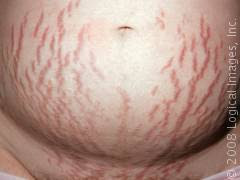 Reddish purple strech marks that usually occur on the abdomen, breasts, thighs, and upper arm. As a nurse, you would document this correctly in the client’s chart by using what medical terminology? Reddish purple strech marks that usually occur on the abdomen, breasts, thighs, and upper arm. As a nurse, you would document this correctly in the client’s chart by using what medical terminology? | |
| Possible correct answers: Striae gravidarum, striae gravidarum | ||
| Unanswered | 72% got this correct |
| 58) | Which of the following fundal heights indicates less than 12 weeks’ gestation when the date of the LMP is unknown? | |||
| Uterus in the pelvis | ||||
| Uterus at the xiphoid process | ||||
| Uterus in the abdomen | ||||
| Uterus in the umbilicus | ||||
| FeedbackWhen the LMP is unknown, the gestational age of the fetus is estimated by uterine size or position (fundal height). The presence of the uterus in the pelvis indicates less than 12 weeks’ gestation. At approximately 12 to 14 weeks, the fundus is out of the pelvis above the symphysis pubis. The fundus is at the level of the umbilicus at approximately 20 weeks’ gestation and reaches the xiphoid at term or 40 weeks. | ||||
| Unanswered | 55% got this correct |
| 59) | Ativan 0.5 mg IM every 1 hour as needed is prescribed for a client experiencing delirium tremens. The medication vial reads 2mg/mL of solution. How many mL should the LPN draw into the syringe for single-dose administration? | |||
| Possible correct answers: 0.25 mL, 0.25mL, 0.25ml, 0.25 ml | ||||
| Feedback2mg/mL= 0.5mg/xmL2x=0.5x=0.5/2x=0.25 mL | ||||
| Incorrect | 70% got this correct |
| 60) | On which of the following areas would the nurse expect to observe chloasma? | |||
| Breast, areola, and nipples | ||||
| Chest, neck, arms, and legs | ||||
| Abdomen, breast, and thighs | ||||
| Cheeks, forehead, and nose | ||||
| FeedbackChloasma, also called the mask of pregnancy, is an irregular hyperpigmented area found on the face. It is not seen on the breasts, areola, nipples, chest, neck, arms, legs, abdomen, or thighs. | ||||