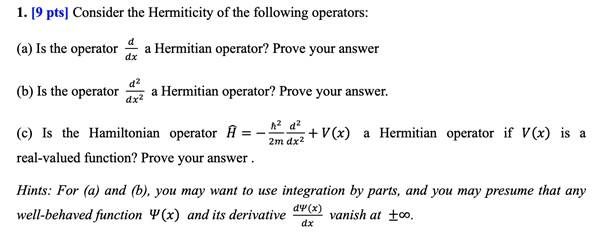
Consider the Hermiticity of the following operators: (a) Is the operator
dx
d
?
a Hermitian operator? Prove your answer (b) Is the operator
dx
2
d
2
?
a Hermitian operator? Prove your answer. (c) Is the Hamiltonian operator
H
=-
2m
?
2
?
dx
2
d
2
?
+V(x) a Hermitian operator if V(x) is a real-valued function? Prove your answer . Hints: For (a) and (b), you may want to use integration by parts, and you may presume that any well-behaved function ?(x) and its derivative
dx
d?(x)
?
vanish at ±8.
The Correct Answer and Explanation is :
(a) Is the operator ddx\frac{d}{dx} a Hermitian operator?
To determine if ddx\frac{d}{dx} is Hermitian, we must check if the following condition holds for all well-behaved wave functions ψ(x)\psi(x) and ϕ(x)\phi(x): ∫−∞∞ψ∗(x)dϕ(x)dx dx=∫−∞∞(dψ(x)dx)∗ϕ(x) dx\int_{-\infty}^{\infty} \psi^*(x) \frac{d\phi(x)}{dx} \, dx = \int_{-\infty}^{\infty} \left( \frac{d\psi(x)}{dx} \right)^* \phi(x) \, dx
We perform an integration by parts: ∫−∞∞ψ∗(x)dϕ(x)dx dx=[ψ∗(x)ϕ(x)]−∞∞−∫−∞∞dψ∗(x)dxϕ(x) dx\int_{-\infty}^{\infty} \psi^*(x) \frac{d\phi(x)}{dx} \, dx = \left[ \psi^*(x) \phi(x) \right]_{-\infty}^{\infty} – \int_{-\infty}^{\infty} \frac{d\psi^*(x)}{dx} \phi(x) \, dx
Given that ψ(x)\psi(x) and ϕ(x)\phi(x) vanish at infinity, the boundary term [ψ∗(x)ϕ(x)]−∞∞=0\left[ \psi^*(x) \phi(x) \right]_{-\infty}^{\infty} = 0. Thus, we are left with: ∫−∞∞ψ∗(x)dϕ(x)dx dx=−∫−∞∞dψ∗(x)dxϕ(x) dx\int_{-\infty}^{\infty} \psi^*(x) \frac{d\phi(x)}{dx} \, dx = – \int_{-\infty}^{\infty} \frac{d\psi^*(x)}{dx} \phi(x) \, dx
Now, compare this result with the right-hand side of the Hermiticity condition: ∫−∞∞(dψ(x)dx)∗ϕ(x) dx\int_{-\infty}^{\infty} \left( \frac{d\psi(x)}{dx} \right)^* \phi(x) \, dx
The two expressions are not identical because of the negative sign. Thus, ddx\frac{d}{dx} is not a Hermitian operator.
(b) Is the operator d2dx2\frac{d^2}{dx^2} a Hermitian operator?
Now, let’s check if d2dx2\frac{d^2}{dx^2} is Hermitian. We need to verify the following: ∫−∞∞ψ∗(x)d2ϕ(x)dx2 dx=∫−∞∞(d2ψ(x)dx2)∗ϕ(x) dx\int_{-\infty}^{\infty} \psi^*(x) \frac{d^2\phi(x)}{dx^2} \, dx = \int_{-\infty}^{\infty} \left( \frac{d^2\psi(x)}{dx^2} \right)^* \phi(x) \, dx
Performing integration by parts twice:
- First integration by parts: ∫−∞∞ψ∗(x)d2ϕ(x)dx2 dx=[ψ∗(x)dϕ(x)dx]−∞∞−∫−∞∞dψ∗(x)dxdϕ(x)dx dx\int_{-\infty}^{\infty} \psi^*(x) \frac{d^2\phi(x)}{dx^2} \, dx = \left[ \psi^*(x) \frac{d\phi(x)}{dx} \right]_{-\infty}^{\infty} – \int_{-\infty}^{\infty} \frac{d\psi^*(x)}{dx} \frac{d\phi(x)}{dx} \, dx
- The boundary term vanishes, and we are left with: −∫−∞∞dψ∗(x)dxdϕ(x)dx dx- \int_{-\infty}^{\infty} \frac{d\psi^*(x)}{dx} \frac{d\phi(x)}{dx} \, dx
- Apply integration by parts again to the remaining integral: −∫−∞∞dψ∗(x)dxdϕ(x)dx dx=[dψ∗(x)dxϕ(x)]−∞∞−∫−∞∞d2ψ∗(x)dx2ϕ(x) dx- \int_{-\infty}^{\infty} \frac{d\psi^*(x)}{dx} \frac{d\phi(x)}{dx} \, dx = \left[ \frac{d\psi^*(x)}{dx} \phi(x) \right]_{-\infty}^{\infty} – \int_{-\infty}^{\infty} \frac{d^2\psi^*(x)}{dx^2} \phi(x) \, dx
Again, the boundary term vanishes, leaving: ∫−∞∞ψ∗(x)d2ϕ(x)dx2 dx=∫−∞∞(d2ψ(x)dx2)∗ϕ(x) dx\int_{-\infty}^{\infty} \psi^*(x) \frac{d^2\phi(x)}{dx^2} \, dx = \int_{-\infty}^{\infty} \left( \frac{d^2\psi(x)}{dx^2} \right)^* \phi(x) \, dx
Thus, d2dx2\frac{d^2}{dx^2} is a Hermitian operator.
(c) Is the Hamiltonian operator H=−ℏ22md2dx2+V(x)H = -\frac{\hbar^2}{2m} \frac{d^2}{dx^2} + V(x) a Hermitian operator if V(x)V(x) is a real-valued function?
The Hamiltonian operator consists of two parts: the kinetic term −ℏ22md2dx2-\frac{\hbar^2}{2m} \frac{d^2}{dx^2} and the potential term V(x)V(x).
- We already established that the kinetic term −ℏ22md2dx2-\frac{\hbar^2}{2m} \frac{d^2}{dx^2} is Hermitian.
- The potential term V(x)V(x) is a real-valued function. To check if it is Hermitian, we need to verify if:
∫−∞∞ψ∗(x)V(x)ϕ(x) dx=∫−∞∞(ψ(x))∗V(x)ϕ(x) dx\int_{-\infty}^{\infty} \psi^*(x) V(x) \phi(x) \, dx = \int_{-\infty}^{\infty} \left( \psi(x) \right)^* V(x) \phi(x) \, dx
Since V(x)V(x) is real, this condition holds trivially, as V(x)V(x) does not involve derivatives, and the integrals will be symmetric.
Thus, the Hamiltonian operator HH is a Hermitian operator, given that V(x)V(x) is real-valued.
Conclusion:
- ddx\frac{d}{dx} is not a Hermitian operator.
- d2dx2\frac{d^2}{dx^2} is a Hermitian operator.
- The Hamiltonian operator H=−ℏ22md2dx2+V(x)H = -\frac{\hbar^2}{2m} \frac{d^2}{dx^2} + V(x) is a Hermitian operator if V(x)V(x) is a real-valued function.