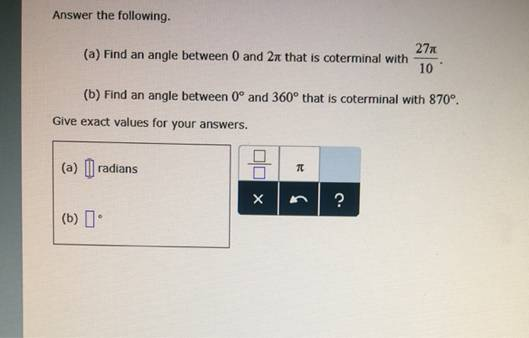
find an angle between 0 and 2pi that is coterminal with 27pi over 10.find an angle between 0 degrees and 360 degrees that is coterminal with 870 degrees.
The Correct Answer and Explanation is :
To find coterminal angles, we add or subtract multiples of a full rotation (360° or 2π radians) to the given angle until it falls within the desired range. Let’s apply this method to the two problems:
1. Coterminal Angle of 27π/10 Radians Between 0 and 2π:
- Step 1: Convert 27π/10 to a Decimal:
27π/10 ≈ 8.4823 radians. - Step 2: Subtract 2π (One Full Rotation) to Find a Coterminal Angle:
8.4823 – 2π ≈ 8.4823 – 6.2832 ≈ 2.1991 radians. - Step 3: Verify the Result:
2.1991 radians is between 0 and 2π, so it’s the coterminal angle.
2. Coterminal Angle of 870° Between 0° and 360°:
- Step 1: Subtract 360° (One Full Rotation) to Find a Coterminal Angle:
870° – 360° = 510°. - Step 2: Subtract 360° Again:
510° – 360° = 150°. - Step 3: Verify the Result:
150° is between 0° and 360°, so it’s the coterminal angle.
Explanation:
Coterminal angles share the same terminal side when drawn in standard position. To find a coterminal angle within a specific range, we add or subtract multiples of 360° (or 2π radians) until the angle falls within the desired interval. This method ensures that the angle represents the same direction or position as the original angle.
For example, subtracting 360° from 870° twice results in 150°, which is coterminal with 870° and lies within the 0° to 360° range. Similarly, subtracting 2π radians from 27π/10 radians once yields 2.1991 radians, which is coterminal with 27π/10 radians and lies within the 0 to 2π radians range.
Understanding coterminal angles is essential in trigonometry and geometry, as it allows for the simplification of angle measures and the analysis of periodic functions. By recognizing that angles differing by full rotations are coterminal, we can work with angles within a standard range, making calculations and interpretations more straightforward.
In summary, to find a coterminal angle within a specific range, subtract or add multiples of 360° (or 2π radians) until the angle falls within the desired interval. This approach ensures that the angle represents the same direction or position as the original angle, facilitating easier analysis and computation.