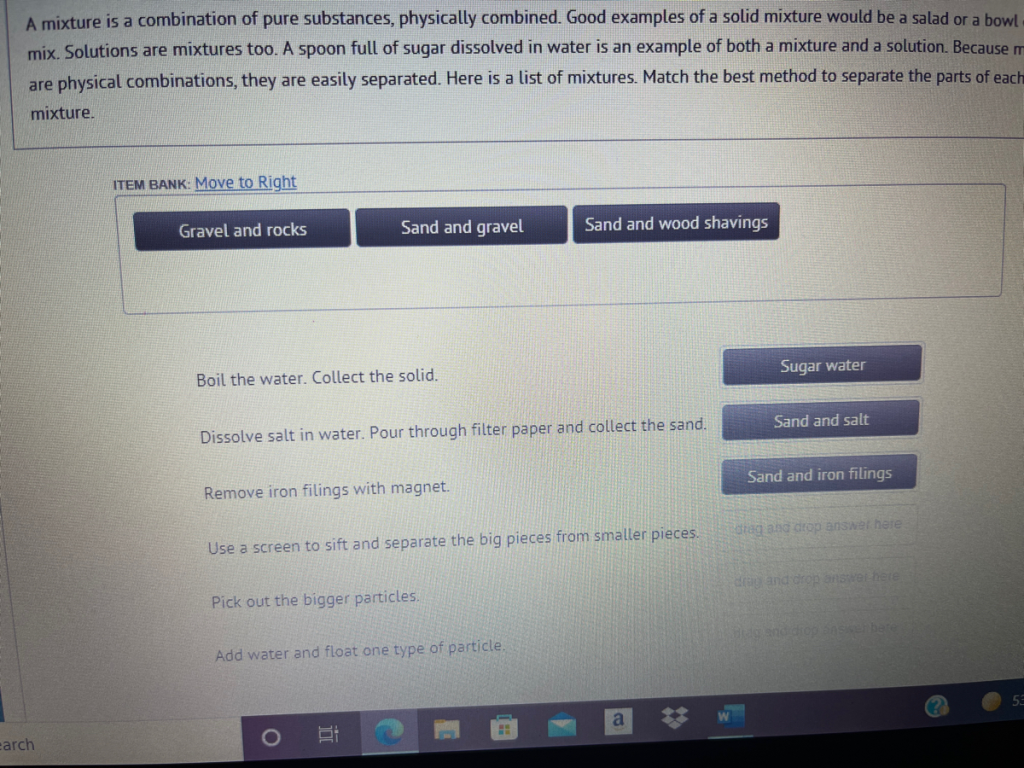
A mixture is a combination of pure substances, physically combined. Good examples of a solid mixture would be a salad or a bowl mix. Solutions are mixtures too. A spoon full of sugar dissolved in water is an example of both a mixture and a solution. Because m are physical combinations, they are easily separated. Here is a list of mixtures. Match the best method to separate the parts of each mixture. ITEM BANK: Move to Right Gravel and rocks Sand and gravel Sand and wood shavings Boil the water. Collect the solid. Sugar water Dissolve salt in water. Pour through filter paper and collect the sand. Sand and salt Remove iron filings with magnet. Sand and iron filings diag and drop answer here Use a screen to sift and separate the big pieces from smaller pieces. dreg and drop answei here Pick out the bigger particles. Add water and float one type of particle. None
The Correct Answer and Explanation is :
The question is asking to match methods to separate the different mixtures listed in the “ITEM BANK.” Let’s go through each mixture and determine the best separation method:
1. Gravel and rocks
- Best Method: Use a screen to sift and separate the big pieces from smaller pieces.
- Explanation: Gravel and rocks are large solid particles. A screen or sieve would allow the smaller pieces of gravel to pass through, while the larger rocks remain. This method works because the sizes of the materials differ, making it easy to separate by size.
2. Sand and gravel
- Best Method: Use a screen to sift and separate the big pieces from smaller pieces.
- Explanation: Similar to gravel and rocks, sand and gravel can be separated by size. A sieve or screen with appropriate mesh size will allow the sand to pass through while leaving the gravel behind.
3. Sand and wood shavings
- Best Method: Add water and float one type of particle.
- Explanation: Wood shavings are less dense than sand and will float when water is added. Sand, being denser, will sink to the bottom. The water will help separate the two based on their different densities.
4. Sugar water
- Best Method: Boil the water. Collect the solid.
- Explanation: Sugar water is a solution, so to separate the sugar from the water, you can boil the water away, leaving the sugar behind as a solid. This method works because water is volatile and will evaporate at lower temperatures, while the sugar remains as a solid.
5. Sand and salt
- Best Method: Dissolve salt in water. Pour through filter paper and collect the sand.
- Explanation: Salt is soluble in water, while sand is not. By adding water to the mixture, the salt dissolves, leaving the sand behind. The solution can then be poured through filter paper, where the sand is trapped, and the salt solution can be further evaporated to obtain the salt.
6. Sand and iron filings
- Best Method: Remove iron filings with a magnet.
- Explanation: Iron filings are magnetic, while sand is not. By using a magnet, you can easily pull the iron filings out of the sand.
7. Sugar water (solution)
- Best Method: Boil the water. Collect the solid.
- Explanation: As mentioned earlier, boiling the sugar water will cause the water to evaporate, leaving the sugar behind as a solid. This is an effective way to separate the components of a solution.
Summary of methods:
- Gravel and rocks – Use a screen to sift and separate the big pieces from smaller pieces.
- Sand and gravel – Use a screen to sift and separate the big pieces from smaller pieces.
- Sand and wood shavings – Add water and float one type of particle.
- Sugar water – Boil the water. Collect the solid.
- Sand and salt – Dissolve salt in water. Pour through filter paper and collect the sand.
- Sand and iron filings – Remove iron filings with magnet.
Each separation method is based on the physical properties of the substances involved, such as their size, density, or solubility.