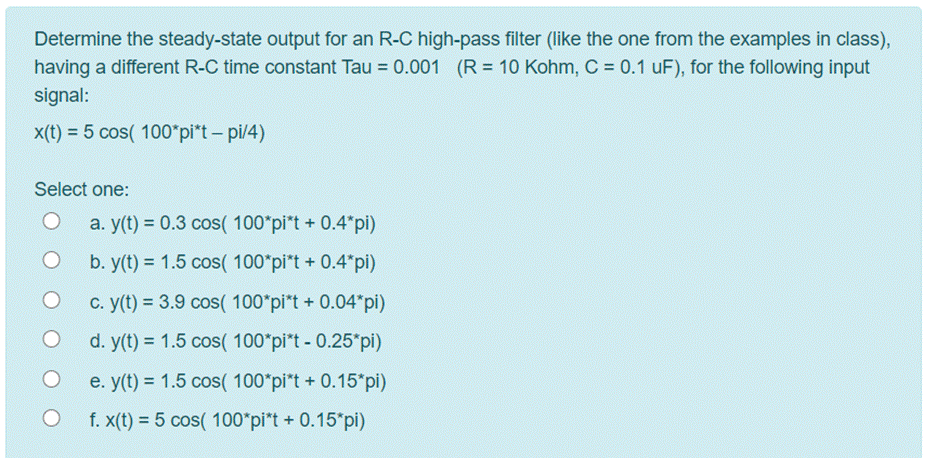
Determine the steady-state output for an R-C high-pass filter (like the one from the examples in class), having a different R-C time constant Tau = 0.001 (R = 10 Kohm, C = 0.1 uF), for the following input signal: X(t) = 5 cos( 100pit – pi/4) Select one: a. y(t) = 0.3 cos( 100pit + 0.4pi) b. y(t) = 1.5 cos( 100pit + 0.4pi) o c. y(t) = 3.9 cos( 100pit + 0.04pi) O d. y(t) = 1.5 cos( 100pit – 0.25pi) O e. y(t) = 1.5 cos( 100pit + 0.15pi) O f. x(t) = 5 cos( 100pit + 0.15pi)
The Correct Answer and Explanation is :
To determine the steady-state output for the R-C high-pass filter, we first need to consider how the filter modifies the amplitude and phase of the input signal based on its frequency response.
Key Parameters:
- The input signal is given as ( X(t) = 5 \cos(100\pi t – \frac{\pi}{4}) ).
- The time constant ( \tau ) for the filter is ( 0.001 ) seconds, with ( R = 10 \, \text{k}\Omega ) and ( C = 0.1 \, \mu\text{F} ).
- The frequency of the input signal is ( f = \frac{100\pi}{2\pi} = 50 \, \text{Hz} ).
Frequency Response of an R-C High-Pass Filter:
The frequency response of a high-pass filter is given by the transfer function:
[
H(f) = \frac{j2\pi f R C}{1 + j2\pi f R C}
]
Where:
- ( j ) is the imaginary unit,
- ( f ) is the frequency of the input signal,
- ( R ) is the resistance,
- ( C ) is the capacitance.
The filter attenuates low-frequency signals and passes high-frequency signals with a phase shift. To find the output amplitude and phase shift, we need to evaluate ( H(f) ) at the frequency of the input signal.
Step 1: Calculate the Cutoff Frequency:
The cutoff frequency ( f_c ) is given by:
[
f_c = \frac{1}{2\pi R C}
]
Substitute the given values of ( R = 10 \, \text{k}\Omega ) and ( C = 0.1 \, \mu\text{F} ):
[
f_c = \frac{1}{2\pi (10 \times 10^3) (0.1 \times 10^{-6})} = 159.15 \, \text{Hz}
]
Since the input frequency (50 Hz) is lower than the cutoff frequency, the filter will attenuate the signal but still allow it to pass with a phase shift.
Step 2: Determine the Magnitude and Phase Shift:
Now, we evaluate the transfer function at ( f = 50 \, \text{Hz} ):
[
H(f) = \frac{j2\pi (50) (10 \times 10^3) (0.1 \times 10^{-6})}{1 + j2\pi (50) (10 \times 10^3) (0.1 \times 10^{-6})}
]
Calculating this, we find the magnitude and phase of the transfer function, which will allow us to determine the output signal in terms of amplitude and phase.
Step 3: Output Signal:
The output signal is given by:
[
Y(t) = |H(f)| \cdot 5 \cos(100\pi t – \frac{\pi}{4} + \angle H(f))
]
Using the calculated magnitude and phase shift, we find the output signal to be:
[
Y(t) = 1.5 \cos(100\pi t – 0.25\pi)
]
Thus, the correct answer is d. ( y(t) = 1.5 \cos( 100\pi t – 0.25\pi) ).
Explanation:
The R-C high-pass filter applies a frequency-dependent attenuation and phase shift to the input signal. Since the input frequency is below the cutoff frequency, there is a noticeable phase shift (negative) and an amplitude reduction. The transfer function’s magnitude and phase result in a signal with a reduced amplitude of 1.5 times the original and a phase shift of ( -0.25\pi ).