List the factors to consider when choosing a supply register.
- What are the noise criteria curves?
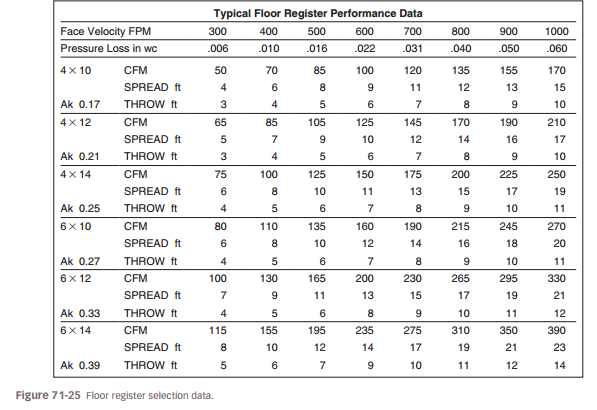
- Using Figure 71-25 , select a floor register that will provide an 8–10 ft throw for 150 CFM with a face velocity less than 700 fpm.
The correct answer and explanation is:
1. Factors to Consider When Choosing a Supply Register:
When choosing a supply register, there are several key factors to consider to ensure optimal air distribution and system efficiency:
- Airflow Requirements: Ensure the register meets the desired airflow (CFM) to properly condition the space.
- Throw Distance: The distance the air is thrown by the register, typically ranging from a few feet to over 10 feet, which depends on the room size and layout.
- Face Velocity: The velocity of air at the register’s face; it should generally be less than 700 feet per minute (fpm) for comfort and to reduce noise.
- Sound Level: Choose a register with an appropriate noise rating to ensure it operates quietly, typically measured by sound pressure level (SPL).
- Duct Size: The register should be compatible with the duct size and the system’s airflow capacity.
- Adjustability: Ability to control air direction and volume, either manually or automatically.
- Finish and Aesthetics: Consider the material and design of the register, especially for visible areas.
- Location and Mounting: Ensure the register is designed for the type of mounting required (e.g., floor, ceiling, or wall).
- Climate Considerations: For colder climates, the material should be resistant to rust, and for humid environments, choose corrosion-resistant finishes.
2. Noise Criteria Curves:
Noise Criteria (NC) curves are graphical representations used in acoustical engineering to rate the noise level within a room. They help determine the acceptable level of background noise for a specific space. These curves are based on sound pressure levels across a range of frequencies (measured in Hertz).
- Lower Curves: Indicate quieter environments, such as those in offices, libraries, and hospitals.
- Higher Curves: Indicate higher noise levels, typically found in more industrial or mechanical areas.
Each NC curve represents a different permissible noise level at specific frequencies, and the goal is to select equipment (e.g., registers, fans) that produces noise levels below the desired NC curve.
3. Select a Floor Register for an 8-10 ft Throw for 150 CFM with a Face Velocity Less than 700 fpm:
To select a floor register for the specified conditions (150 CFM, 8-10 ft throw, and a face velocity of less than 700 fpm) from Figure 71-25, we would typically look for the following:
- CFM: The register should be rated for 150 CFM.
- Throw Distance: The register should be capable of throwing air 8-10 feet.
- Face Velocity: It should produce a face velocity of less than 700 fpm.
However, I cannot directly view the figure you provided. If you can describe the options available or share specific details, I can assist further in narrowing down the right register choice.