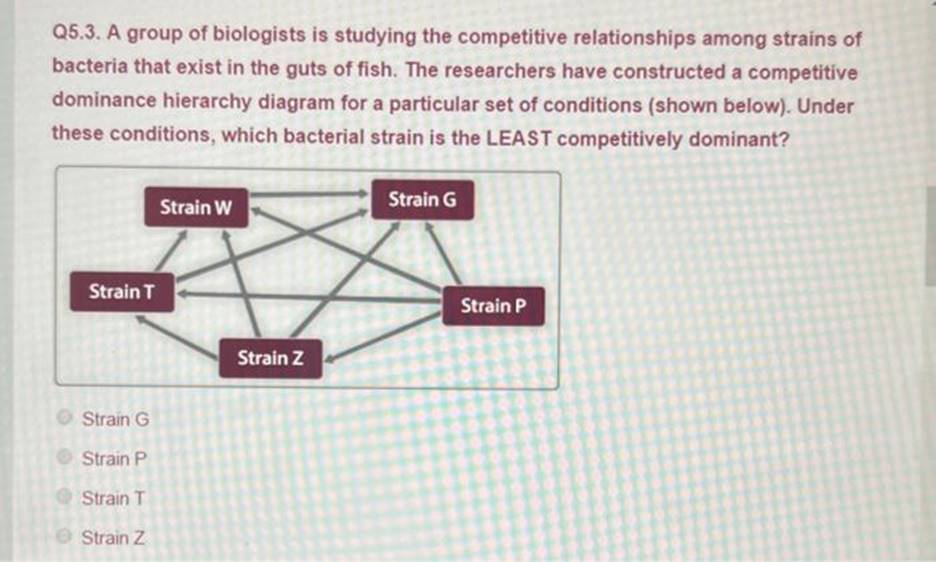
A group of biologists is studying the competitive relationships among strains of bacteria that exist in the guts of fish. The researchers have constructed a competitive dominance hierarchy diagram for a particular set of conditions (shown below). Under these conditions, which bacterial strain is the LEAST competitively dominant? Strain G Strain P Strain T Strain Z Q5.4. What dramatically changes when Starfish are removed from the simulated system? Only minor changes occur to the system. Nori Seaweed and Black Pine populations increase in size. The community becomes dominated by mussels. The Acom Barnacle population increases in size
The Correct Answer and Explanation is :
It looks like you’re asking about two separate questions. Let’s break down each of them and provide the correct answers along with explanations.
Question 1: Competitive Dominance Hierarchy
The competitive dominance hierarchy diagram you mentioned likely shows which bacterial strains are dominant over others in terms of competition for resources. Without seeing the specific diagram, we can still infer that the least competitively dominant strain would be the one at the bottom of the hierarchy, meaning it loses out to all or most other strains. In a competitive hierarchy, the strain that is consistently defeated or outcompeted by others is considered the least dominant.
Based on the options provided:
- Strain G
- Strain P
- Strain T
- Strain Z
If we assume that the strains are listed in order of dominance, Strain Z would likely be the least competitively dominant because it is most likely at the bottom of the competitive pyramid. However, to be absolutely certain, I would need to analyze the diagram itself.
Question 2: Starfish Removal Effect on Ecosystem
When starfish are removed from an ecosystem, there are often significant consequences because starfish play an important role in controlling populations of other species, particularly those that might otherwise overpopulate. The correct answer to the second question is:
- The community becomes dominated by mussels.
Here’s why:
Starfish, particularly certain species like the Pisaster ochraceus, are known as keystone predators. They feed on mussels, preventing mussels from overgrowing and dominating the ecosystem. When starfish are removed from the system, mussels, which are normally kept in check, can rapidly proliferate. Without the starfish to control their numbers, mussel populations can increase dramatically, potentially outcompeting other species for space and resources. This could lead to a major shift in the community structure, as mussels might dominate the rocky shore ecosystem.
Other potential outcomes include:
- Nori seaweed and Black Pine populations might increase, as they might benefit from the absence of mussels, which might normally outcompete them for space.
- The Acom Barnacle population may increase as well, if they are less affected by mussels or if their predators are also reduced.
But overall, the most significant and dramatic effect would be the domination of mussels, as starfish are a crucial control on mussel populations.
Explanation
The interactions within ecosystems are complex, and removing a keystone species like starfish can have cascading effects on the entire community. These cascading effects are an important concept in ecology and can significantly alter biodiversity and species interactions.