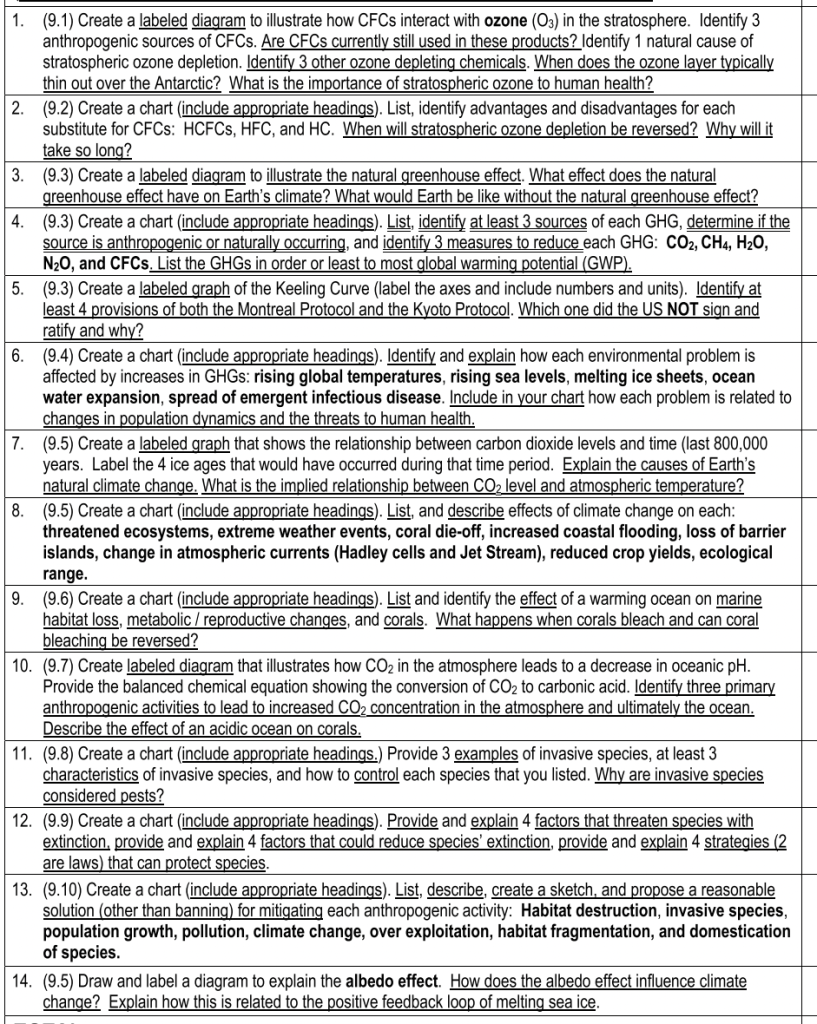
(9.1) Create a labeled diagram to illustrate how CFCs interact with ozone (03) in the CFCs interact with ozone (03) in the stratosphere. Identify 3 anthropogenic sources of CFCs. Are CFCs currently still used in these products? Identify 1 natural cause of stratospheric ozone depletion. Identify 3 other ozone depleting chemicals. When does the ozone layer typically thin out over the Antarctic? What is the importance of stratospheric ozone to human health? 2. (9.2) Create a chart (include appropriate headings). List, identify advantages and disadvantages for each substitute for CFCs: HCFCs, HFC, and HC. When will stratospheric ozone depletion be reversed? Why will it take so long? 3. 4. (9.3) Create a labeled diagram to illustrate the natural greenhouse effect. What effect does the natural greenhouse effect have on Earth’s climate? What would Earth be like without the natural greenhouse effect? (9.3) Create a chart (include appropriate headings). List, identify at least 3 sources of each GHG, determine if the source is anthropogenic or naturally occurring, and identify 3 measures to reduce each GHG: CO2, CH4, Hâ‚‚O, Nâ‚‚O, and CFCs. List the GHGs in order or least to most global warming potential (GWP). 5. (9.3) Create a labeled graph of the Keeling Curve (label the axes and include numbers and units). Identify at least 4 provisions of both the Montreal Protocol and the Kyoto Protocol. Which one did the US NOT sign and ratify and why? 6. (9.4) Create a chart (include appropriate headings). Identify and explain how each environmental problem is affected by increases in GHGS: rising global temperatures, rising sea levels, melting ice sheets, ocean water expansion, spread of emergent infectious disease. Include in your chart how each problem is related to changes in population dynamics and the threats to human health. 7. (9.5) Create a labeled graph that shows the relationship between carbon dioxide levels and time (last 800,000 years. Label the 4 ice ages that would have occurred during that time period. Explain the causes of Earth’s natural climate change. What is the implied relationship between COâ‚‚ level and atmospheric temperature? 8. (9.5) Create a chart (include appropriate headings). List, and describe effects of climate change on each: threatened ecosystems, extreme weather events, coral die-off, increased coastal flooding, loss of barrier islands, change in atmospheric currents (Hadley cells and Jet Stream), reduced crop yields, ecological range. 9. (9.6) Create a chart (include appropriate headings). List and identify the effect of a warming ocean on marine habitat loss, metabolic / reproductive changes, and corals. What happens when corals bleach and can coral bleaching be reversed? 10. (9.7) Create labeled diagram that illustrates how COâ‚‚ in the atmosphere leads to a decrease in oceanic pH. Provide the balanced chemical equation showing the conversion of COâ‚‚ to carbonic acid. Identify three primary anthropogenic activities to lead to increased COâ‚‚ concentration in the atmosphere and ultimately the ocean. Describe the effect of an acidic ocean on corals. 11. (9.8) Create a chart (include appropriate headings.) Provide 3 examples of invasive species, at least 3 characteristics of invasive species, and how to control each species that you listed. Why are invasive species considered pests? 12. (9.9) Create a chart (include appropriate headings). Provide and explain 4 factors that threaten species with extinction, provide and explain 4 factors that could reduce species’ extinction, provide and explain 4 strategies (2 are laws) that can protect species. 13. (9.10) Create a chart (include appropriate headings). List, describe, create a sketch, and propose a reasonable solution (other than banning) for mitigating each anthropogenic activity: Habitat destruction, invasive species, population growth, pollution, climate change, over exploitation, habitat fragmentation, and domestication of species. 14. (9.5) Draw and label a diagram to explain the albedo effect. How does the albedo effect influence climate change? Explain how this is related to the positive feedback loop of melting sea ice.
The Correct Answer and Explanation is :
To answer these questions in a structured way, here’s a breakdown of the key concepts with their explanations. While I can’t create physical diagrams, I can provide detailed explanations for each part that you can translate into visual representations.
1. CFCs and Ozone Interaction
CFCs (chlorofluorocarbons) are synthetic compounds that contain chlorine, fluorine, and carbon. When they are released into the atmosphere, they rise and eventually reach the stratosphere, where the ozone layer is located. UV radiation from the sun breaks down CFCs, releasing chlorine atoms that interact with ozone (O₃) molecules. The chlorine atoms catalyze the destruction of ozone by breaking the O₃ molecules into oxygen (O₂) and single oxygen atoms (O), a process that weakens the ozone layer.
Anthropogenic sources of CFCs:
- Refrigerants (air conditioning and refrigeration)
- Aerosol propellants
- Solvents in cleaning products Are CFCs still used? CFCs were phased out by the Montreal Protocol in 1987 due to their role in ozone depletion, and they are now largely replaced by less harmful alternatives. Natural cause of stratospheric ozone depletion: Volcanic eruptions can release natural chlorine and bromine compounds into the stratosphere, contributing to ozone depletion. Other ozone-depleting chemicals:
- Halons
- Methyl bromide
- Nitrous oxide (N₂O) When does the ozone layer thin over Antarctica? The ozone layer typically thins from September to November each year over Antarctica, creating the “ozone hole.” Importance of stratospheric ozone: Ozone absorbs harmful UV radiation, protecting living organisms on Earth, including humans, from skin cancer, cataracts, and immune system suppression.
2. Substitutes for CFCs
HCFCs (hydrochlorofluorocarbons):
- Advantages: Lower ozone depletion potential than CFCs.
- Disadvantages: Still have some ozone-depleting potential and are greenhouse gases. HFCs (hydrofluorocarbons):
- Advantages: No ozone depletion potential.
- Disadvantages: High global warming potential. HC (Hydrocarbons):
- Advantages: Lower environmental impact compared to CFCs and HFCs.
- Disadvantages: Highly flammable. When will stratospheric ozone depletion be reversed? Ozone depletion is expected to be reversed by around 2050, but it will take a long time due to the persistence of CFCs and their long atmospheric lifetime.
3. Natural Greenhouse Effect
The natural greenhouse effect occurs when certain gases, including CO₂, CH₄, and water vapor, trap heat in the Earth’s atmosphere. This effect maintains the planet’s temperature by preventing some heat from escaping into space. Without it, Earth would be too cold to support most forms of life.
Effect on Earth’s climate: The natural greenhouse effect helps maintain an average global temperature of about 15°C. Without it, Earth would be about 33°C cooler, making life difficult.
Global Warming Potential (GWP) of GHGs:
- CO₂ (1)
- CH₄ (25)
- N₂O (298)
- CFCs (varies, some have a very high GWP)
4. Keeling Curve
The Keeling Curve shows the increase in atmospheric CO₂ levels since the late 1950s. The graph demonstrates that CO₂ concentrations are steadily rising, primarily due to human activities like burning fossil fuels.
Montreal and Kyoto Protocols:
- Montreal Protocol (1987): Focused on phasing out CFCs and other ozone-depleting substances. The US signed and ratified this protocol.
- Kyoto Protocol (1997): Focused on reducing greenhouse gas emissions. The US signed but did not ratify it, citing concerns over economic impacts.
5. Climate Change Impacts
Rising global temperatures: More greenhouse gases trap heat, causing average temperatures to rise.
Rising sea levels: Higher temperatures cause ice to melt and seawater to expand, leading to rising sea levels.
Melting ice sheets: Ice sheets, particularly in Greenland and Antarctica, melt faster due to warming temperatures, contributing to sea level rise.
Ocean water expansion: Warming ocean waters expand, exacerbating sea level rise.
Spread of infectious disease: Warmer temperatures can extend the range of many pathogens and increase the spread of diseases like malaria.
6. CO₂ and Ocean Acidification
CO₂ dissolves in seawater and reacts with water to form carbonic acid (H₂CO₃), lowering the ocean’s pH. This process, known as ocean acidification, affects marine life, particularly corals, which rely on calcium carbonate to form their skeletons. Acidification weakens corals, leading to coral bleaching.
Balanced chemical equation:
[
CO_2 + H_2O \rightarrow H_2CO_3
]
7. Albedo Effect
The albedo effect refers to how reflective Earth’s surface is. Lighter surfaces like ice have a high albedo and reflect more sunlight, helping cool the Earth. As ice melts, darker ocean water or land is exposed, absorbing more sunlight and increasing warming—a positive feedback loop.
Conclusion:
These topics address key environmental issues, including the role of CFCs in ozone depletion, the greenhouse effect’s impact on Earth’s climate, and the challenge of reversing climate change. Understanding these processes and their interactions is crucial for developing solutions to mitigate environmental damage.