Synthesis Of Aspirin (Acetylsalicylic Acid)
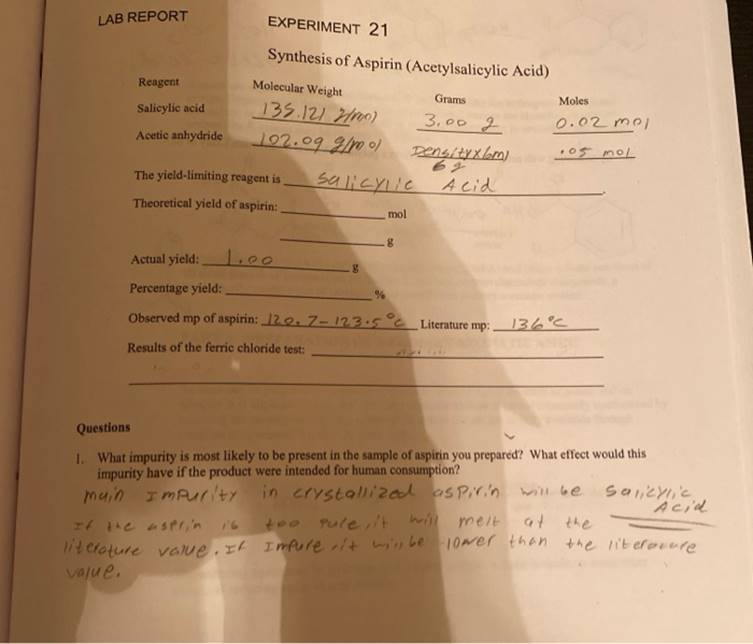
The Correct Answer and Explanation is :
Aspirin, or acetylsalicylic acid, is synthesized through an esterification reaction between salicylic acid and acetic anhydride. This process involves the hydroxyl group of salicylic acid reacting with the acetyl group from acetic anhydride, resulting in the formation of aspirin and acetic acid as a byproduct.
Experimental Procedure:
- Preparation: Weigh 2.0 grams (0.015 moles) of salicylic acid and place it in a 125-mL Erlenmeyer flask. Add 5 mL (0.05 moles) of acetic anhydride to the flask, followed by 5 drops of concentrated sulfuric acid (H₂SO₄) as a catalyst. Gently swirl the flask to mix the contents until the salicylic acid dissolves.
- Heating: Heat the mixture gently on a steam bath for at least 10 minutes to facilitate the reaction.
- Cooling and Crystallization: Allow the flask to cool to room temperature. If crystallization does not occur, scratch the walls of the flask with a glass rod. Then, cool the mixture further in an ice bath until crystallization is complete.
- Purification: Add 50 mL of cold water to the mixture and cool it in an ice bath. Vacuum filter the product using a Buchner funnel, rinsing the crystals with cold water to remove impurities. Dry the crystals by suction until they appear free of solvent.
- Recrystallization: To purify the product further, dissolve the crude aspirin in a minimum amount of hot ethyl acetate. Cool the solution to room temperature and then in an ice bath. Collect the recrystallized aspirin by vacuum filtration and rinse with cold petroleum ether. Dry the crystals completely.
Reaction Mechanism:
The esterification reaction proceeds as follows:
- Activation: The sulfuric acid protonates the carbonyl group of acetic anhydride, increasing its electrophilicity.
- Nucleophilic Attack: The phenoxide ion (the conjugate base of salicylic acid) attacks the activated carbonyl carbon of acetic anhydride, leading to the formation of an intermediate complex.
- Acetylation: The intermediate undergoes a rearrangement, resulting in the formation of acetylsalicylic acid and the release of acetic acid.
- Deprotonation: The protonated aspirin is deprotonated by water or the solvent, yielding the final product.
This reaction is commonly demonstrated in undergraduate laboratories to illustrate esterification and the synthesis of pharmaceutical compounds.