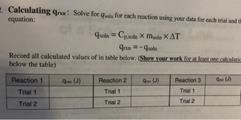
Calculating qrxn: Solve for qsoln for each reaction using your data for each trial andth equation
The Correct Answer and Explanation is :
To calculate ( q_{\text{rxn}} ), we need to solve for ( q_{\text{soln}} ) using the equation:
[
q_{\text{soln}} = m \cdot c \cdot \Delta T
]
Where:
- ( m ) = mass of the solution (often assumed equal to the volume of solution in grams, as the density of water is approximately 1 g/mL),
- ( c ) = specific heat capacity (for water, typically ( 4.184 \, \text{J/g°C} )),
- ( \Delta T ) = change in temperature (( T_{\text{final}} – T_{\text{initial}} )).
For each trial, you need:
- Mass of the solution (( m )): This is usually provided or derived from the volume of the solution in milliliters (assuming ( 1 \, \text{mL} = 1 \, \text{g} )).
- Specific heat capacity (( c )): Use ( 4.184 \, \text{J/g°C} ) unless stated otherwise.
- Temperature change (( \Delta T )): Measure the initial and final temperatures, then calculate the difference.
Example Calculation
Suppose:
- ( m = 100 \, \text{g} ) (solution mass),
- ( c = 4.184 \, \text{J/g°C} ),
- ( T_{\text{initial}} = 25.0 \, \text{°C} ),
- ( T_{\text{final}} = 30.0 \, \text{°C} ).
Then:
[
\Delta T = T_{\text{final}} – T_{\text{initial}} = 30.0 – 25.0 = 5.0 \, \text{°C}
]
[
q_{\text{soln}} = m \cdot c \cdot \Delta T = 100 \cdot 4.184 \cdot 5.0 = 2092 \, \text{J}
]
This value represents the heat absorbed by the solution. To find ( q_{\text{rxn}} ), you may need to account for the system’s heat transfer convention (( q_{\text{rxn}} = -q_{\text{soln}} )) if the reaction releases heat.
Explanation
The calculation uses the principle of calorimetry: the heat absorbed or released by the solution reflects the heat exchanged during the reaction. Mass and specific heat relate energy to temperature changes, while ( \Delta T ) quantifies the thermal response. This method assumes no heat loss to the environment, making precise measurements of mass, temperature, and reaction conditions critical. Ensure the specific heat matches the solution type if not using pure water.