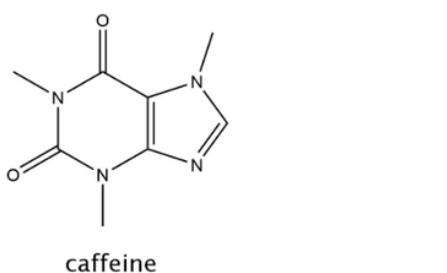
Caffeine occurs naturally in tea leaves and coffee beans. Pure caffeine (mp 236°C) is a white crystalline solid material at room temperature. It is classified as an alkaloid a nitrogen-containing basic compound that is obtained from plants and has physiological effects in the body. A student pulverizes 8.78 grams (g) of coffee beans into a finely ground powder by using a mortar and pestle. The caffeine is then extracted into 300 mL of boiling dichloromethane (CH2Cl2) by the same solid- liquid extraction technique used in Unit 1. After 30 minutes, the solution is filtered hot to remove a large amount of brown insoluble material. Dichloromethane is removed from the filtrate via rotary evaporation, leaving 916.3 milligrams (mg) of caffeine behind, as a white solid. What is the percentage of isolated caffeine with respect to the starting amount of crude coffee beans?
The Correct Answer and Explanation is :
To calculate the percentage of isolated caffeine with respect to the starting amount of crude coffee beans, you can use the following formula:
[
\text{Percentage of caffeine} = \left( \frac{\text{mass of isolated caffeine}}{\text{mass of coffee beans}} \right) \times 100
]
Given Data:
- Mass of crude coffee beans = 8.78 grams
- Mass of isolated caffeine = 916.3 milligrams = 0.9163 grams
Calculation:
[
\text{Percentage of caffeine} = \left( \frac{0.9163 \, \text{grams}}{8.78 \, \text{grams}} \right) \times 100 = 10.44\%
]
Explanation:
This calculation shows that 10.44% of the starting mass of the coffee beans was successfully isolated as caffeine. This percentage is based on the mass of caffeine recovered after the extraction process compared to the initial amount of coffee beans. The extraction process, involving the use of dichloromethane, dissolves caffeine from the beans, and the caffeine is then isolated after the solvent is removed. The efficiency of the extraction can be influenced by several factors, including the method of grinding, the extraction time, and the purity of the caffeine.
This value is important in understanding the effectiveness of the extraction process and the yield of caffeine from the raw coffee beans.