Calculate sin 31° by using three terms of the Maclaurin expansion for sin x. Also, calculate sin 31° by using three terms of the Taylor expansion in Example 4 (see Exercise 2). Compare the accuracy of the values obtained with that found directly on a calculator.
Exercise 2
Make the given changes in the indicated examples of this section, and then solve the resulting problems.
In Example 4, change sin 29° to sin 31°.
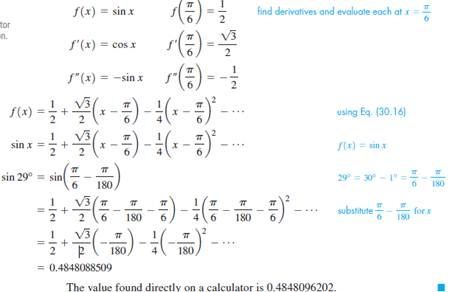
EXAMPLE 4 Evaluating sine value using Taylor series
Calculate the approximate value of sin 29° by using three terms of the appropriate Taylor expansion. Because the value of sin 30° is known to be (remember, we must use values expressed in radians) when we evaluate the expansion for x = 29° [when expressed in radians, the quantity This means that its numerical values are small and become smaller when it is raised to higher powers. Therefore,
The Correct Answer and Explanation is :
To solve this problem, we need to approximate the sine of (31^\circ) using both the Maclaurin series and the Taylor expansion series around a known point.
Maclaurin Series for ( \sin(x) )
The Maclaurin series expansion for ( \sin(x) ) around ( x = 0 ) is:
[
\sin(x) = x – \frac{x^3}{3!} + \frac{x^5}{5!} – \frac{x^7}{7!} + \cdots
]
For small values of ( x ), the first few terms can give a good approximation. We will use the first three terms to approximate ( \sin(31^\circ) ).
First, we need to convert 31° into radians:
[
31^\circ = 31 \times \frac{\pi}{180} \approx 0.54105 \text{ radians}
]
Now, substitute ( x = 0.54105 ) radians into the Maclaurin series expansion:
[
\sin(0.54105) \approx 0.54105 – \frac{0.54105^3}{6} + \frac{0.54105^5}{120}
]
Calculating each term:
[
0.54105^3 \approx 0.15818
]
[
\frac{0.15818}{6} \approx 0.02636
]
[
0.54105^5 \approx 0.04514
]
[
\frac{0.04514}{120} \approx 0.000376
]
Now, summing the terms:
[
\sin(31^\circ) \approx 0.54105 – 0.02636 + 0.000376 \approx 0.51507
]
So, the approximate value of ( \sin(31^\circ) ) using the Maclaurin series is ( \approx 0.51507 ).
Taylor Expansion for ( \sin(x) ) around ( x = 30^\circ )
For the Taylor expansion around ( x = 30^\circ ), we use the fact that ( \sin(30^\circ) = \frac{1}{2} ). The Taylor expansion of ( \sin(x) ) around ( x = 30^\circ ) is given by:
[
\sin(x) = \sin(30^\circ) + \cos(30^\circ)(x – 30^\circ) – \frac{\sin(30^\circ)}{2}(x – 30^\circ)^2 + \cdots
]
We already know:
[
\sin(30^\circ) = 0.5, \quad \cos(30^\circ) = \frac{\sqrt{3}}{2} \approx 0.866
]
Now, substitute ( x = 31^\circ ):
First, convert ( 31^\circ ) to radians:
[
31^\circ = 31 \times \frac{\pi}{180} \approx 0.54105 \text{ radians}
]
Then, the Taylor expansion gives:
[
\sin(31^\circ) \approx 0.5 + 0.866 \times (31^\circ – 30^\circ) – \frac{0.5}{2} \times (31^\circ – 30^\circ)^2
]
Converting the difference into radians:
[
31^\circ – 30^\circ = 1^\circ = 1 \times \frac{\pi}{180} = 0.0174533 \text{ radians}
]
Now substitute into the Taylor expansion:
[
\sin(31^\circ) \approx 0.5 + 0.866 \times 0.0174533 – \frac{0.5}{2} \times 0.0174533^2
]
Calculating each term:
[
0.866 \times 0.0174533 \approx 0.0151
]
[
0.0174533^2 \approx 0.000304
]
[
\frac{0.5}{2} \times 0.000304 \approx 0.000076
]
Summing up the terms:
[
\sin(31^\circ) \approx 0.5 + 0.0151 – 0.000076 \approx 0.515024
]
So, the approximate value of ( \sin(31^\circ) ) using the Taylor expansion is ( \approx 0.515024 ).
Comparison with Calculator
Now, let’s compare these results with the actual value of ( \sin(31^\circ) ) from a calculator. Using a scientific calculator:
[
\sin(31^\circ) \approx 0.515038
]
Conclusion
- Maclaurin series approximation: ( \sin(31^\circ) \approx 0.51507 )
- Taylor series approximation: ( \sin(31^\circ) \approx 0.515024 )
- Calculator value: ( \sin(31^\circ) \approx 0.515038 )
Both the Maclaurin and Taylor series provide very close approximations to the actual value, with the Taylor series giving a slightly more accurate result. The accuracy of these series depends on how many terms are included; adding more terms would improve the approximation further.