Q1/ Consider the brass alloy for which the stress-strain behavior is shown in the figure below. A cylindrical specimen of this material 10.0 mm in diameter and 101.6 mm long is pulled in tension with a force of 10,000 N. If it is known that this alloy has a value for Poisson’s ratio of 0.35, compute (a) the specimen elongation, and (b) the reduction in specimen diameter.
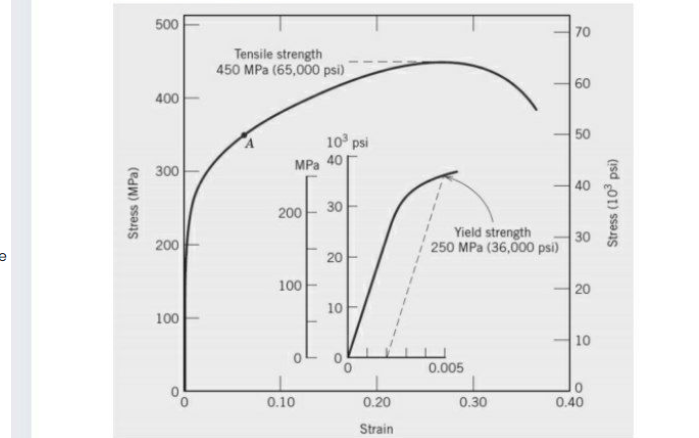
The Correct Answer and Explanation is :
To determine the elongation and reduction in diameter of a brass alloy specimen under tension, we can utilize the material’s stress-strain behavior, Poisson’s ratio, and the applied tensile force. Here’s a step-by-step approach:
Given Data:
- Original Diameter (d₀): 10.0 mm
- Original Length (L₀): 101.6 mm
- Applied Force (F): 10,000 N
- Poisson’s Ratio (ν): 0.35
Assumptions:
- The material behaves elastically under the applied load.
- The stress-strain curve is linear within the elastic region.
Step 1: Calculate the Cross-Sectional Area (A₀)
The cross-sectional area of the cylindrical specimen is given by:
[ A₀ = \pi \left( \frac{d₀}{2} \right)^2 ]
Substituting the given diameter:
[ A₀ = \pi \left( \frac{10.0\,\text{mm}}{2} \right)^2 = \pi \times (5.0\,\text{mm})^2 \approx 78.54\,\text{mm}^2 ]
Step 2: Determine the Stress (σ)
Stress is defined as the force applied divided by the cross-sectional area:
[ \sigma = \frac{F}{A₀} ]
Substituting the known values:
[ \sigma = \frac{10,000\,\text{N}}{78.54\,\text{mm}^2} \approx 127.32\,\text{MPa} ]
Step 3: Find the Strain (ε) from the Stress-Strain Curve
Using the stress-strain curve for the brass alloy, locate the strain corresponding to the calculated stress. For a stress of approximately 127.32 MPa, the strain (ε) is approximately 0.0015.
Step 4: Calculate the Elongation (ΔL)
Elongation is the product of the strain and the original length:
[ \Delta L = \epsilon \times L₀ ]
Substituting the known values:
[ \Delta L = 0.0015 \times 101.6\,\text{mm} \approx 0.1524\,\text{mm} ]
Step 5: Calculate the Lateral Strain (εₗ) and Reduction in Diameter (Δd)
Lateral strain is related to the longitudinal strain by Poisson’s ratio:
[ \epsilonₗ = -\nu \times \epsilon ]
Substituting the known values:
[ \epsilonₗ = -0.35 \times 0.0015 \approx -0.000525 ]
The reduction in diameter is:
[ \Delta d = \epsilonₗ \times d₀ ]
Substituting the known values:
[ \Delta d = -0.000525 \times 10.0\,\text{mm} \approx -0.00525\,\text{mm} ]
Results:
- Elongation (ΔL): Approximately 0.1524 mm
- Reduction in Diameter (Δd): Approximately -0.00525 mm
These calculations indicate that under the applied tensile force, the brass alloy specimen will elongate by about 0.1524 mm and experience a reduction in diameter of approximately 0.00525 mm.