| Activity: Deuterostome DiversityPart AWhich of the following statements about deuterostomes is false?Which of the following statements about deuterostomes is false?All deuterostomes have a coelom.All deuterostomes are triploblastic and have three tissue layers.All deuterostomes have a similar pattern of early embryonic development.All deuterostomes exhibit radial symmetry in their bodies.Part BWhich structure is not an innovation that occurred during vertebrate diversification?HintsWhich structure is not an innovation that occurred during vertebrate diversification?Amniotic eggExoskeletonJawsBoneSubmitMy AnswersGive UpPart CTrue or false? An organism that is radially symmetric has many well-developed head regions.HintsTrue or false? An organism that is radially symmetric has many well-developed head regions.TrueFalseSubmitMy AnswersGive UpPart DWhich characteristic distinguishes echinoderms from the other two deuterostome lineages?HintsWhich characteristic distinguishes echinoderms from the other two deuterostome lineages?The presence of an endoskeletonTheir body planTheir ability to moveTheir habitatSubmitMy AnswersGive UpPart EWhich of the following statements about vertebrates is true?HintsWhich of the following statements about vertebrates is true?Birds are more related to mammals than to dinosaurs.All vertebrates have jaws with which to catch their prey.The development of more efficient surfaces for gas exchange in reptiles stimulated expansion into terrestrial habitats.The development of an amniotic egg and internal fertilization allowed vertebrates to reproduce away from water.SubmitMy AnswersGive UpPart FWhich characteristics define a chordate?HintsWhich characteristics define a chordate?The presence of four specific morphological traitsThe presence of a well-developed circulatory systemThe development of an anu-s from the blastoporeThe ability to live on landPart GWhich structure can be used for feeding and gas exchange?HintsWhich structure can be used for feeding and gas exchange?EndoskeletonDorsal nerve cordPharyngeal gill slitNotochord |
Echinodermata Hemichordata Chordata
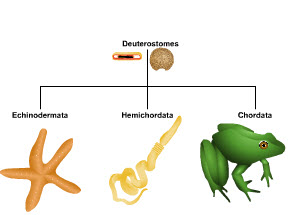
The correct answer and explanation is:
Part A: Which of the following statements about deuterostomes is false?
Correct Answer: All deuterostomes exhibit radial symmetry in their bodies.
Explanation:
Deuterostomes include groups such as echinoderms, hemichordates, and chordates. While echinoderms exhibit radial symmetry as adults, they have bilateral symmetry as larvae. Hemichordates and chordates maintain bilateral symmetry throughout their life cycle. Therefore, the claim that all deuterostomes exhibit radial symmetry is false.
Part B: Which structure is not an innovation that occurred during vertebrate diversification?
Correct Answer: Exoskeleton
Explanation:
The exoskeleton is a characteristic of invertebrates such as arthropods, not vertebrates. Innovations in vertebrate diversification include the amniotic egg (enabling reproduction on land), jaws (for predation), and bones (providing structural support and protection). Vertebrates have endoskeletons, not exoskeletons.
Part C: True or false? An organism that is radially symmetric has many well-developed head regions.
Correct Answer: False
Explanation:
Radially symmetric organisms, like cnidarians and adult echinoderms, lack a centralized head region. Radial symmetry does not support cephalization, which is the development of a head with concentrated sensory structures. Instead, these organisms typically have sensory structures distributed around their body.
Part D: Which characteristic distinguishes echinoderms from the other two deuterostome lineages?
Correct Answer: Their body plan
Explanation:
Echinoderms are unique among deuterostomes for their pentaradial symmetry as adults, a water vascular system for movement and feeding, and their calcified endoskeleton made of ossicles. This body plan sets them apart from hemichordates and chordates, which maintain bilateral symmetry and have different structural adaptations.
Part E: Which of the following statements about vertebrates is true?
Correct Answer: The development of an amniotic egg and internal fertilization allowed vertebrates to reproduce away from water.
Explanation:
The amniotic egg, with its protective membranes, allowed vertebrates (such as reptiles, birds, and mammals) to lay eggs in terrestrial environments without desiccation. This was a major evolutionary advancement. Birds are more related to dinosaurs, all vertebrates do not have jaws (e.g., lampreys), and reptiles developed efficient gas exchange for terrestrial adaptation.
Part F: Which characteristics define a chordate?
Correct Answer: The presence of four specific morphological traits
Explanation:
Chordates are defined by the presence of these four features during some stage of their life:
- Notochord: A flexible rod providing support.
- Dorsal hollow nerve cord: A tube that develops into the central nervous system.
- Pharyngeal gill slits: Openings in the throat region used for feeding or gas exchange.
- Post-anal tail: A tail extending beyond the anus, aiding in locomotion.
These traits differentiate chordates from other deuterostomes.
Part G: Which structure can be used for feeding and gas exchange?
Correct Answer: Pharyngeal gill slit
Explanation:
Pharyngeal gill slits are openings found in the pharynx of chordates. In aquatic organisms, they function in both feeding and gas exchange. For example, in fish, gills are derived from these slits and are essential for oxygen absorption. In other chordates, such as lancelets, these slits help filter food particles from water.