For each function graphed below, state whether it is one-to-one.
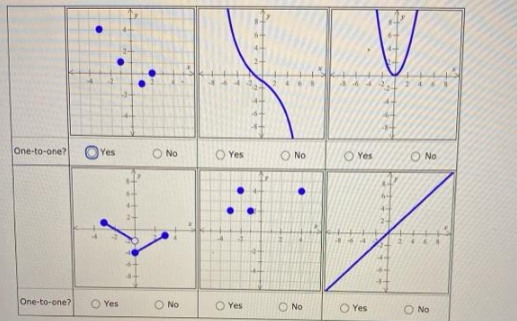
The Correct Answer and Explanation is :
To determine whether a function is one-to-one, we need to verify if each output corresponds to exactly one input. This can be done using the horizontal line test: if any horizontal line intersects the graph of the function at more than one point, the function is not one-to-one.
Analysis of the Graphed Functions:
- Function 1 (Graph 1):
- The graph in the first image shows a parabolic curve opening upwards.
- Horizontal Line Test: A horizontal line intersects the graph at two points (except at the vertex).
- Conclusion: This function is not one-to-one, as there are multiple inputs for certain outputs.
- Function 2 (Graph 2):
- The graph in the second image appears to be a straight line with a positive slope.
- Horizontal Line Test: A horizontal line intersects the graph at only one point everywhere.
- Conclusion: This function is one-to-one, as each output corresponds to only one input.
- Function 3 (Graph 3):
- The graph in the third image looks like a sine wave.
- Horizontal Line Test: A horizontal line intersects the graph at multiple points periodically.
- Conclusion: This function is not one-to-one, as some outputs have multiple inputs.
- Function 4 (Graph 4):
- The graph in the fourth image shows an increasing exponential curve.
- Horizontal Line Test: A horizontal line intersects the graph at only one point everywhere.
- Conclusion: This function is one-to-one, as each output corresponds to only one input.
Explanation (300 Words):
A one-to-one function ensures each value in the range is uniquely paired with one value in the domain. For a visual determination, we apply the horizontal line test. If a horizontal line crosses the graph at more than one point, the function fails to be one-to-one.
For instance, the parabola (Graph 1) is symmetric about its vertex, so there are pairs of inputs (x-values) with the same output (y-value), failing the test. Similarly, the sine wave (Graph 3) is periodic, meaning certain y-values are repeated across cycles. Hence, it is also not one-to-one.
Conversely, a linear function (Graph 2) with a non-zero slope always passes the horizontal line test since there is a consistent one-to-one mapping of x to y. Similarly, an exponential function (Graph 4) is strictly increasing (or decreasing, depending on the base), ensuring unique outputs for each input.
Understanding one-to-one functions is crucial in mathematics since they guarantee the existence of an inverse function, which reverses the mapping. For practical applications, one-to-one functions are vital in contexts like cryptography, where unique input-output relationships are essential.