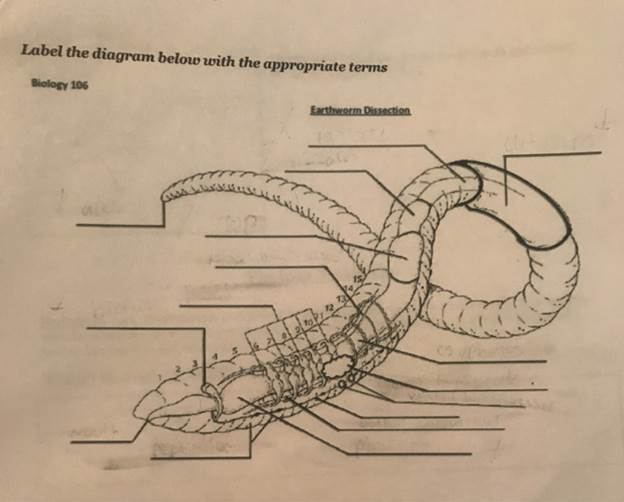
Earthworm Dissection Obtain a preserved sample and locate the clitellum near the anterior portion of the worm. The ventral side of the worm is the side where the clitellum is incomplete. Place your worm on the dissecting tray ventral side down. Car Carefully make an incision down the length of your worin exposing the organs inside. Be certain not to cut too deeply or you will disturb the organs inside. Pin down the body wall to expose the organs. Find the following structures and know their function: brain pharynx espophagus hearts (aortic arches)/ crop gizzard typhlosole (inside the intestine) seminal receptacles seminal vesicles intestine dorsal blood vessel ventral blood vessel ventral nerve cord anus septa
The Correct Answer and Explanation is :
The earthworm is an excellent example of a segmented invertebrate that has various systems for digestion, reproduction, circulation, and movement. During a dissection, you can locate and study different anatomical structures that help the worm survive in its environment. Below are the structures you need to locate and their functions:
- Brain: Located at the anterior end of the worm, the brain is a pair of ganglia connected by a ventral nerve cord. It controls the worm’s movements and responses to stimuli.
- Pharynx: This muscular structure is used to suck in food from the soil. It is located just behind the mouth and helps move food to the esophagus.
- Esophagus: The esophagus connects the pharynx to the crop and helps transport food deeper into the digestive system.
- Hearts (Aortic Arches): These five pairs of muscular vessels contract to pump blood through the circulatory system. They are located near the anterior end and are part of the earthworm’s closed circulatory system.
- Crop: A temporary storage area for food, the crop holds the ingested material until it is ready to be processed by the gizzard.
- Gizzard: The gizzard is a muscular structure that grinds the food. It is located just after the crop and contains tiny stones that help break down the food.
- Typhlosole: Found inside the intestine, the typhlosole is a fold of tissue that increases the surface area for nutrient absorption.
- Seminal Receptacles: These structures store sperm received during mating. Located near the posterior part of the worm, they help in reproduction.
- Seminal Vesicles: These glands produce and store sperm. They are located closer to the anterior end of the worm.
- Intestine: The digestive tract, where nutrients are absorbed. The worm’s intestine is long and stretches from the gizzard to the anus.
- Dorsal Blood Vessel: This vessel carries blood from the posterior to the anterior part of the worm. It runs along the top of the body.
- Ventral Blood Vessel: This vessel transports blood from the anterior to the posterior end of the worm, running along the underside.
- Ventral Nerve Cord: This cord runs along the ventral side of the body and transmits signals from the brain to the rest of the body.
- Anus: The terminal opening where waste is expelled from the body after digestion.
- Septa: These are internal walls that separate the segments of the earthworm’s body. They help in maintaining the structural integrity of the body and are crucial for the worm’s movement.
Each of these organs plays an essential role in the earthworm’s survival, contributing to its ability to move, digest food, reproduce, and respond to its environment. The earthworm is a model organism for understanding basic biological systems and functions.