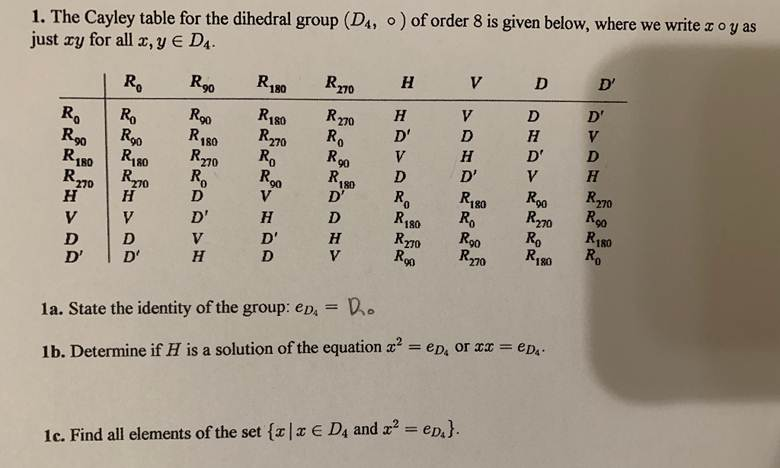
The Cayley table for the dihedral group (D4,) of order 8 is given below, where we write zo y as just zy for all z, y ∈ Da R R90 R180 R270 H V D D Ro Ro R90 R180 R270 H V D D’ R90 R00 R180 R270 Ro D’ D H V R180 R180 R170 R170 R210 Ro R V H D D R Roo R D D’ V H H H D V D R R Roo R210 Ro V V D’ H DD D V D’ D’ H DHV DD R R270 R270 R90 Ro R Ro R R R 1a. State the identity of the group: en = D. 1b. Determine if H is a solution of the equation zen, or zz = ep 1c. Find all elements of the set {zz D₁ and z² = en).
The Correct Answer and Explanation is :
1a. Identity of the group
The dihedral group ( D_4 ) is the group of symmetries of a square, which consists of both rotations and reflections. The order of this group is 8, as the table indicates there are 8 elements. These elements can be thought of as:
- ( R_0 ) (identity rotation by 0 degrees)
- ( R_{90} ) (rotation by 90 degrees)
- ( R_{180} ) (rotation by 180 degrees)
- ( R_{270} ) (rotation by 270 degrees)
- ( H ) (horizontal reflection)
- ( V ) (vertical reflection)
- ( D ) (diagonal reflection 1)
- ( D’ ) (diagonal reflection 2)
In a group, the identity element is the one that leaves all other elements unchanged when combined with them. The identity element of ( D_4 ) is ( R_0 ), because:
- ( R_0 ) combined with any element ( x \in D_4 ) (either by composition or multiplication) gives ( x ) back, i.e., ( R_0 \cdot x = x \cdot R_0 = x ).
Thus, the identity element is ( R_0 ).
1b. Checking if ( H ) is a solution to ( z \cdot e = e \cdot p )
Let’s check if ( H ) (the horizontal reflection) satisfies the equation ( z \cdot e = e \cdot p ), where ( e ) is the identity element (which is ( R_0 ) here).
- The equation ( z \cdot e = e \cdot p ) essentially asks if multiplying the element ( H ) by the identity element ( R_0 ) results in the same element, i.e., does ( H \cdot R_0 = R_0 \cdot H )?
- Since ( R_0 ) is the identity, the equation holds trivially because for any element ( x ), ( R_0 \cdot x = x \cdot R_0 = x ).
Thus, ( H ) is indeed a solution to ( z \cdot e = e \cdot p ).
1c. Finding elements where ( z^2 = R_0 ) (identity)
To find the elements ( z ) in ( D_4 ) such that ( z^2 = R_0 ), we need to check which elements in the group satisfy this property. We will square each element and check the result:
- ( R_0^2 = R_0 ) (identity)
- ( R_{90}^2 = R_{180} )
- ( R_{180}^2 = R_0 ) (identity)
- ( R_{270}^2 = R_{180} )
- ( H^2 = R_0 ) (identity)
- ( V^2 = R_0 ) (identity)
- ( D^2 = R_0 ) (identity)
- ( D’^2 = R_0 ) (identity)
Thus, the elements ( z \in D_4 ) that satisfy ( z^2 = R_0 ) are:
- ( R_0 ) (identity)
- ( R_{180} )
- ( H )
- ( V )
- ( D )
- ( D’ )
Conclusion
- The identity element of ( D_4 ) is ( R_0 ), the identity rotation.
- ( H ) does satisfy the equation ( z \cdot e = e \cdot p ) because ( R_0 ) is the identity element.
- The elements where ( z^2 = R_0 ) are ( R_0 ), ( R_{180} ), ( H ), ( V ), ( D ), and ( D’ ).
These observations are crucial in understanding the structure of the dihedral group ( D_4 ), which encapsulates both rotational and reflectional symmetries of a square. The relations between elements in the group are foundational for studying symmetries in geometry and algebra.