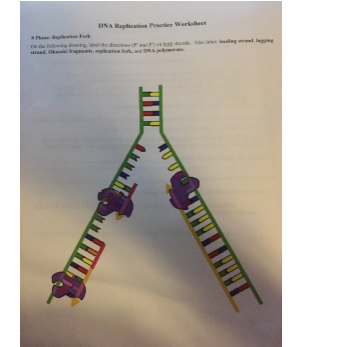
DNA Replication Practice Worksheet S Phase: Replication Fork On the following drawing, label the directions
The Correct Answer and Explanation is :
DNA replication is a fundamental process during the S phase of the cell cycle, ensuring that each daughter cell receives an exact copy of the DNA. The replication fork is the Y-shaped structure where the DNA double helix unwinds, allowing for the synthesis of new strands.
Labeling the Directions on the Replication Fork Diagram:
- Leading Strand: This strand is synthesized continuously in the 5′ to 3′ direction, moving toward the replication fork.
- Lagging Strand: This strand is synthesized discontinuously in the 5′ to 3′ direction, moving away from the replication fork, resulting in short segments known as Okazaki fragments.
- Replication Fork Movement: The replication fork progresses in the 5′ to 3′ direction along the template strands.
- Helicase: This enzyme unwinds the DNA double helix ahead of the replication fork, separating the two strands.
- Primase: Synthesizes short RNA primers that provide starting points for DNA polymerases.
- DNA Polymerase: Extends the new DNA strands by adding nucleotides in the 5′ to 3′ direction.
- Okazaki Fragments: Short DNA segments synthesized on the lagging strand, later joined together to form a continuous strand.
Explanation:
During DNA replication, the double helix unwinds at the origin of replication, forming a replication fork. At this fork, helicase enzymes separate the two strands of DNA, creating single-stranded templates. DNA polymerases then synthesize new strands complementary to these templates.
The leading strand is synthesized continuously in the 5′ to 3′ direction, moving toward the replication fork. In contrast, the lagging strand is synthesized discontinuously in the 5′ to 3′ direction, moving away from the replication fork. This results in the formation of Okazaki fragments, which are later joined together by DNA ligase to form a continuous strand.
Primase synthesizes short RNA primers that provide starting points for DNA polymerases. These primers are essential because DNA polymerases can only add nucleotides to an existing strand. Once the primers are in place, DNA polymerases extend the new DNA strands by adding nucleotides in the 5′ to 3′ direction.
The coordinated action of these enzymes ensures accurate and efficient DNA replication, maintaining genetic integrity during cell division.
For a visual demonstration of labeling a replication fork, you might find the following video helpful: