Do programmed decisions and the use of performance programs always evolve from what were originally nonprogrammed decisions? Why or why not?
The Correct Answer and Explanation is :
No, programmed decisions and the use of performance programs do not always evolve from what were originally nonprogrammed decisions. While it’s true that nonprogrammed decisions may eventually become more structured and programmed over time, not all nonprogrammed decisions lead to programmed decisions. The distinction lies in the nature of the decision-making process and the level of complexity involved.
Programmed decisions refer to those decisions that are routine, repetitive, and often guided by established policies, procedures, or rules. These decisions can be made using predefined guidelines and often don’t require much individual judgment. On the other hand, nonprogrammed decisions are more complex and involve unique, novel situations that do not have a predetermined solution. These decisions require more thoughtful analysis, creativity, and judgment.
The process of evolving nonprogrammed decisions into programmed decisions is often driven by organizational learning and experience. If a certain type of decision is frequently encountered, organizations may standardize the process, thus converting it into a programmed decision. For example, a company might initially face a nonprogrammed decision when dealing with customer complaints. Over time, however, the company may develop standardized procedures for handling similar complaints, thereby making the process more programmed.
However, not all nonprogrammed decisions will follow this path. Some decisions, due to their complexity, rapid changes in the environment, or unique nature, may always require a nonprogrammed approach. For instance, decisions about entering a new market or launching a new product are typically complex and require novel solutions, and thus may never evolve into programmed decisions.
Thus, while there is potential for some nonprogrammed decisions to evolve into programmed ones, the complexity and uniqueness of certain decisions mean that this transition does not always occur.
Let me generate an image to help illustrate this concept.
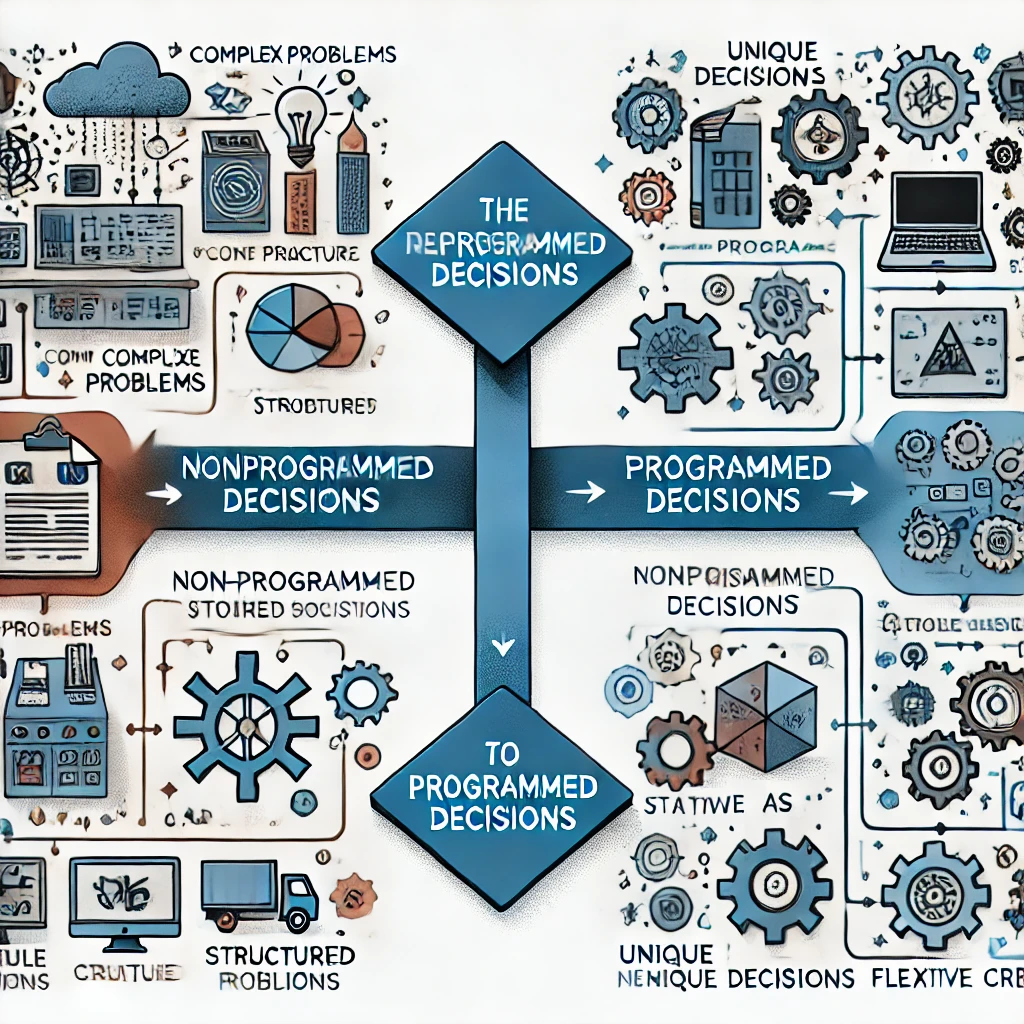
Here is the flowchart illustrating the decision-making process. It shows how some nonprogrammed decisions may evolve into programmed decisions, while others remain flexible and creative. This visual should help clarify the distinction between the two types of decisions. Let me know if you’d like further details!