Dilations Worksheet Period Graph The Image Of The Figure Using The Transformation Given. Make A Chart Of The Pre-Image Coordinates, Mapping And Compute The New Coordinate Values, And Graph The New Image. 1) Dilation Of 2) Dilation Of 2.5 3) Dilation Of 1.5 4) Dilation Of 0.5
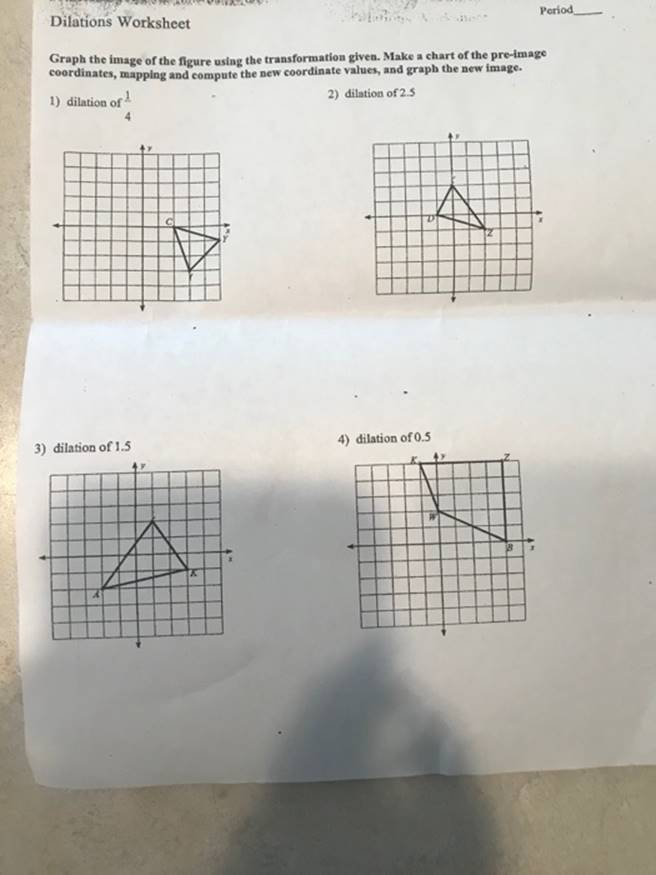
The Correct Answer and Explanation is :
Dilations are transformations that resize figures on the coordinate plane, producing similar shapes by scaling distances from a fixed center point. The scale factor determines how much the figure is enlarged or reduced:
- Scale Factor > 1: Enlargement
- Scale Factor < 1: Reduction
Applying Dilations with Different Scale Factors
Given a set of pre-image coordinates, we can calculate the new coordinates after applying various scale factors. Assuming the center of dilation is the origin (0, 0), the transformation rule for dilation is:
(x, y) → (k·x, k·y)
Where:
- (x, y) are the coordinates of a point on the pre-image.
- k is the scale factor.
Let’s apply this rule to a hypothetical set of pre-image coordinates:
Pre-Image Coordinates:
- A(1, 2)
- B(3, 4)
- C(5, 6)
1. Dilation by a Scale Factor of 2:
Applying the transformation rule:
- A'(1·2, 2·2) = A'(2, 4)
- B'(3·2, 4·2) = B'(6, 8)
- C'(5·2, 6·2) = C'(10, 12)
2. Dilation by a Scale Factor of 2.5:
Applying the transformation rule:
- A'(1·2.5, 2·2.5) = A'(2.5, 5)
- B'(3·2.5, 4·2.5) = B'(7.5, 10)
- C'(5·2.5, 6·2.5) = C'(12.5, 15)
3. Dilation by a Scale Factor of 1.5:
Applying the transformation rule:
- A'(1·1.5, 2·1.5) = A'(1.5, 3)
- B'(3·1.5, 4·1.5) = B'(4.5, 6)
- C'(5·1.5, 6·1.5) = C'(7.5, 9)
4. Dilation by a Scale Factor of 0.5:
Applying the transformation rule:
- A'(1·0.5, 2·0.5) = A'(0.5, 1)
- B'(3·0.5, 4·0.5) = B'(1.5, 2)
- C'(5·0.5, 6·0.5) = C'(2.5, 3)
Graphing the Dilated Images
To graph the dilated images:
- Plot the Pre-Image: Mark points A(1, 2), B(3, 4), and C(5, 6) on the coordinate plane.
- Apply Each Scale Factor: For each scale factor, plot the corresponding A’, B’, and C’ points.
- Connect the Points: For each set of transformed points, connect them to form the dilated figure.
Explanation of Dilations
Dilations affect the size of a figure without altering its shape. The center of dilation serves as the reference point, and all points on the figure move closer to or farther from this center based on the scale factor. This transformation maintains the proportionality of the figure, ensuring that corresponding angles remain equal, and sides are proportional. Understanding dilations is crucial in geometry, as they are foundational to concepts like similarity and scaling in real-world applications.
For additional practice and worksheets on dilations, consider exploring resources like the Dilations on the Coordinate Plane Worksheet and the Dilation with Center at Origin Worksheets.