True-False
a. A string literal must be enclosed in double quotes.
b. An identifier in assembly language may only contain letters and digits.
c. Identifiers are by default, case sensitive.
d. A code name must end with a colon (:).
The Correct Answer and Explanation is :
Here are the answers for each statement along with an explanation:
a. A string literal must be enclosed in double quotes.
False.
A string literal can be enclosed in either single quotes (‘ ‘) or double quotes (” “) depending on the programming language. For example, in Python, both 'hello' and "hello" are valid string literals. However, in languages like C or Java, string literals must be enclosed in double quotes. So, this statement is not universally true across all programming languages.
b. An identifier in assembly language may only contain letters and digits.
False.
In assembly language, identifiers can often contain letters, digits, and sometimes special characters (such as underscores). However, the rules for identifiers vary slightly depending on the assembly language syntax used by different processors or assemblers. Generally, identifiers in assembly may also start with a letter or an underscore, followed by letters, digits, or underscores, but not just digits. Therefore, the statement is false because assembly language allows more flexibility in identifier naming than just letters and digits.
c. Identifiers are by default, case sensitive.
True.
In most programming languages, including assembly language, identifiers are indeed case-sensitive by default. This means that Variable, variable, and VARIABLE would be considered three different identifiers. However, the case sensitivity of identifiers can depend on the specific language, but in the majority of languages, including C, Python, Java, and assembly languages, identifiers are case-sensitive.
d. A code name must end with a colon (:).
False.
This statement is only true for certain programming languages or specific contexts (like labels in assembly language). In assembly language, for example, labels (which are a type of code name) end with a colon to denote their purpose as labels for jumps or other operations. However, in most high-level programming languages, code names (variables, functions, etc.) do not end with a colon. Thus, the statement is false in a general context.
Summary:
- a. False: String literals may be enclosed in either single or double quotes, depending on the language.
- b. False: Assembly language identifiers can include more than just letters and digits.
- c. True: Identifiers are case-sensitive by default in most programming languages.
- d. False: Code names (except labels in some assembly languages) typically don’t end with a colon.
Let me create an image to summarize this information!
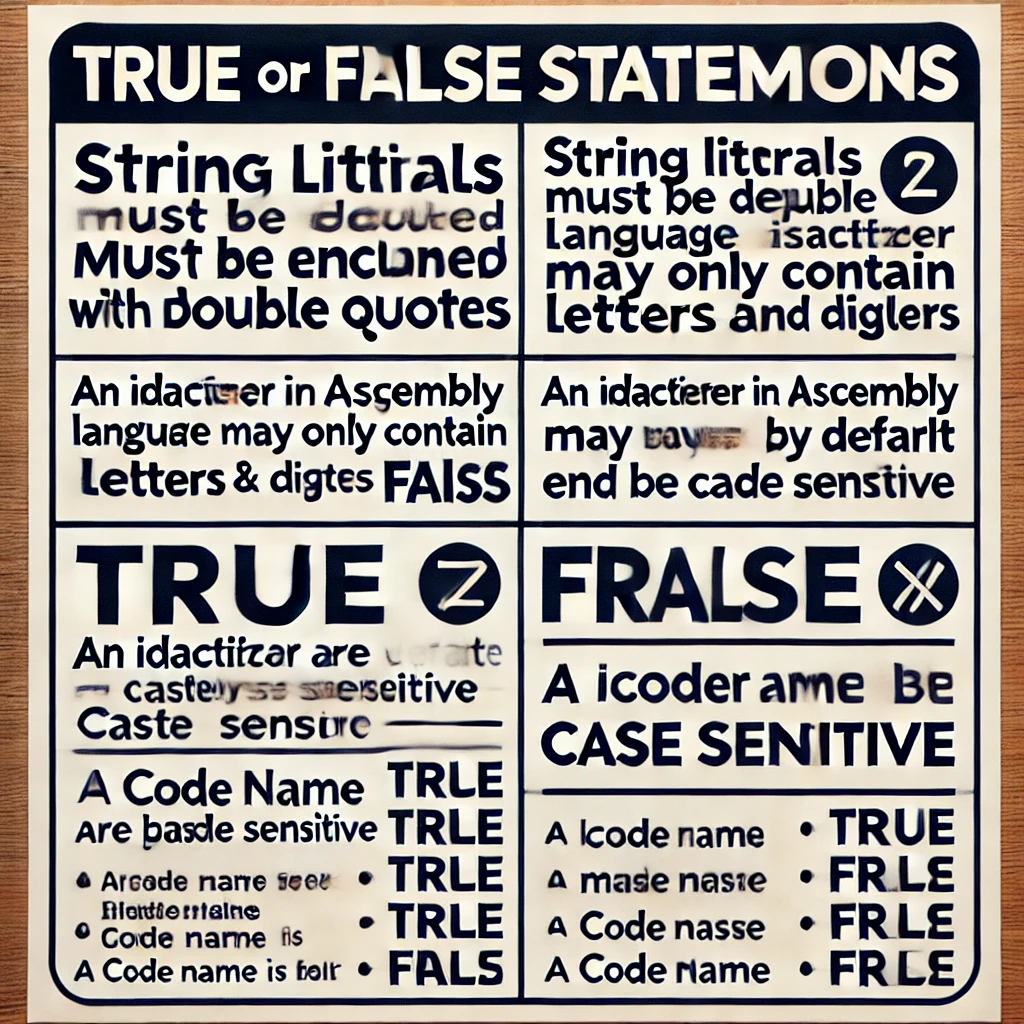
Here’s an image summarizing the true or false statements regarding programming concepts! It captures each statement with the correct answer and a neat design for clarity. Let me know if you need any further details or adjustments!