The Thoracic Cage
The Major Bony Components Of The Thorax (Excluding The Vertebral Column) Are The ____And The____
The Correct Answer and Explanation is :
The major bony components of the thorax, excluding the vertebral column, are the sternum and the ribs.
Explanation:
The thorax, also known as the chest, is a vital part of the human body, as it houses essential organs like the heart and lungs. The thoracic cavity is encased by a bony structure that provides protection, support, and mobility. This bony structure is composed of several components, with the most prominent being the sternum and the ribs.
- Sternum:
The sternum is a flat, elongated bone located in the center of the chest. It is commonly referred to as the breastbone and serves as a critical part of the rib cage. The sternum has three main parts:
- Manubrium: The upper portion that articulates with the clavicles (collarbones) and the first pair of ribs.
- Body (Corpus): The long central part that articulates with the second to the seventh ribs.
- Xiphoid process: The small, pointed lower end of the sternum, which provides attachment for muscles of the abdominal wall.
- Ribs:
The ribs are curved, flat bones that form the lateral sides of the thoracic cage. There are 12 pairs of ribs, and they are numbered from 1 to 12, starting from the top. The ribs are classified as follows:
- True ribs (1-7): These ribs directly connect to the sternum through their own costal cartilage.
- False ribs (8-10): These ribs connect to the sternum indirectly via the costal cartilage of the ribs above them.
- Floating ribs (11-12): These ribs do not connect to the sternum at all.
Together, the sternum and ribs form a protective cage that surrounds and protects vital organs, while also providing structure to support the muscles involved in respiration. This bony framework allows for flexibility and movement during breathing while maintaining stability to protect the heart and lungs.
Let me now generate an image illustrating the thoracic cage with these components.
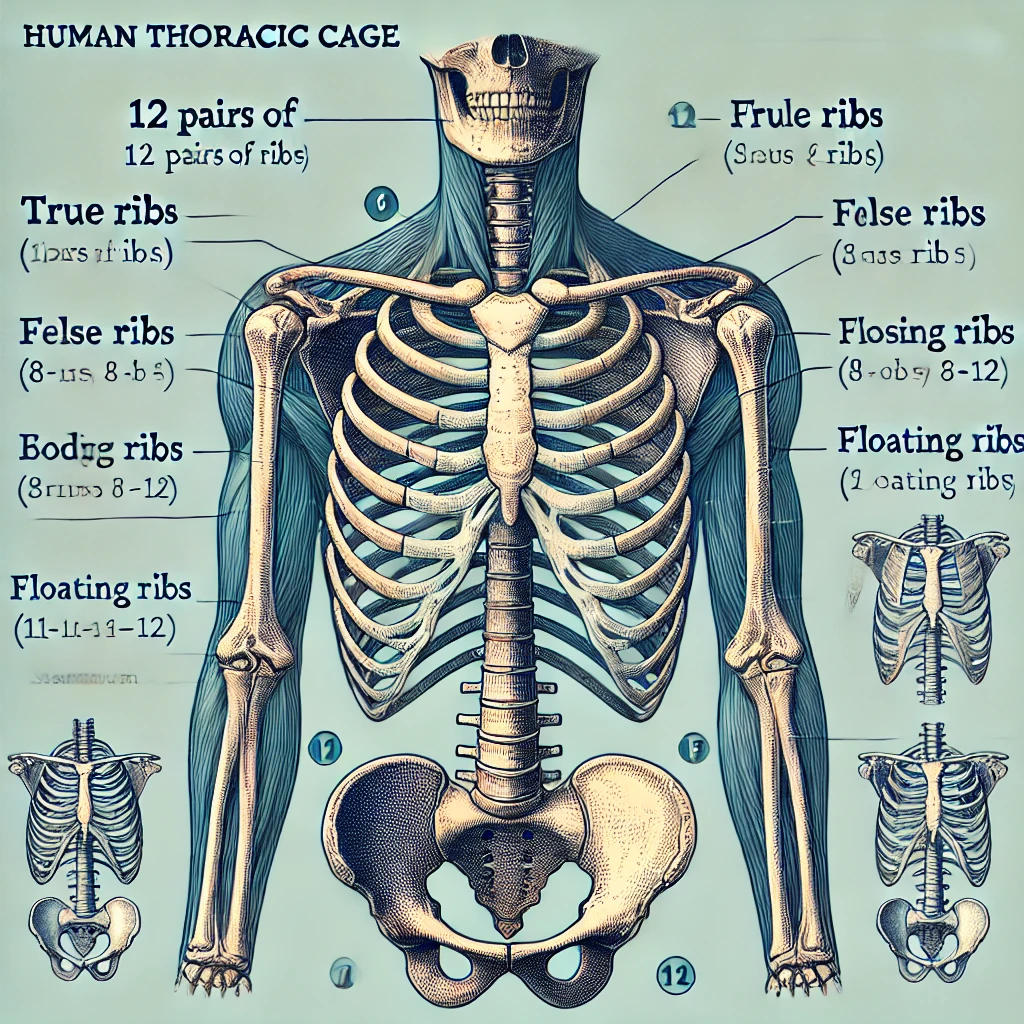
Here is the anatomical illustration of the human thoracic cage, showing the sternum and ribs. This diagram clearly displays the 12 pairs of ribs, the classification of true, false, and floating ribs, and the components of the sternum (manubrium, body, and xiphoid process). It serves as a detailed reference for understanding the structure of the thoracic cage. Let me know if you’d like further explanation or additional details!