What are the two methods commonly used to represent a timer within a PlC’s ladder logic program?
a. Explain the difference between the operation of a nonretentive timer and that of a
retentive timer.
b. Explain how the accumulated (ount of programmed retentive and nonretentive timers is
reset to zero.
The Correct Answer and Explanation is :
Two Common Methods to Represent a Timer in PLC Ladder Logic:
- TON (Timer On Delay):
- The TON timer is a nonretentive timer. When the input condition is true, the timer starts counting. If the input condition goes false before the preset time is reached, the timer resets to zero. This timer is typically used for delay purposes where an action needs to be delayed after a condition becomes true.
- TOF (Timer Off Delay):
- The TOF timer is also a nonretentive timer but works oppositely to the TON timer. When the input condition goes false, the timer starts counting. If the input condition goes true before the preset time is reached, the timer resets to zero. This is used for applications where a delay is needed when the condition turns off.
a. Difference Between Nonretentive and Retentive Timers:
- Nonretentive Timer (TON and TOF):
- A nonretentive timer does not retain its accumulated time when the input or condition changes state. For example, when the input for a TON timer goes off before the preset time is completed, the timer resets. The timer starts counting again from zero when the condition becomes true.
- This type of timer is often used where a precise time delay is required, and the timer should not be influenced by interruptions or changes in state.
- Retentive Timer (RTO):
- A retentive timer, such as the RTO (Retentive Timer On Delay), retains its accumulated time even if the input condition goes false. The timer will continue from where it left off when the input condition becomes true again. This allows the timer to “remember” its accumulated time between cycles, ensuring a complete time delay even through interruptions.
- This timer is typically used when the exact timing needs to be preserved even if the control signal fluctuates.
b. How the Accumulated Time of Retentive and Nonretentive Timers is Reset:
- Nonretentive Timers (TON, TOF):
- The accumulated time for nonretentive timers is reset automatically to zero when the input condition changes state (goes off) before the preset time is completed. Once the condition turns true again, the timer starts counting from zero.
- Retentive Timers (RTO):
- The accumulated time in retentive timers can be reset manually by programming a reset instruction within the ladder logic. This reset will bring the accumulated time back to zero, regardless of whether the input condition is true or false. This is useful when you need to explicitly clear the accumulated time before starting the timing process again.
I will now generate a diagram to visually represent these concepts.
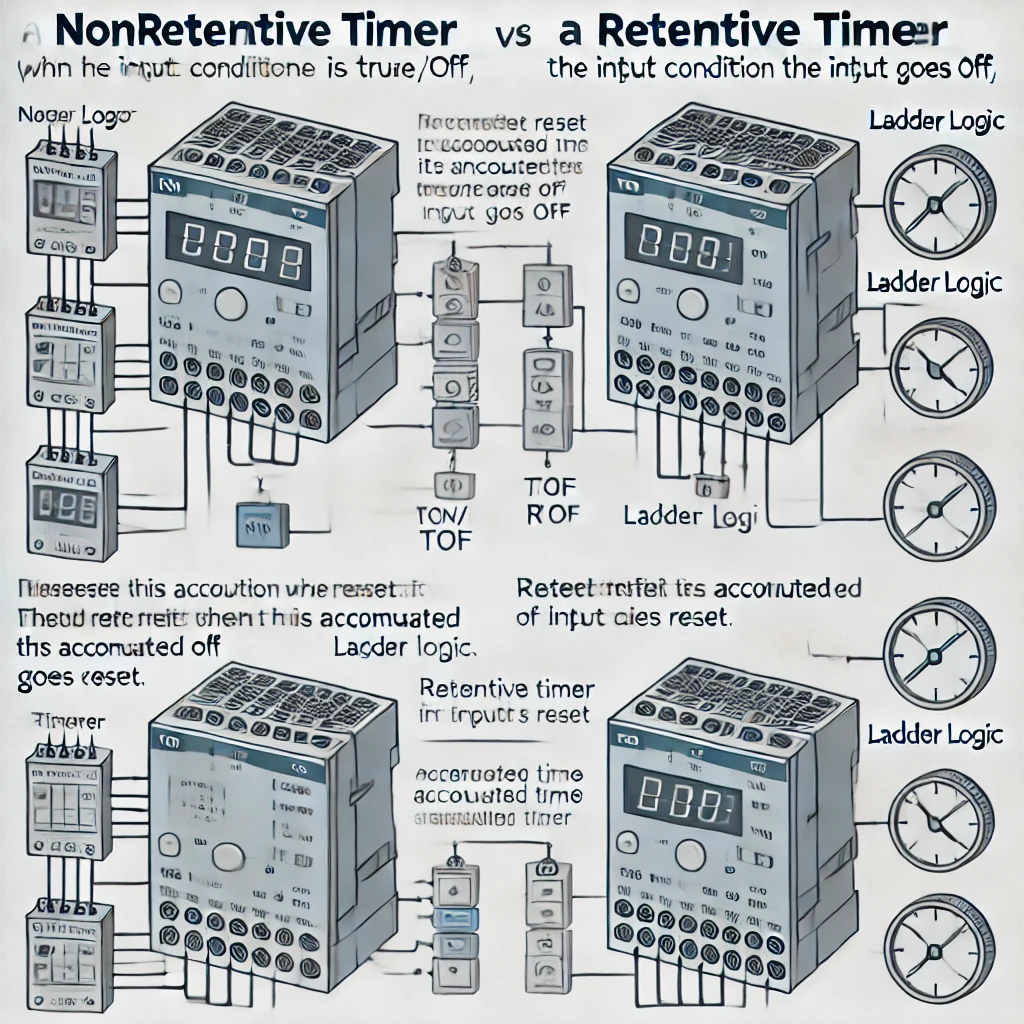
Here is the diagram illustrating the difference between a nonretentive timer (TON/TOF) and a retentive timer (RTO) in PLC ladder logic. It shows how the timers behave when the input condition is true or false, as well as how the accumulated time is handled differently in each case.