Two youngsters dive off an overhang into a lake. Diver 1 drops straight down, and diver 2 runs off the cliff with an initial horizontal speed v0.
(a) Is the splashdown speed of diver 2 greater than, less than, or equal to the splashdown speed of diver 1?
(b) Choose the best explanation from among the following:
I. Both divers are in free fall, and hence they will have the same splashdown speed.
II. The divers have the same vertical speed at splashdown, but diver 2 has the greater horizontal speed.
III. The diver who drops straight down gains more speed than the one who moves horizontally.
The Correct Answer and Explanation is :
(a) Is the splashdown speed of diver 2 greater than, less than, or equal to the splashdown speed of diver 1?
The splashdown speed of diver 2 is greater than that of diver 1.
(b) Choose the best explanation from among the following:
The correct explanation is:
II. The divers have the same vertical speed at splashdown, but diver 2 has the greater horizontal speed.
Explanation:
In this scenario, we are comparing two divers. Diver 1 drops straight down, while diver 2 runs off the cliff with an initial horizontal velocity (v_0). Let’s break down the reasoning step by step.
1. Vertical Motion:
- Both divers are in free fall, which means they are only affected by gravity in the vertical direction. The vertical motion of both divers follows the same physics, so their vertical speeds at the moment of splashdown are determined by the same acceleration due to gravity ((g)) and the height from which they fall.
- Both divers will experience the same vertical displacement and will hit the water at the same time, meaning their vertical velocities at splashdown are the same. The formula for the vertical velocity at splashdown is:
[
v_y = \sqrt{2gh}
]
where (h) is the height from which the divers fall. Since both divers start from the same height, their vertical speeds at the moment of splashdown are equal.
2. Horizontal Motion:
- Diver 1, who drops straight down, has no horizontal velocity.
- Diver 2, who runs off the cliff, has an initial horizontal velocity (v_0), which means that while diver 2 is falling, they maintain that horizontal speed throughout the fall.
- This horizontal velocity contributes to the total speed at splashdown, making diver 2’s splashdown speed greater than diver 1’s. The total splashdown speed (v_{total}) for each diver is the vector sum of their vertical and horizontal velocities:
[
v_{total} = \sqrt{v_x^2 + v_y^2}
]
where (v_x) is the horizontal velocity (which is (v_0) for diver 2 and 0 for diver 1), and (v_y) is the vertical velocity (which is the same for both divers).
Therefore, diver 2’s splashdown speed is greater because their horizontal velocity adds to the total speed.
Best Explanation:
Explanation II is the best because it correctly identifies that both divers have the same vertical speed but diver 2 has a horizontal speed as well, making their total splashdown speed greater.
Now, I’ll generate a visual representation to help illustrate the comparison between diver 1 and diver 2’s motions.
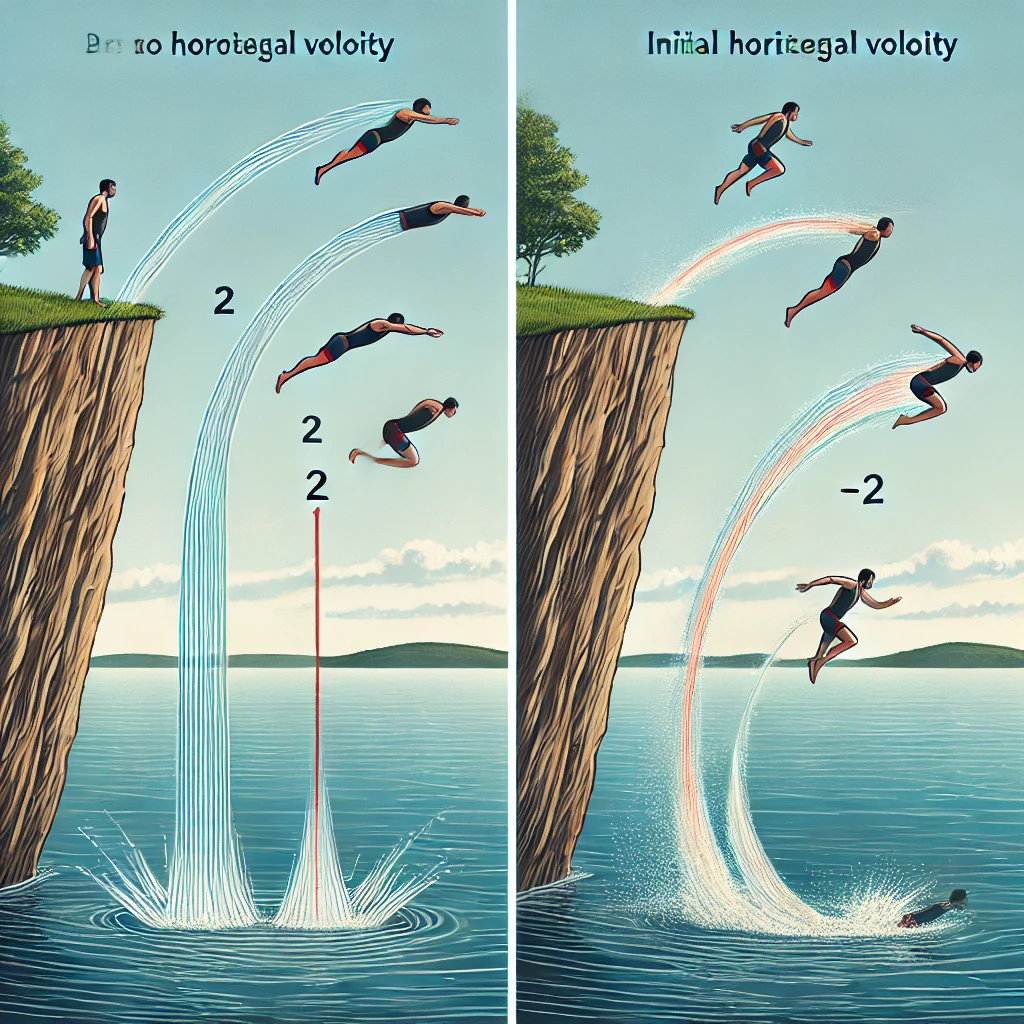
Here is the visual representation of the two divers. Diver 1 drops straight down, while Diver 2 runs off the cliff with an initial horizontal speed. This highlights the different motions and paths of each diver. As you can see, diver 2’s motion is more complex due to their horizontal velocity, while diver 1’s motion is purely vertical.