Locate the centroid y of the area.
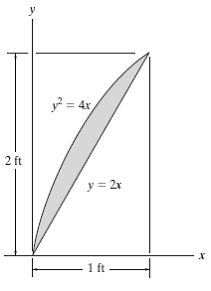
The Correct Answer and Explanation is :

To determine the centroid (ȳ) of a given area, we need to calculate the first moment of area about the x-axis (Q_x) and divide it by the total area (A). The formula is:
[ ȳ = \frac{Q_x}{A} ]
Steps to Calculate the Centroid ȳ:
- Divide the Area into Simple Shapes: Break down the complex shape into simpler, known shapes (rectangles, triangles, circles, etc.).
- Calculate the Area (A) of Each Shape: Use standard geometric formulas to find the area of each simple shape.
- Determine the Centroid of Each Shape: Find the centroid (center of gravity) of each simple shape. For standard shapes, these are located at specific points:
- Rectangle: Centroid at the intersection of the diagonals.
- Triangle: Centroid at the intersection of the medians.
- Circle: Centroid at the center.
- Calculate the First Moment of Area (Q_x): For each shape, compute Q_x using:
[ Q_x = A \times y_{\text{centroid}} ]
where ( y_{\text{centroid}} ) is the distance from the x-axis to the centroid of the shape. - Compute the Total Area (A): Sum the areas of all simple shapes.
- Calculate the Overall Centroid (ȳ): Use the formula:
[ ȳ = \frac{\sum Q_{x}}{A} ]
where the summation is over all simple shapes.
Example:
Consider an L-shaped area composed of two rectangles:
- Rectangle 1: Width = 4 units, Height = 10 units.
- Rectangle 2: Width = 6 units, Height = 4 units.
Calculations:
- Areas:
- A₁ = 4 × 10 = 40 units².
- A₂ = 6 × 4 = 24 units².
- Total Area A = A₁ + A₂ = 40 + 24 = 64 units².
- Centroids:
- For Rectangle 1: y₁ = (10/2) = 5 units.
- For Rectangle 2: y₂ = (4/2) = 2 units.
- First Moments of Area:
- Q₁ = A₁ × y₁ = 40 × 5 = 200 units³.
- Q₂ = A₂ × y₂ = 24 × 2 = 48 units³.
- Total First Moment of Area:
- ΣQ_x = Q₁ + Q₂ = 200 + 48 = 248 units³.
- Centroid ȳ:
- ȳ = ΣQ_x / A = 248 / 64 ≈ 3.875 units.
Therefore, the centroid ȳ of the L-shaped area is approximately 3.875 units from the x-axis.