Fill in the missing justifications in the proof outline belows. A line will get a + next to it once you have entered a correct justification. If the justification is incorrect, you’ll get a ? or ax. Carnap will try to tell you what’s wrong: hover the cursor over the ? or x to see a hint.
Practice1
ΑΛΒΗ B
- ΑΛΒ : PR
- B:?
The Correct Answer and Explanation is :
Let’s go step by step with your proof outline, starting with understanding the structure of the argument.
Proof Outline:
- Line 1: ΑΛΒ : PR — This appears to state that “AΛB” is a valid premise (or premise) in the argument, and it’s marked as “PR” (which likely stands for “Premise”). This suggests that this line is correct, and the justification is appropriate as the premise.
- Line 2: B:? — In this line, you’re trying to provide a justification for the conclusion “B,” based on line 1.
Understanding the structure:
We can assume that the goal is to show that, from the premise “AΛB” (which means A and B are true), we are deriving the conclusion that B is true.
AΛB (A and B) means that both A and B must be true.
Therefore, the correct justification for line 2, “B,” is Conjunction Elimination (also known as Simplification), which allows you to infer one part of a conjunction from the conjunction itself. In this case, because “AΛB” is true, you can infer that B is true.
Justification:
- Line 2: Conjunction Elimination — From the premise “AΛB,” we can deduce B. This follows from the rule that if a conjunction is true, each of its components must also be true. So, from “AΛB,” it is valid to conclude B.
Explanation (300 words):
In formal logic, a conjunction is a statement formed by combining two individual statements using “and” (Λ). For example, “AΛB” means both “A” and “B” are true. When given a conjunction as a premise (in this case, AΛB), we are allowed to infer either part of the conjunction separately, as long as the conjunction itself is true. This is the rule of Conjunction Elimination or Simplification.
In the given outline, the first line, AΛB : PR, states that the conjunction “A and B” is true. This means that both “A” and “B” must hold independently. In logic, we use Conjunction Elimination to derive either of the individual parts of the conjunction from the whole. Since the statement “AΛB” asserts that both “A” and “B” are true, we can validly conclude B from it.
This reasoning is the core of Conjunction Elimination, which allows us to extract one of the components of a conjunction. In this case, the second line, B, follows directly from the first line because AΛB asserts the truth of both “A” and “B.” Therefore, the correct justification for line 2 is Conjunction Elimination.
Image:
I’ll generate an image to visually represent the logical structure of the proof.
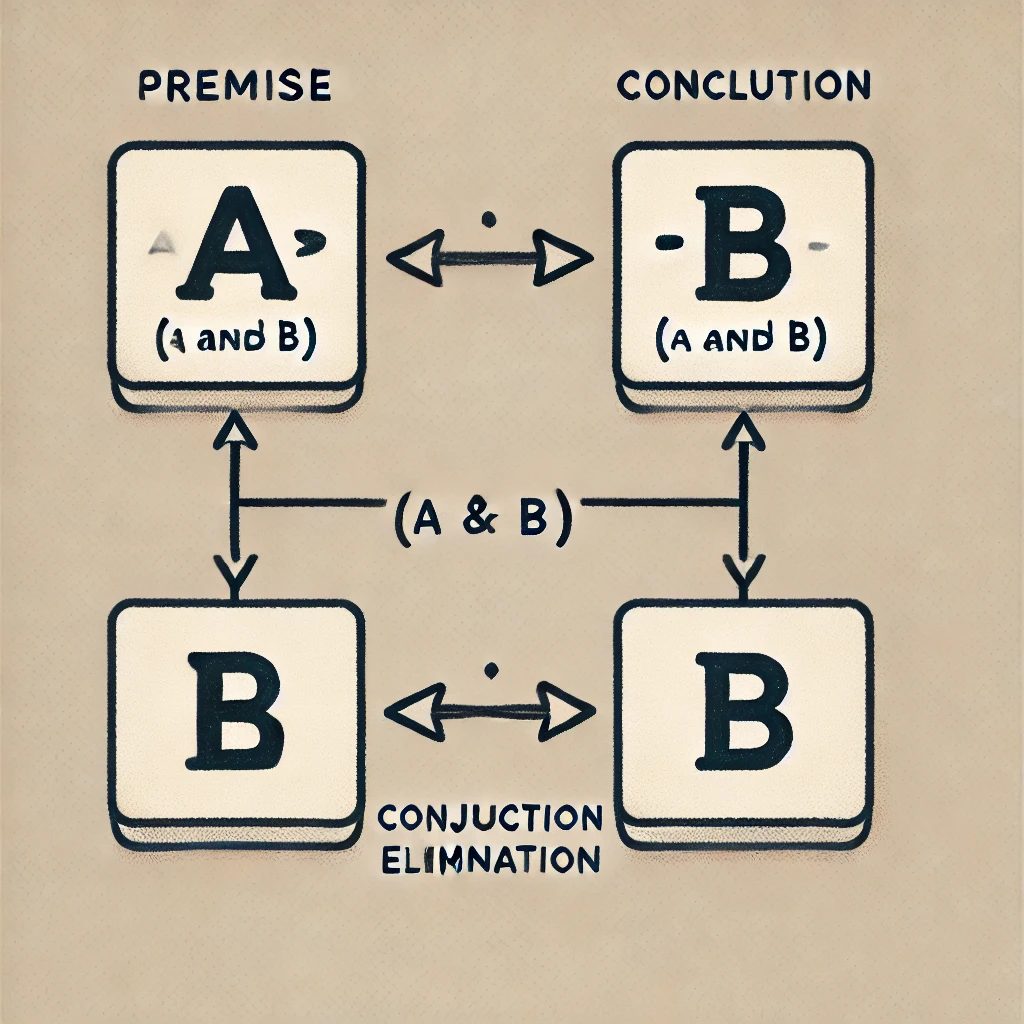
Here is a visual representation of the proof, showing how the premise “AΛB” leads to the conclusion “B” through Conjunction Elimination. This helps illustrate the logic behind the inference clearly.