What physical property is identical for the isomers of C5H12?
The correct answer and explanation is :
The physical property that is identical for the isomers of C₅H₁₂ (pentane, isopentane, and neopentane) is their molar mass (or molecular weight).
Explanation:
Isomers are compounds that have the same molecular formula but different structural arrangements. For C₅H₁₂, there are three possible structural isomers:
- n-Pentane (normal pentane) – a straight-chain alkane.
- Isopentane (methylbutane) – a branched alkane with one methyl group on the second carbon.
- Neopentane (dimethylpropane) – a highly branched alkane with two methyl groups on the central carbon.
Since all three isomers are composed of the same atoms (5 carbon atoms and 12 hydrogen atoms), their molar mass remains the same:
- Molar mass of C₅H₁₂ = (5 × 12.01 g/mol) + (12 × 1.008 g/mol)
= 72.15 g/mol
Even though their molar mass is identical, their physical and chemical properties vary due to differences in molecular structure. These differences affect boiling points, melting points, densities, and other physical properties:
- Boiling point: n-Pentane (36.1°C) > Isopentane (27.8°C) > Neopentane (9.5°C)
- Melting point: n-Pentane (-129.7°C) < Isopentane (-160°C) < Neopentane (-16.4°C)
The molar mass remains the same because it depends solely on the number and type of atoms present in the molecule, not their arrangement.
Now, I will generate an image illustrating the three isomers of C₅H₁₂ for better visualization.
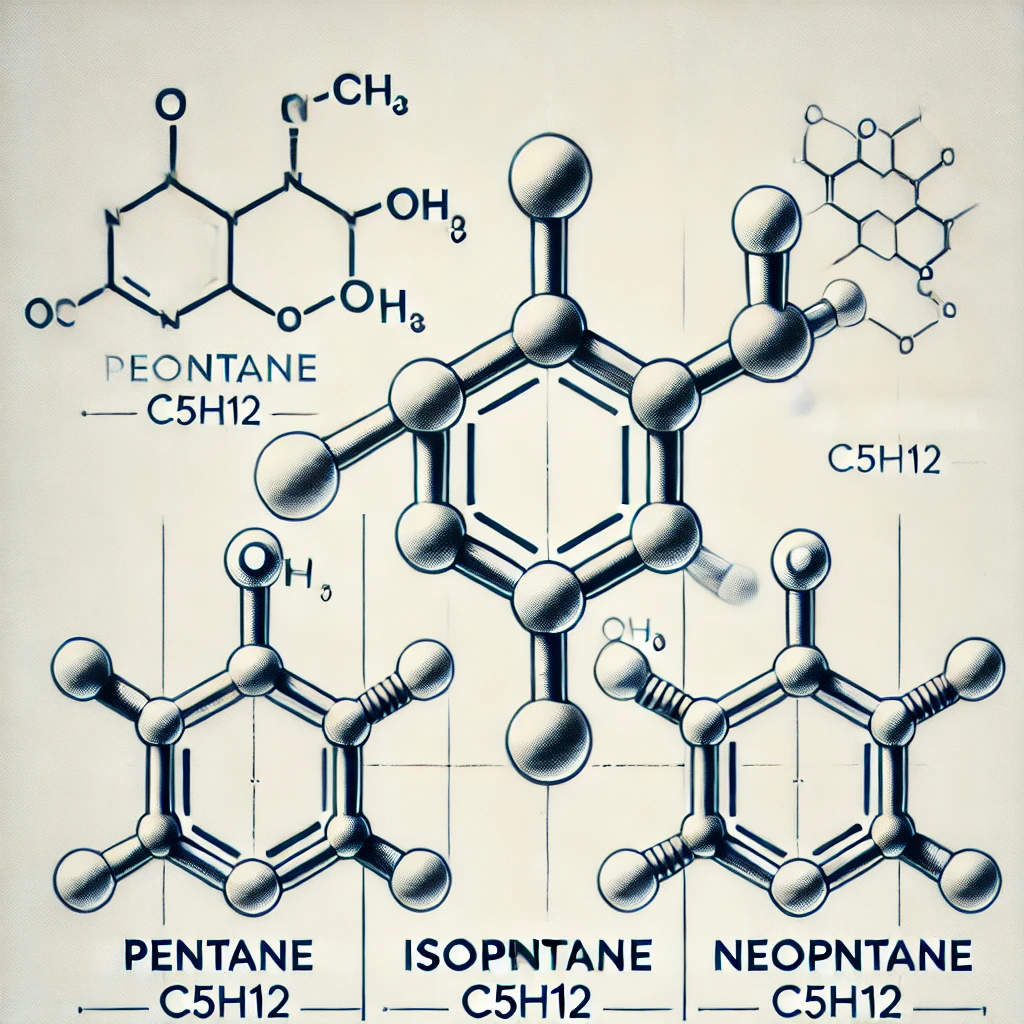
Here is an image illustrating the three isomers of C₅H₁₂ (pentane, isopentane, and neopentane). It clearly shows their molecular structures and highlights their differences while maintaining the same molar mass.