Match the definition with the correct term.
Group of answer choices
Cup-like collecting region of the renal pelvis
[ ?Choose ]
Nitrogenous waste excreted in urine
[ ?Choose ]
Process whereby some substances, but not all, pass through a filter
[ ?Choose ]
Tiny ball of capillaries in the kidney
[ ?Choose ]
Hormone secreted by the kidney to stimulate the production of red blood cells by bone marrow
[ ?Choose ]
Enclosing structure surrounding each glomerulus
[ ?Choose ]
An electrolyte regulated by the kidney; essential for muscle and nerve function
[ ?Choose ]
Combination of glomerulus and renal tubule where urine is formed
[ ?Choose ]
Process whereby renal tubules return materials necessary to the body back into the blood vessel
[ ?Choose ]
Central collecting region in the kidney
[ ?Choose ]
Final process in the formation of urine; some substances leave the blood stream and pass to the renal tubules
[ ?Choose ]
Active form of vitamin D, ?secreted by the kidney
[ ?Choose ]
Hormone secreted by the kidney; it raises blood pressure by influencing vasoconstriction
[ ?Choose ]
Process of expelling urine
[ ?Choose ]
The correct answer and explanation is :
Here are the correct terms matched with their definitions:
- Cup-like collecting region of the renal pelvis → Calyx (calyces)
- Nitrogenous waste excreted in urine → Urea
- Process whereby some substances, but not all, pass through a filter → Filtration
- Tiny ball of capillaries in the kidney → Glomerulus
- Hormone secreted by the kidney to stimulate the production of red blood cells by bone marrow → Erythropoietin (EPO)
- Enclosing structure surrounding each glomerulus → Bowman’s capsule
- An electrolyte regulated by the kidney; essential for muscle and nerve function → Potassium (K⁺)
- Combination of glomerulus and renal tubule where urine is formed → Nephron
- Process whereby renal tubules return materials necessary to the body back into the blood vessel → Reabsorption
- Central collecting region in the kidney → Renal pelvis
- Final process in the formation of urine; some substances leave the bloodstream and pass to the renal tubules → Secretion
- Active form of vitamin D, secreted by the kidney → Calcitriol
- Hormone secreted by the kidney; it raises blood pressure by influencing vasoconstriction → Renin
- Process of expelling urine → Urination (Micturition)
Explanation:
The kidney is an essential organ responsible for filtering waste from the blood and maintaining fluid and electrolyte balance. The nephron, the functional unit of the kidney, consists of the glomerulus (a network of capillaries) and renal tubules, where filtration, reabsorption, and secretion occur.
Filtration occurs in the glomerulus, allowing water and small molecules to pass through while retaining large proteins and blood cells. Reabsorption follows, as vital substances like glucose, sodium, and water are returned to the blood. Secretion ensures that excess ions and waste products like urea are excreted into urine.
The renal pelvis collects urine before it moves to the bladder. Hormones like erythropoietin and renin regulate red blood cell production and blood pressure, respectively. Calcitriol helps with calcium absorption. Electrolytes such as potassium are crucial for nerve and muscle function.
Together, these processes ensure homeostasis and efficient waste removal, making the kidneys vital to overall health.
Image Representation:
I will now generate an image illustrating the kidney’s anatomy, including structures like the nephron, glomerulus, renal pelvis, and related processes.
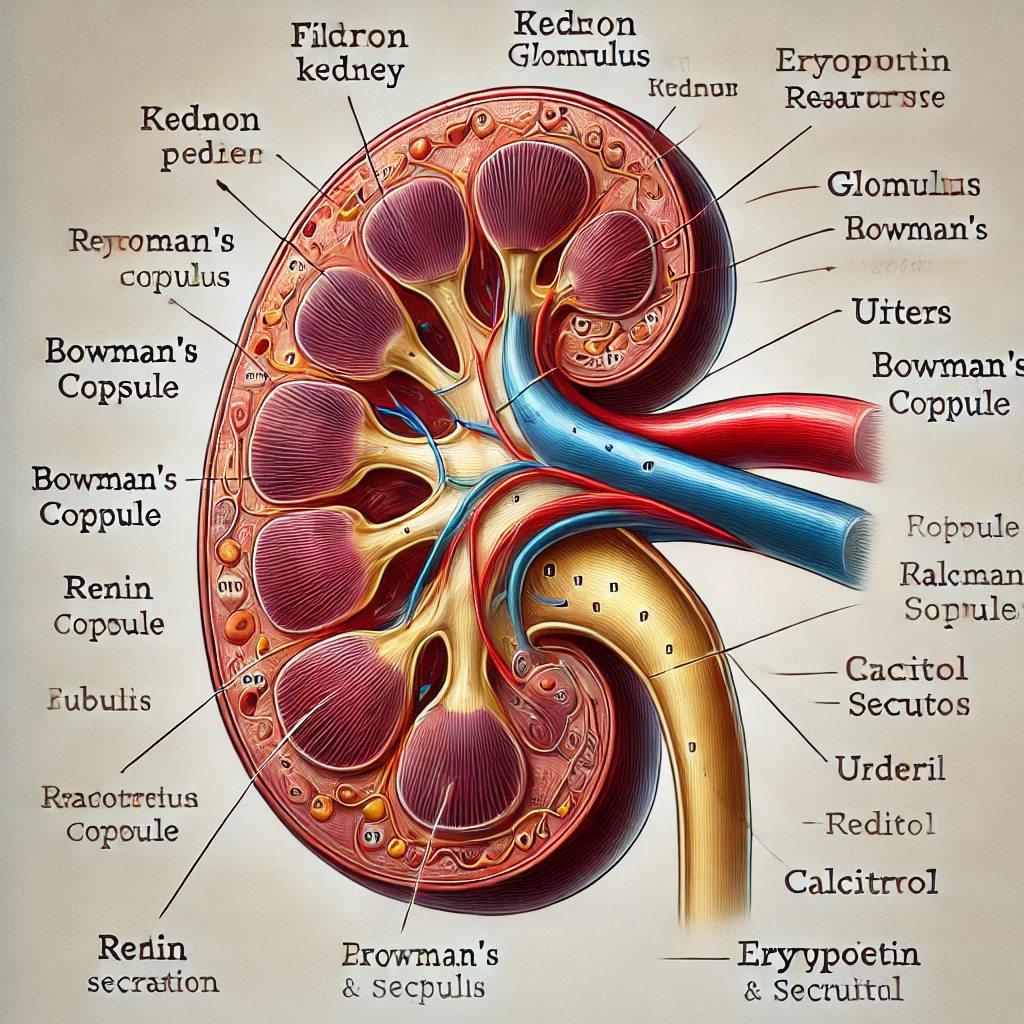
Here is an anatomical illustration of the human kidney, highlighting key structures such as the renal pelvis, nephron, glomerulus, Bowman’s capsule, renal tubules, and ureters. It also depicts the processes of filtration, reabsorption, and secretion, along with the roles of erythropoietin, renin, and calcitriol. This should serve as a helpful reference for understanding kidney function.