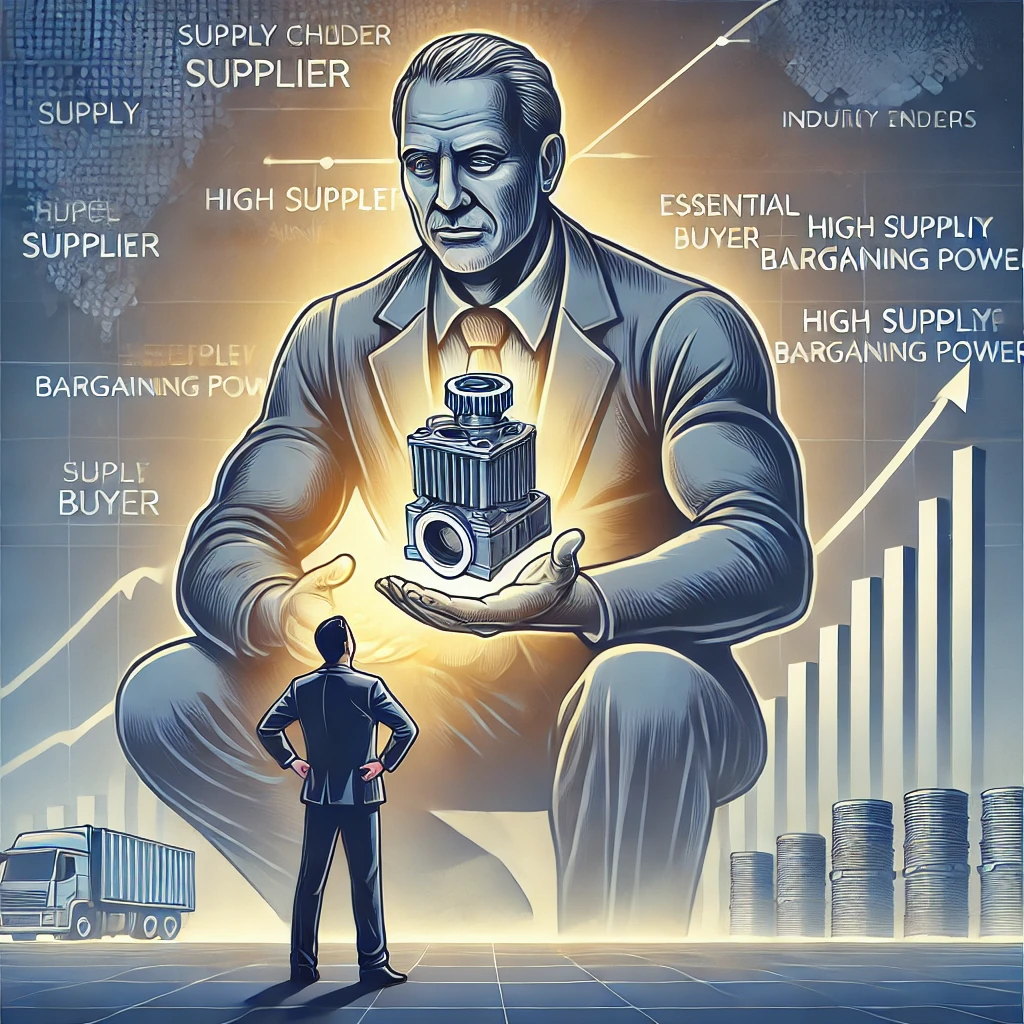
The bargaining leverage of suppliers is stronger when
- industry members are a threat to integrate backward into the business of suppliers and to self-manufacture their own requirements.
- industry members make frequent purchases in small quantities.
- suppliers provide an item that accounts for a small fraction of the costs of the industry’s product and when a needed input is in short supply.
- good substitutes exist for the items being furnished by the suppliers.
- the products of suppliers are strongly differentiated, which reduces the costs industry members incur in switching to alternative suppliers.
The correct answer and explanation is:
Correct Answer:
Suppliers provide an item that accounts for a small fraction of the costs of the industry’s product and when a needed input is in short supply.
Explanation:
The bargaining power of suppliers is an essential component of Porter’s Five Forces framework, which helps assess the competitive dynamics within an industry. The strength of supplier power depends on several factors, including the availability of substitutes, the importance of the supplier’s product to the industry, and the level of differentiation in supplier offerings.
One of the most crucial factors that strengthen supplier power is when suppliers provide a product that constitutes only a small fraction of the total cost of the industry’s product, while simultaneously being essential to production. This dynamic is significant because:
- Limited Cost Concern for Buyers: When an input is a minor cost component of the final product, industry players may not have strong incentives to negotiate aggressively for lower prices, allowing suppliers to exert greater pricing power.
- Essential and Irreplaceable Inputs: If the supplied product is critical to production and is in short supply, industry members have fewer options for sourcing the material, forcing them to accept the supplier’s terms. A shortage of key inputs makes businesses highly dependent on suppliers.
- Few Alternative Suppliers: If suppliers dominate the market for a particular input with little competition, they can dictate prices and terms, further strengthening their leverage.
- Switching Costs: When an industry depends on a specific supplier for unique or specialized materials, switching to an alternative supplier may be expensive or difficult, reinforcing the supplier’s bargaining power.
In such scenarios, suppliers can charge higher prices, impose strict contract terms, and exert significant influence over their buyers, creating a power imbalance in favor of the suppliers.
Here is the conceptual illustration depicting a powerful supplier negotiating with a weaker industry buyer. Let me know if you need any modifications or further explanations!