A gas mixture contains 6 moles of H2 and 2 moles of N2. If the total pressure of the gaseous mixture is 4 kgf/cm2; then the partial pressure of N2 in the mixture will be _ kgf/cm2.
The correct answer and explanation is :
To find the partial pressure of nitrogen ((\text{N}_2)) in the gas mixture, we use Dalton’s Law of Partial Pressures, which states:
[
P_{\text{partial}} = \left( \frac{\text{moles of gas}}{\text{total moles of gas}} \right) \times P_{\text{total}}
]
Given Data:
- Moles of Hydrogen (H₂) = 6
- Moles of Nitrogen (N₂) = 2
- Total pressure ((P_{\text{total}})) = 4 kgf/cm²
Step 1: Calculate Total Moles of Gas
[
\text{Total moles} = 6 + 2 = 8
]
Step 2: Mole Fraction of N₂
[
\text{Mole fraction of N}_2 = \frac{\text{moles of N}_2}{\text{total moles}}
]
[
= \frac{2}{8} = 0.25
]
Step 3: Calculate Partial Pressure of N₂
[
P_{\text{N}2} = (\text{Mole fraction of N}_2) \times P{\text{total}}
]
[
= 0.25 \times 4
]
[
= 1 \text{ kgf/cm}^2
]
Final Answer:
The partial pressure of nitrogen ((N_2)) in the mixture is 1 kgf/cm².
Explanation:
Dalton’s Law states that each gas in a mixture exerts pressure independently, proportional to its mole fraction. Since the total pressure is 4 kgf/cm², and nitrogen contributes 25% (from its mole fraction), its partial pressure is 1 kgf/cm². This principle applies universally to ideal gas mixtures.
Now, I’ll generate an image to illustrate this concept.
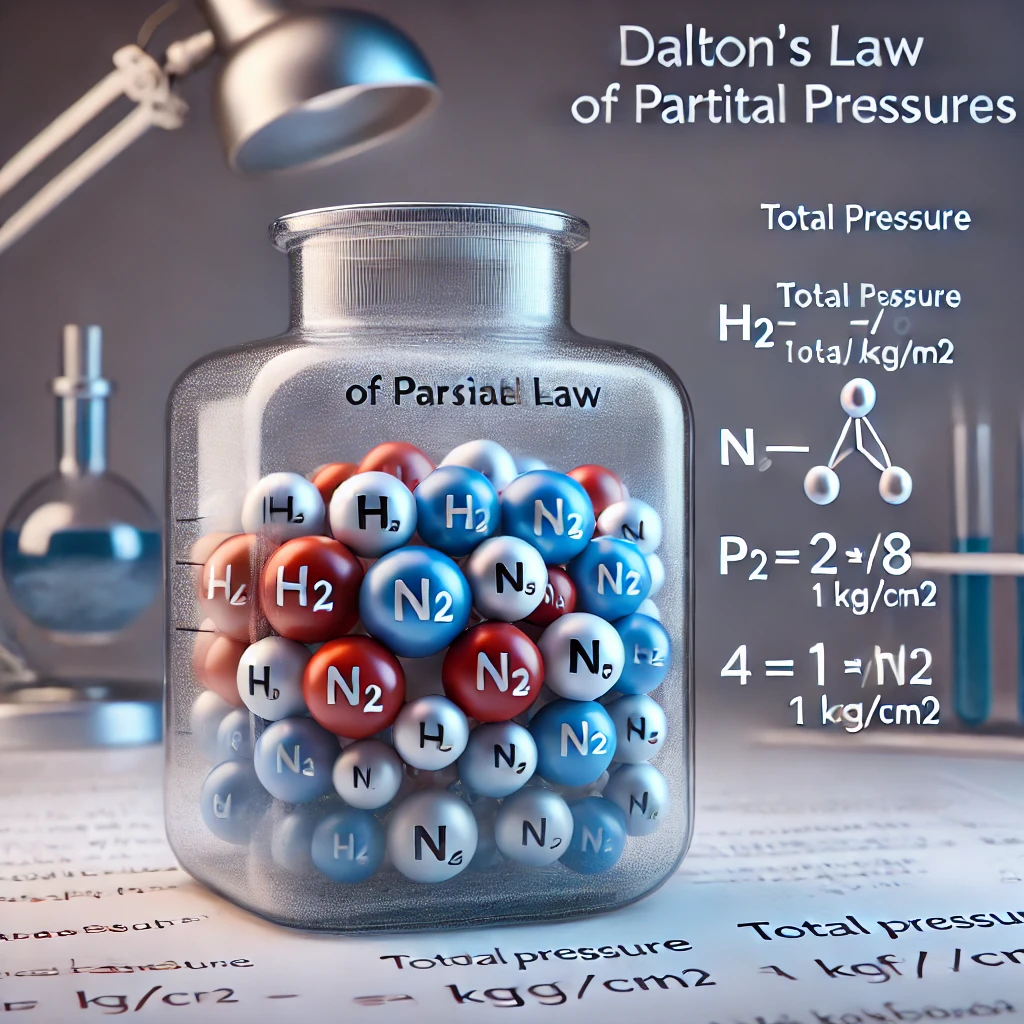
Here is the scientific diagram illustrating Dalton’s Law of Partial Pressures. It visually represents how nitrogen and hydrogen contribute to the total pressure of the gas mixture.