Satum’s moon Enceladus has a mass of 1.08 x 10²⁰ kg and a radius of 2.52 x 10⁶ m. What speed would be required for a 75.0 kg satellite to be in a stable orbit 165 km above the surface of this moon?
The correct answer and explanation is :
To determine the orbital speed required for a 75.0 kg satellite to maintain a stable orbit 165 km above the surface of Saturn’s moon Enceladus, we can use the formula for orbital velocity:
[ v = \sqrt{\frac{G \cdot M}{r}} ]
Where:
- ( v ) is the orbital velocity,
- ( G ) is the gravitational constant ((6.67430 \times 10^{-11} \, \text{m}^3\, \text{kg}^{-1}\, \text{s}^{-2})),
- ( M ) is the mass of Enceladus ((1.08 \times 10^{20} \, \text{kg})),
- ( r ) is the distance from the center of Enceladus to the satellite.
Given that Enceladus has a radius (( R )) of (2.52 \times 10^5 \, \text{m}), and the satellite orbits 165 km ((165 \times 10^3 \, \text{m})) above its surface, the orbital radius (( r )) is:
[ r = R + 165 \times 10^3 \, \text{m} = 2.52 \times 10^5 \, \text{m} + 1.65 \times 10^5 \, \text{m} = 4.17 \times 10^5 \, \text{m} ]
Substituting the values into the orbital velocity formula:
[ v = \sqrt{\frac{6.67430 \times 10^{-11} \, \text{m}^3\, \text{kg}^{-1}\, \text{s}^{-2} \times 1.08 \times 10^{20} \, \text{kg}}{4.17 \times 10^5 \, \text{m}}} ]
Calculating the above expression:
[ v = \sqrt{\frac{7.207044 \times 10^{9} \, \text{m}^3\, \text{s}^{-2}}{4.17 \times 10^5 \, \text{m}}} \approx \sqrt{1.728 \times 10^4 \, \text{m}^2\, \text{s}^{-2}} \approx 131.5 \, \text{m/s} ]
Therefore, the satellite would need to travel at approximately 131.5 meters per second to maintain a stable orbit 165 km above Enceladus’s surface.
Explanation:
Orbital velocity is the speed at which an object must travel to maintain a stable orbit around a celestial body without propulsion. This velocity results from the balance between the gravitational pull of the celestial body and the inertia of the orbiting object. The formula ( v = \sqrt{\frac{G \cdot M}{r}} ) derives from equating the gravitational force to the required centripetal force for circular motion.
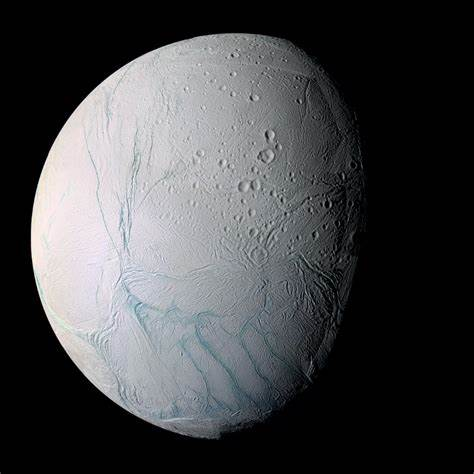
In this scenario, we calculated the necessary orbital speed for a satellite orbiting Enceladus, Saturn’s sixth-largest moon. Enceladus is notable for its high reflectivity and geologically active surface, which includes geysers ejecting water-ice particles. These characteristics make it a subject of interest in planetary science.
The orbital velocity depends on the mass of the central body (Enceladus) and the distance from its center to the satellite. Notably, the mass of the satellite does not influence the required orbital speed; both heavy and light satellites at the same altitude will orbit at the same velocity.
Understanding orbital mechanics is crucial for mission planning and satellite deployment. Accurate calculations ensure that satellites maintain their intended orbits, which is essential for data collection, communication, and exploration objectives.