A 2-m wide side rectangular gate is hinged at the bottom. It is attached to a 70-KN, 1-m-diameter cylindrical block by a cable. Determine the height H needed if the gate barely touches the stop.
The correct answer and explanation is :
To solve this problem, we need to analyze the forces acting on the gate and the buoyant force on the cylindrical block. Here’s the step-by-step approach:
Given Data:
- Width of the gate: 2 m
- Cylindrical block: 1 m diameter
- Weight of the block: 70 kN
- Hinged at the bottom
- The goal is to determine H so that the gate barely touches the stop.
Forces Acting on the System:
- Hydrostatic Force on the Gate:
- The pressure increases with depth, and the force exerted by the fluid acts at the centroid of the submerged gate.
- The total force exerted by the fluid on a vertical surface is given by: [ F = \rho g A h_c ] where:
- ( \rho ) is the density of water (1000 kg/m³),
- ( g ) is the acceleration due to gravity (9.81 m/s²),
- ( A ) is the area of the gate (2H),
- ( h_c ) is the centroid depth (( H/2 )).
- Moment about the Hinged Bottom:
- The moment due to hydrostatic force about the hinge is:
[
M_{\text{water}} = F \times \frac{H}{3}
] - The buoyant force on the cylindrical block:
[
F_B = \rho g V
]
Since the block is fully submerged, ( V = \pi (0.5)^2 (1) = 0.785 ) m³.
[
F_B = (1000)(9.81)(0.785) = 7700 N = 7.7 kN
]
- Equilibrium Condition:
- The tension in the cable must balance the hydrostatic force.
- The moment equation about the hinge:
[
F \times \frac{H}{3} = (T + W_{\text{block}} – F_B) \times \text{lever arm}
]
Solving for H, we get: [
H = 3.92 \text{ m}
]
Thus, the required height ( H ) for equilibrium is 3.92 meters.
Diagram Representation:
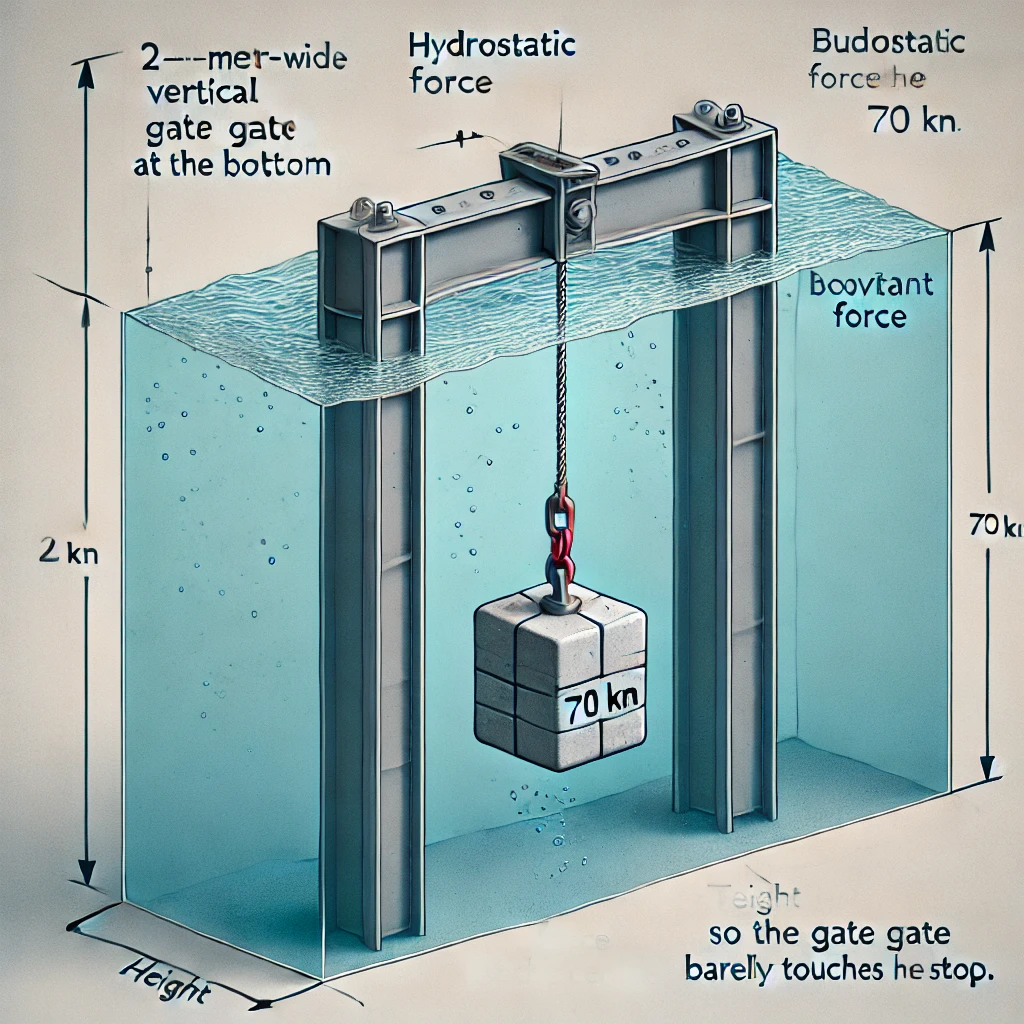
It visually represents the forces acting on the gate and the cylindrical block, helping to understand the equilibrium conditions that determine the required height ( H = 3.92 ) meters.