Which of the following statements best describes inertia?
- Inertia depends on the size of an object.
- Inertia is proportional to speed.
- Inertia is a vector quantity.
- Inertia is a resistance to change in motion.
The correct answer and explanation is:
The correct answer is:
“Inertia is a resistance to change in motion.”
Explanation:
Inertia is a fundamental concept in physics, first described by Sir Isaac Newton in his First Law of Motion, often called the Law of Inertia. This law states that an object at rest will remain at rest, and an object in motion will continue moving at the same velocity unless acted upon by an external force.
Understanding Inertia:
- Inertia is the tendency of an object to resist changes in its motion. If an object is at rest, it wants to stay at rest. If it is moving, it wants to keep moving in the same direction and speed unless something (a force) causes it to change.
- The amount of inertia an object has depends on its mass. Heavier objects have more inertia and require more force to change their motion compared to lighter objects.
Why the Other Statements Are Incorrect:
- “Inertia depends on the size of an object.” → Incorrect. Inertia is dependent on mass, not size. A large but hollow object may have less inertia than a small, dense one.
- “Inertia is proportional to speed.” → Incorrect. Inertia is related to mass, not speed. An object moving fast does not necessarily have more inertia than a slow-moving object; its mass determines inertia.
- “Inertia is a vector quantity.” → Incorrect. Inertia is a scalar quantity because it does not have direction, only magnitude (which depends on mass).
Real-Life Examples of Inertia:
- When a car suddenly stops, passengers lurch forward because their bodies resist the change in motion.
- A heavy truck is harder to start moving and harder to stop due to its large inertia.
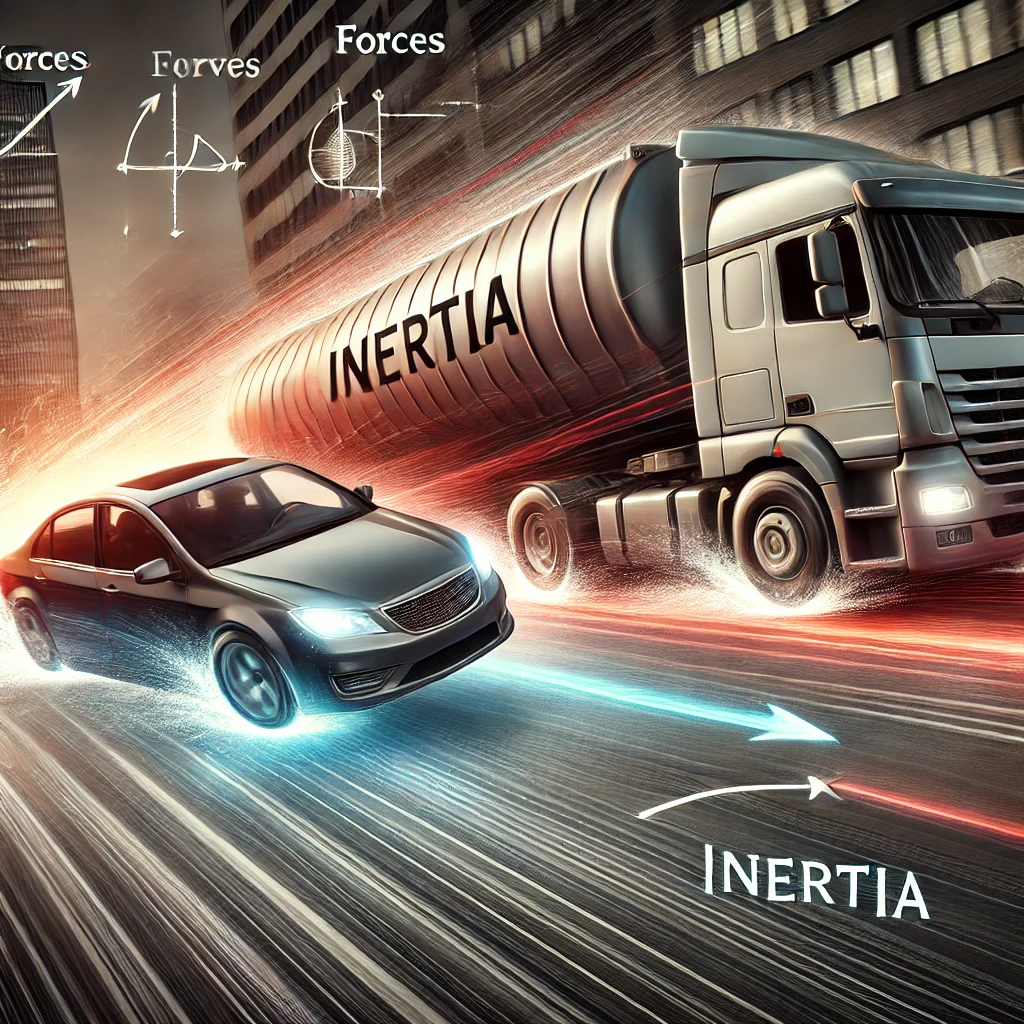
Now, I’ll generate an image illustrating the concept of inertia.
Here is the generated image illustrating the concept of inertia. It shows a car suddenly stopping with passengers leaning forward due to inertia, along with a heavy truck requiring more force to move compared to a small car. The scene includes motion blur effects and physics diagrams with arrows indicating forces and inertia. Let me know if you need any modifications!