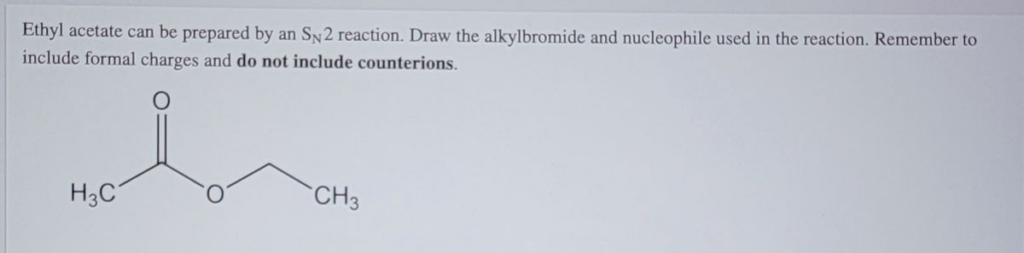
Ethyl acetate can be prepared by an SN2 reaction. Draw the alkylbromide and nucleophile used in the reaction. Remember to include formal charges and do not include counterions. H3C CH3
Draw the alkyl bromide and the nucleophile
The correct answer and explanation is:
iturn0image0turn0image1turn0image3turn0image4Ethyl acetate (CH₃COOCH₂CH₃) can be synthesized via an S_N2 (bimolecular nucleophilic substitution) reaction involving an alkyl bromide and a nucleophile. In this context, the appropriate reactants are ethyl bromide (CH₃CH₂Br) as the alkyl bromide and the acetate ion (CH₃COO⁻) as the nucleophile.
Structures of the Reactants:
- Ethyl Bromide (CH₃CH₂Br):
- This molecule consists of an ethyl group (CH₃CH₂–) bonded to a bromine atom. The bromine atom is more electronegative than carbon, creating a partial positive charge (δ⁺) on the carbon atom bonded to bromine, making it susceptible to nucleophilic attack.
- Acetate Ion (CH₃COO⁻):
- The acetate ion is the conjugate base of acetic acid and carries a negative formal charge on one of the oxygen atoms. This negative charge indicates a high electron density, enabling the acetate ion to act as a nucleophile in substitution reactions.
Mechanism of the S_N2 Reaction:
In the S_N2 mechanism, the nucleophile attacks the electrophilic carbon atom from the side opposite to the leaving group, leading to a backside attack. This simultaneous bond-forming and bond-breaking process results in the inversion of the configuration at the carbon center (if it is chiral).
For the synthesis of ethyl acetate:
- The acetate ion (CH₃COO⁻) approaches the electrophilic carbon in ethyl bromide (CH₃CH₂Br) from the side opposite to the bromine atom.
- As the acetate ion forms a new bond with the carbon atom, the carbon-bromine bond breaks, and the bromide ion (Br⁻) departs as the leaving group.
- The product of this substitution is ethyl acetate (CH₃COOCH₂CH₃).
Importance of the Leaving Group:
The efficiency of an S_N2 reaction heavily depends on the quality of the leaving group. Bromide (Br⁻) is considered a good leaving group due to its ability to stabilize the negative charge after dissociation, thereby facilitating the reaction.
Solvent Considerations:
S_N2 reactions are typically favored in polar aprotic solvents, such as acetone or dimethyl sulfoxide (DMSO). These solvents do not solvate anions strongly, allowing the nucleophile to remain reactive and effectively attack the electrophilic carbon.
Steric Factors:
The rate of S_N2 reactions is significantly influenced by steric hindrance around the electrophilic carbon. Primary alkyl halides, like ethyl bromide, are more reactive in S_N2 reactions because there is less steric hindrance, allowing the nucleophile to access the electrophilic carbon more easily. In contrast, secondary and tertiary alkyl halides are less reactive due to increased steric bulk, which impedes the nucleophile’s approach.
Conclusion:
The synthesis of ethyl acetate via an S_N2 reaction involves the nucleophilic attack of the acetate ion on ethyl bromide, resulting in the substitution of the bromide ion with the acetate group. Understanding the structures of the reactants, the mechanism of the S_N2 reaction, and factors such as the nature of the leaving group, solvent effects, and steric hindrance is crucial for effectively carrying out this transformation.